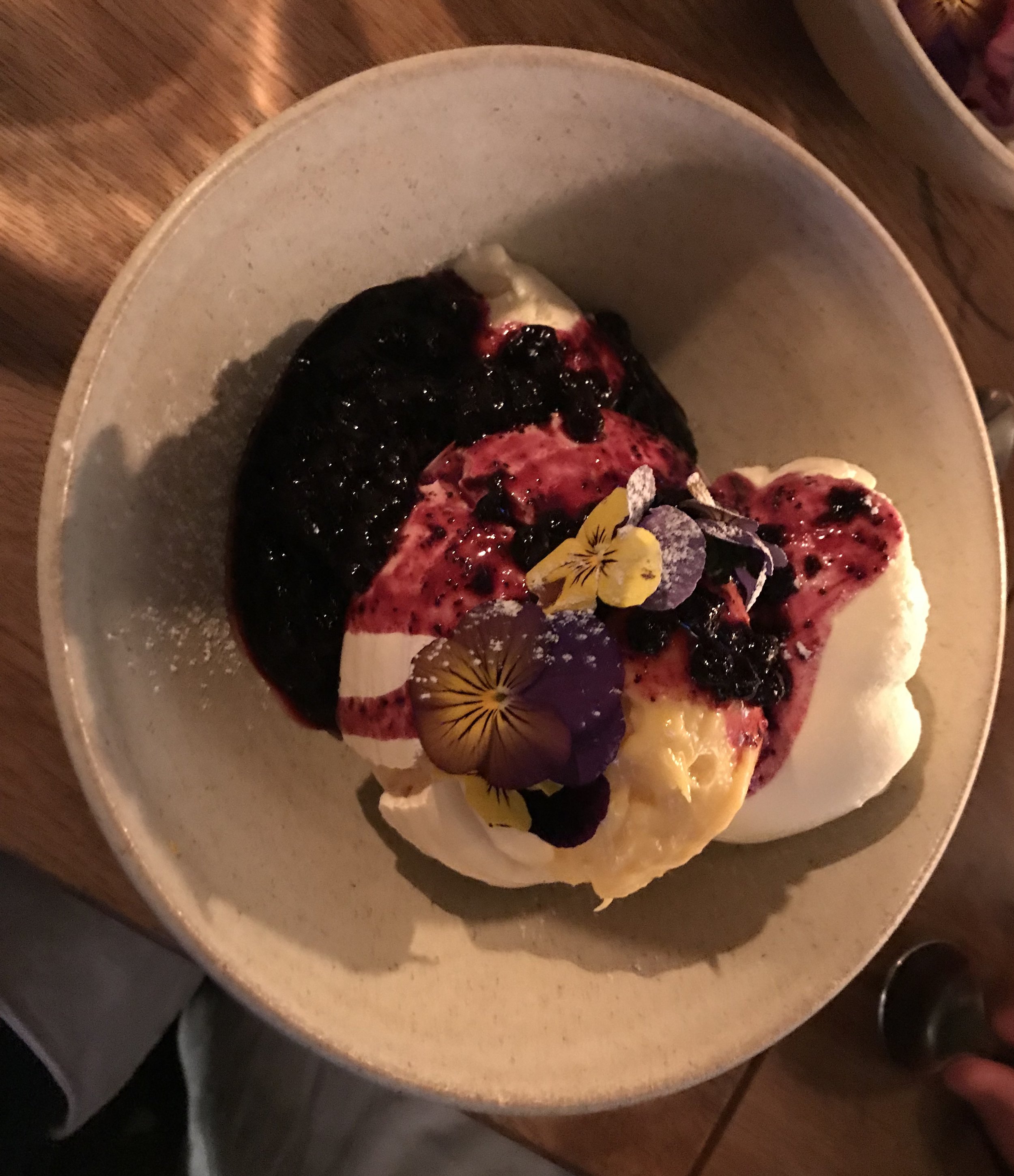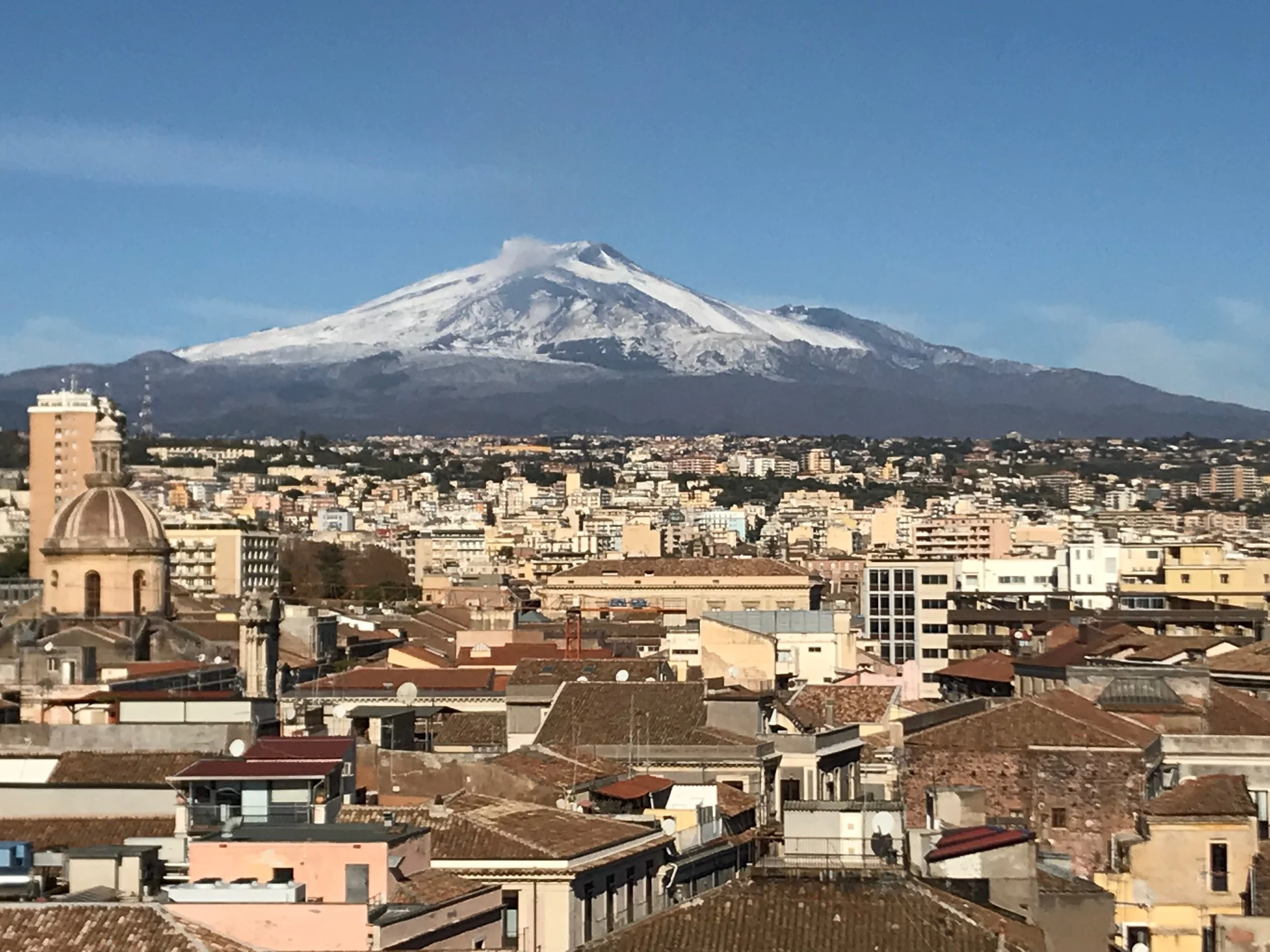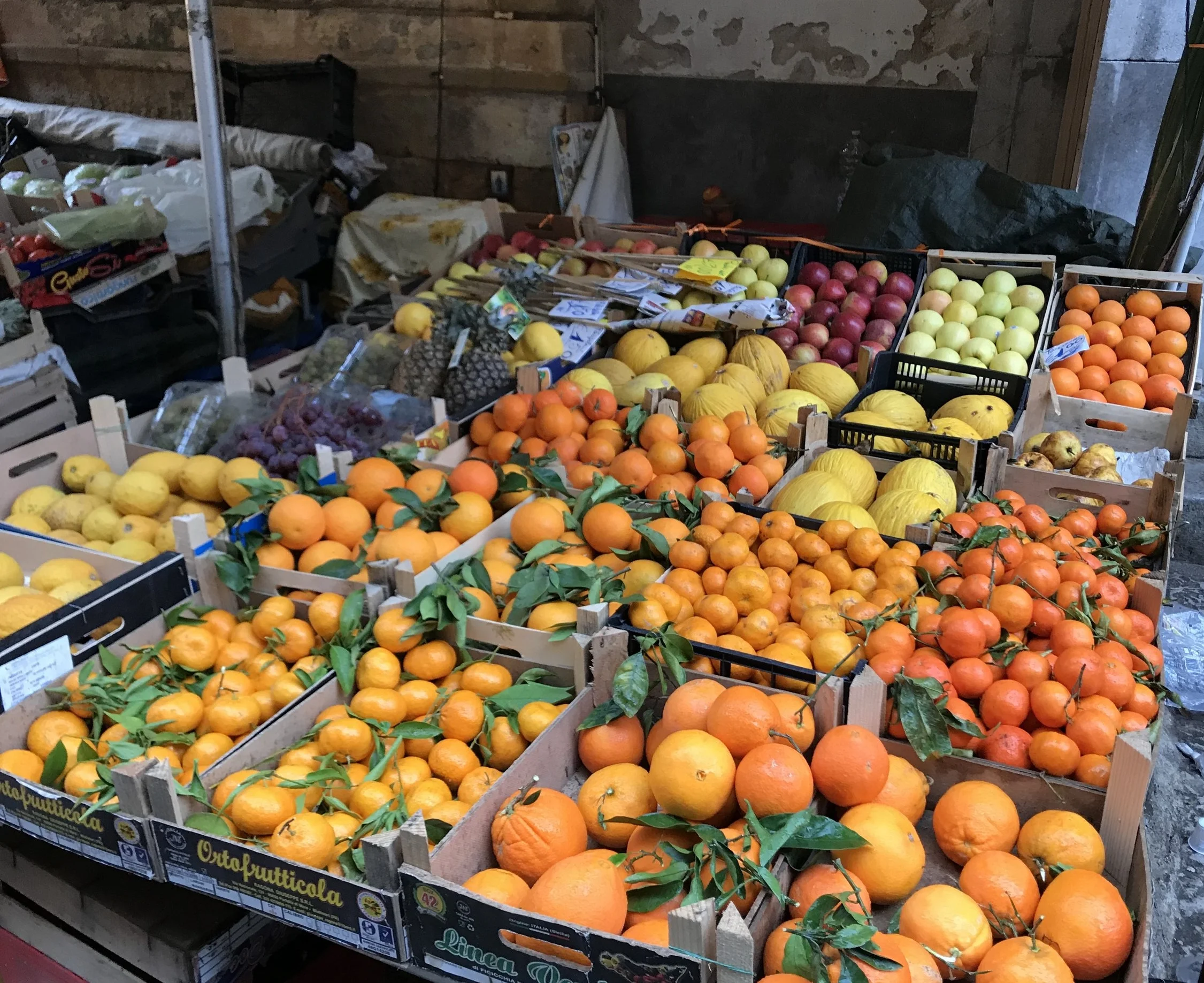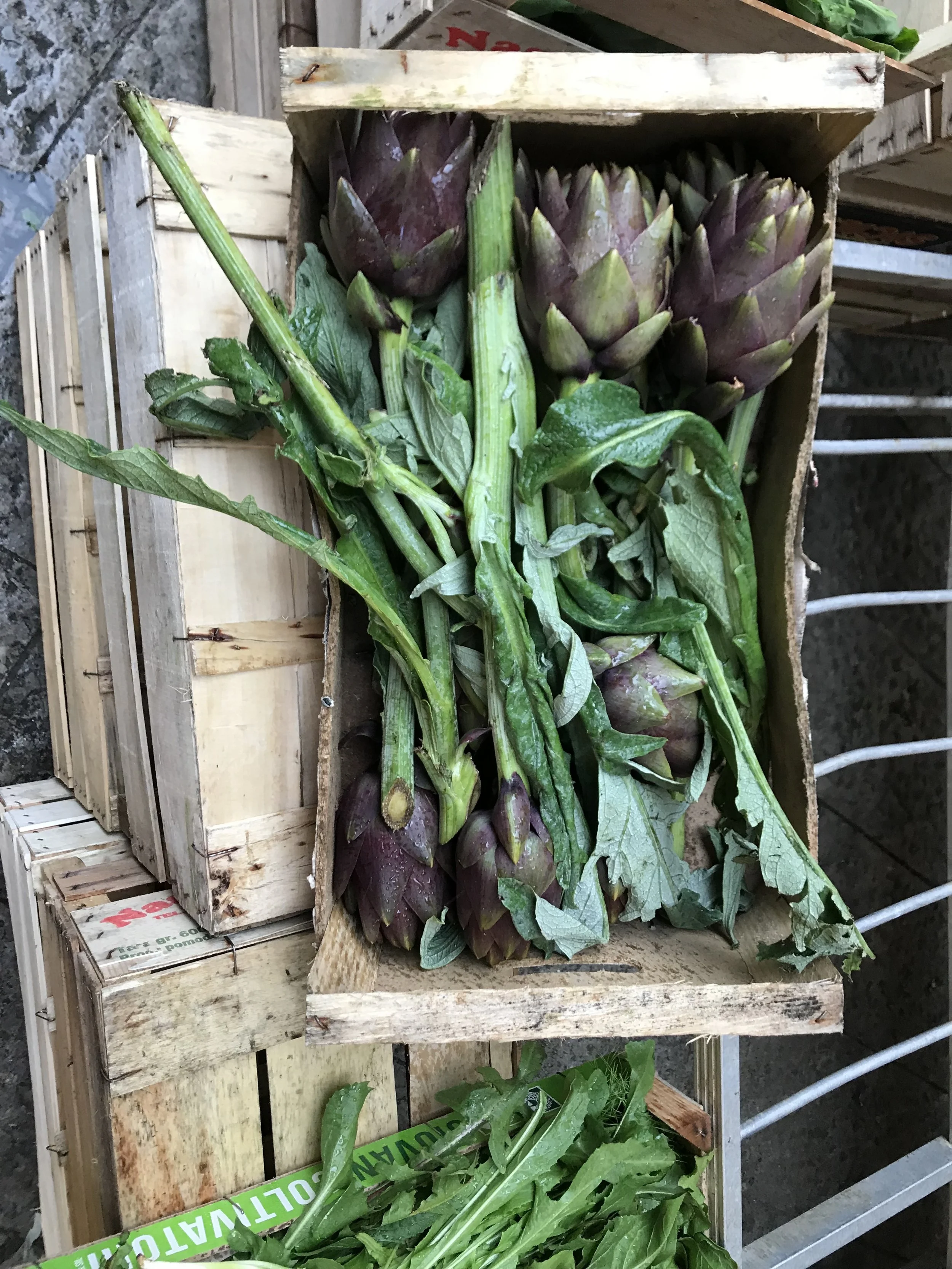
Suzanne Vine's Old and New to Somerville etc.

  • Blog
IMG_2185.jpg

Remembrance of Things Past: Retracing My Life and My Steps in Brittany

July 28, 2018 by Suzanne Vine

With so many places to visit and so little time in a life, it's often difficult to justify return visits. And there is always the worry buried beneath your desire not to repeat: can a place ever live up to the memories you have of it? We so often find a way to make the so-so times during a trip fade, remembering only the exhilarating highs and the crashing lows. Then we cement those in our memories by repeating them over and over (and over) again in the travel stories we share with our sometimes reluctant listeners. This summer, I decided to brave a return to Brittany, a place I spent six weeks in when I was 16. I wrote, in an earlier blog post, about that summer and the wonderful memories I have of the place, the people, and the tastes. Here's what I wrote: "If I go back to Brittany (and that's on the to-do list while we are in Amsterdam) I plan on finding those Breton butter cookies and having the taste instantly transport me back to my 16 year-old-self. I'll keep you posted." Now is the time for that post. 

Through the wonders of the internet, I was able to find the ad my father saw in the back of the Princeton Alumni magazine that resulted in my happy summer.

Through the wonders of the internet, I was able to find the ad my father saw in the back of the Princeton Alumni magazine that resulted in my happy summer.

When Rachel visited in July, and we were in search of a destination for a last-minute get away, I jumped when Peter suggested Brittany. And gulped. Could it possibly fulfill my expectations? And would it make me more than a little sad to be in a place I knew as a teenager, now that I'm 40+ years past those glory days? Thankfully, Brittany didn't disappoint. And graciously welcomed me back. "Come down and see me again," she said. The guitar in this song: gorgeous.

Living without a car in Amsterdam has made me realize I can get by just fine without one. Now when we travel, we look for ways to avoid driving. Turns out you can get to Brittany by train, which is my favorite way to travel. The first leg was the just-over three hour ride to Paris. We went armed with croissants and fancy yogurts in glass jars to get us ready for what would be just be one sliver of our breakfast in Brittany. Once in Paris, you just need to get to a different train station (Gare Montparnasse) to hop on your three-hour train to Saint-Malo, Brittany. High speed. On-time departure. Assigned seats. These are not qualities a gal from New Jersey recognizes in train travel. So civilized. 
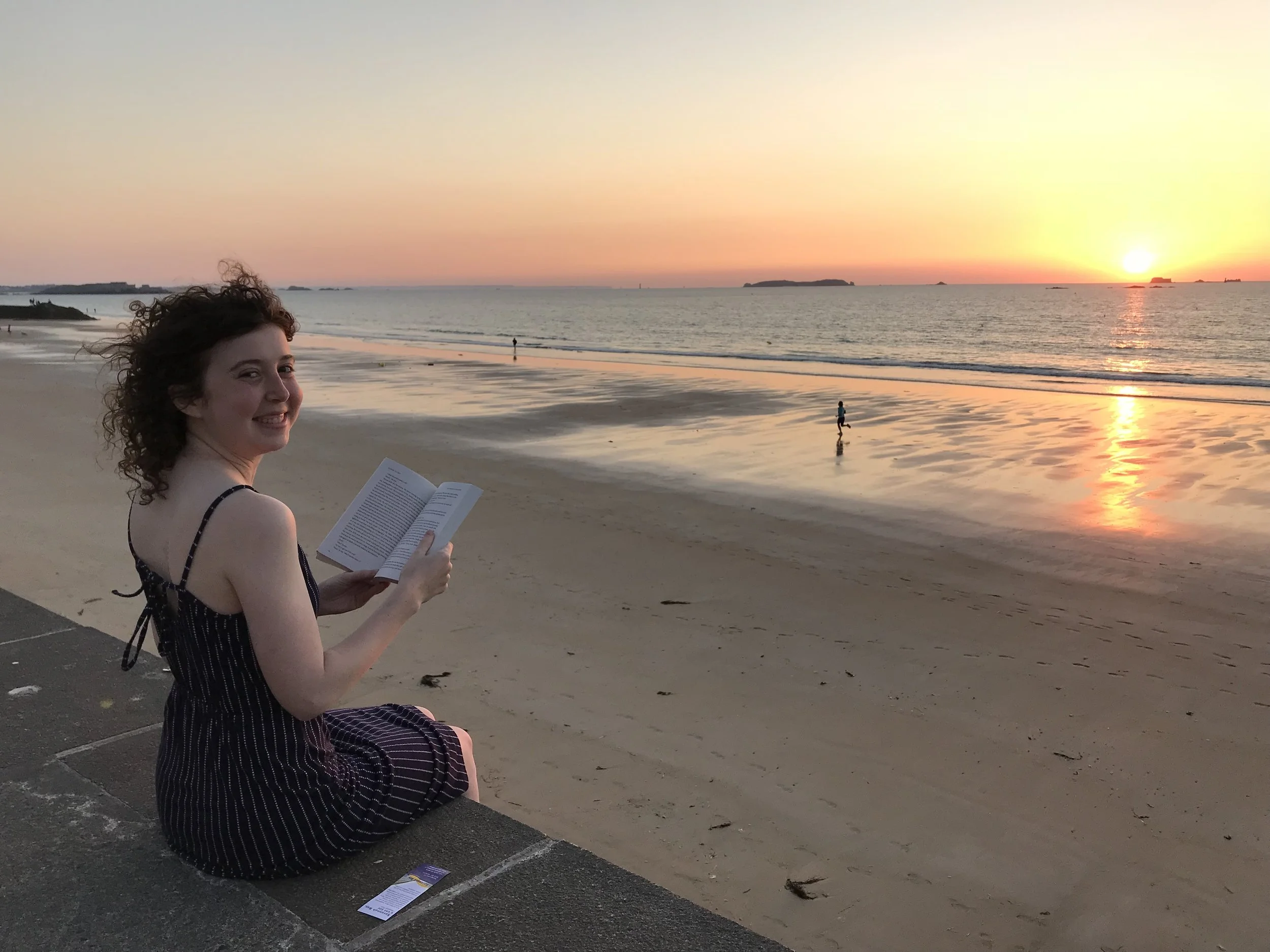
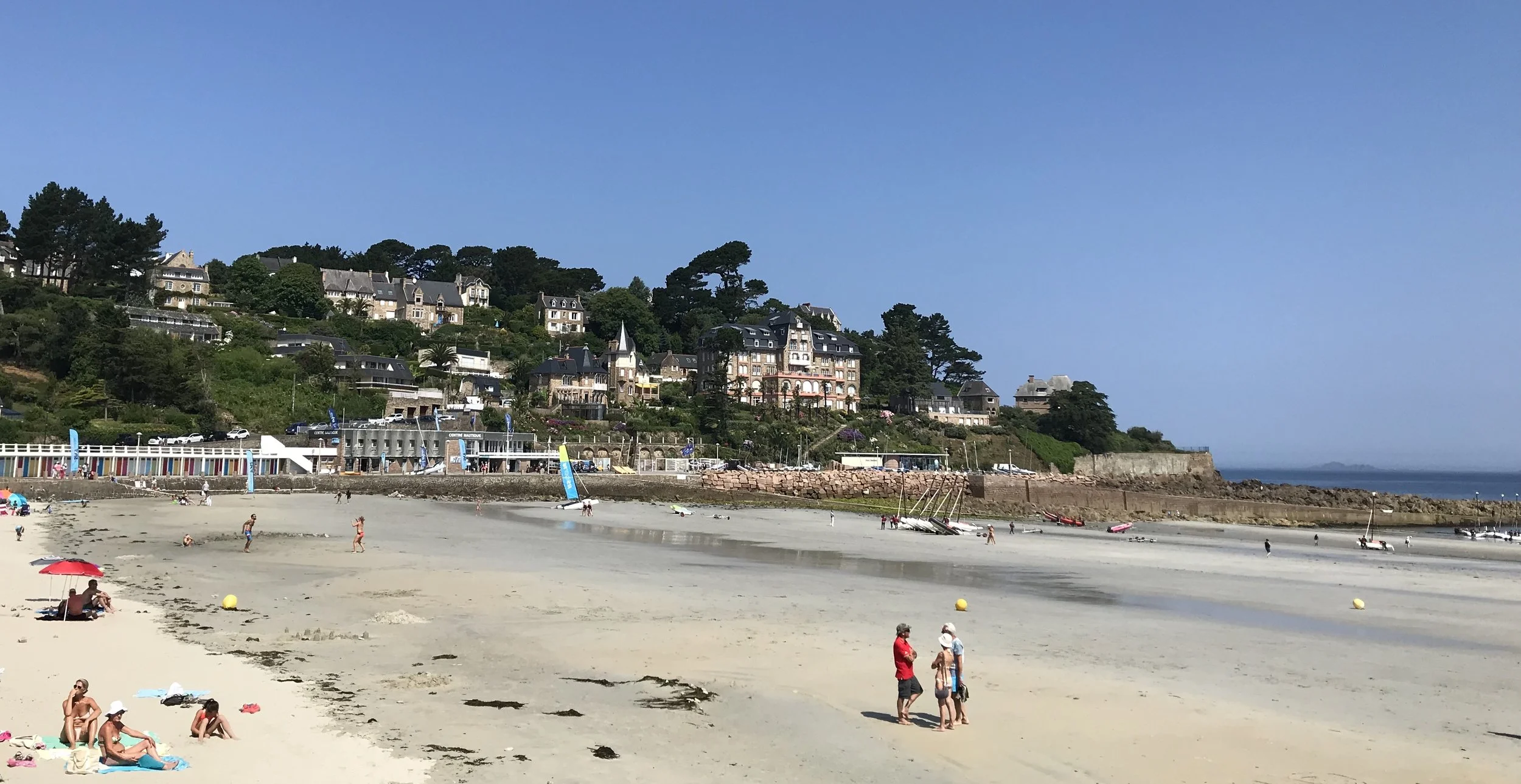
This wide beach, Plage de Rochebonne, in our home base of Saint-Malo was a place for families to play soccer, and at sunset, for everyone to gather. At low tide, the beach was wide enough for everyone to have their own little slice of heaven. A…

This wide beach, Plage de Rochebonne, in our home base of Saint-Malo was a place for families to play soccer, and at sunset, for everyone to gather. At low tide, the beach was wide enough for everyone to have their own little slice of heaven. At high tide, the beach disappeared and the waves reached all the way up to the wall where Rachel was sitting and reading.
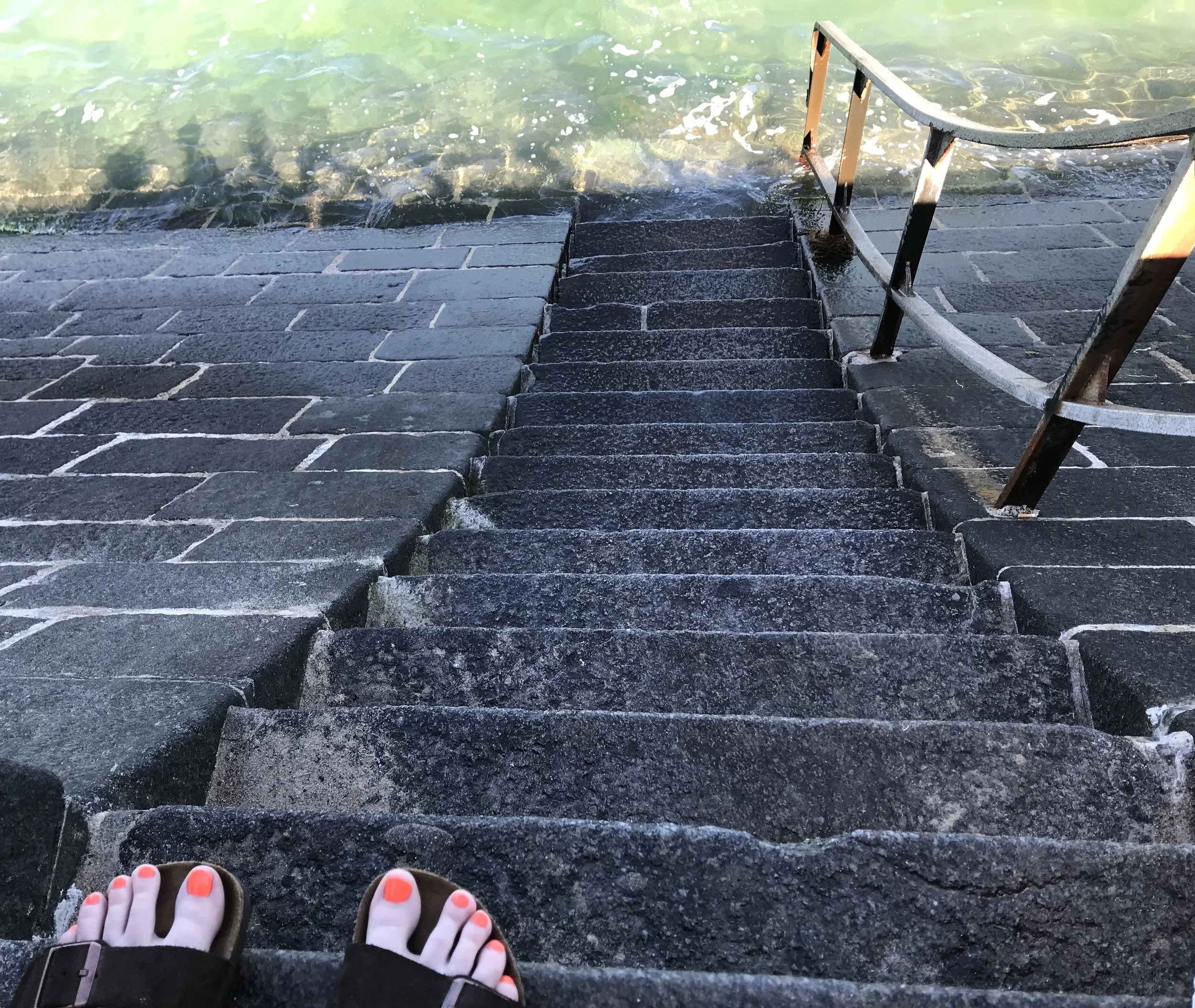
High tide. And the steps you had to climb down to reach the beach. 

High tide. And the steps you had to climb down to reach the beach. 

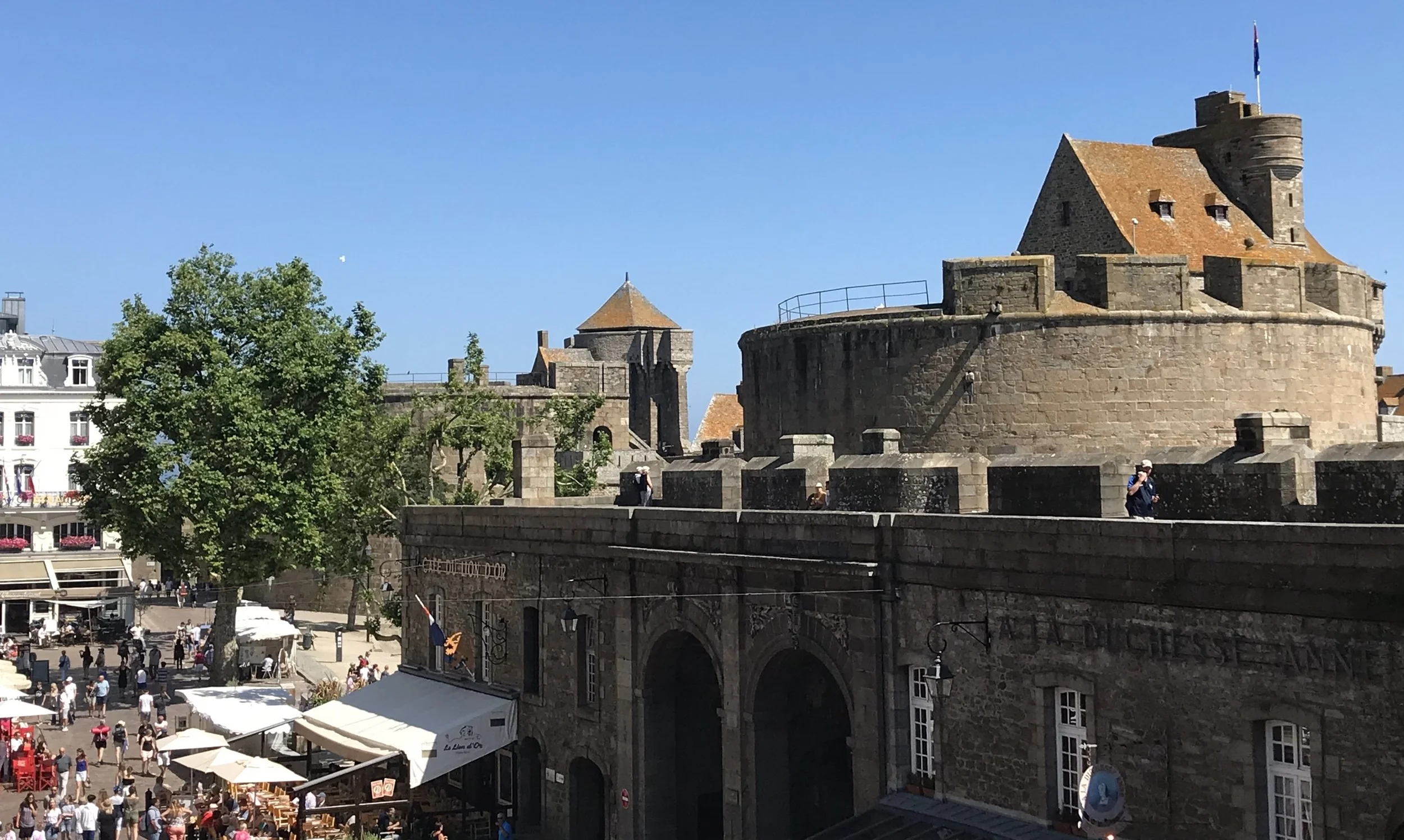
Saint-Malo looks like the other medieval cities you see on the coast, except it isn't. The old city, crouched inside the fortress walls surrounding it, was almost completely destroyed by Allied bombing during WW II. The quote by journalist Philip Beck at the start of the novel All the Light We Cannot See, set in Saint-Malo, explains the history: "In August 1944 the historic walled city of Saint Malo, the brightest jewel of the Emerald Coast of Brittany, France, was almost totally destroyed by fire....Of the 865 buildings within the walls only 182 remained standing and all were damaged to some degree.”

After the war, it was carefully reconstructed to look like it used to. As this article explains, this restoration is very different from those in cities like Dresden and Warsaw, who chose to modernize when they rebuilt instead of trying to reconstruct their past. Somehow, it all works in Saint-Malo, and makes you wonder which buildings are originals, and which are reproductions. It's like really good plastic surgery, since you can't always tell which ones are truly old and which are not.
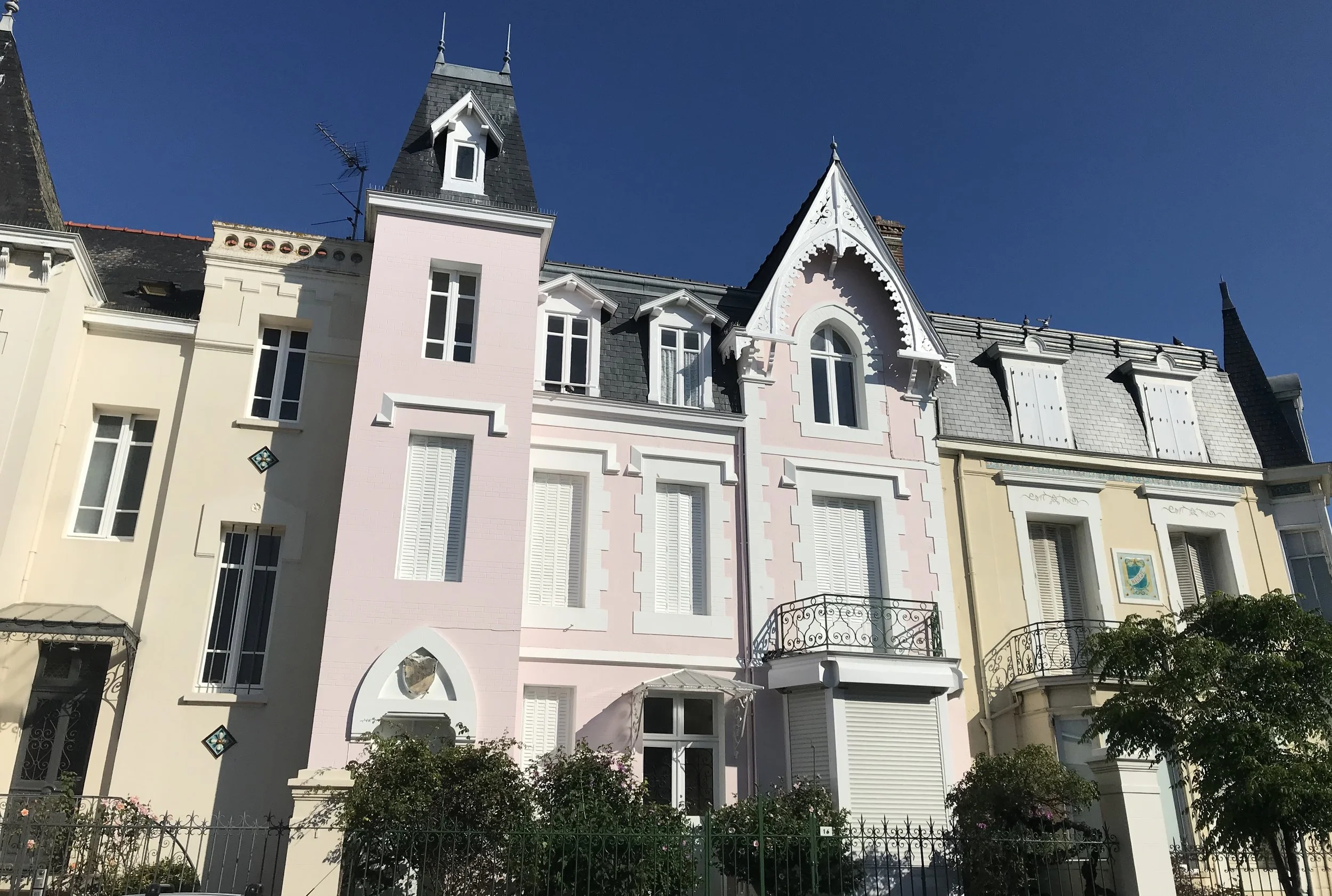
 These mansions overlooking the beach look like reproductions.

These mansions overlooking the beach look like reproductions.

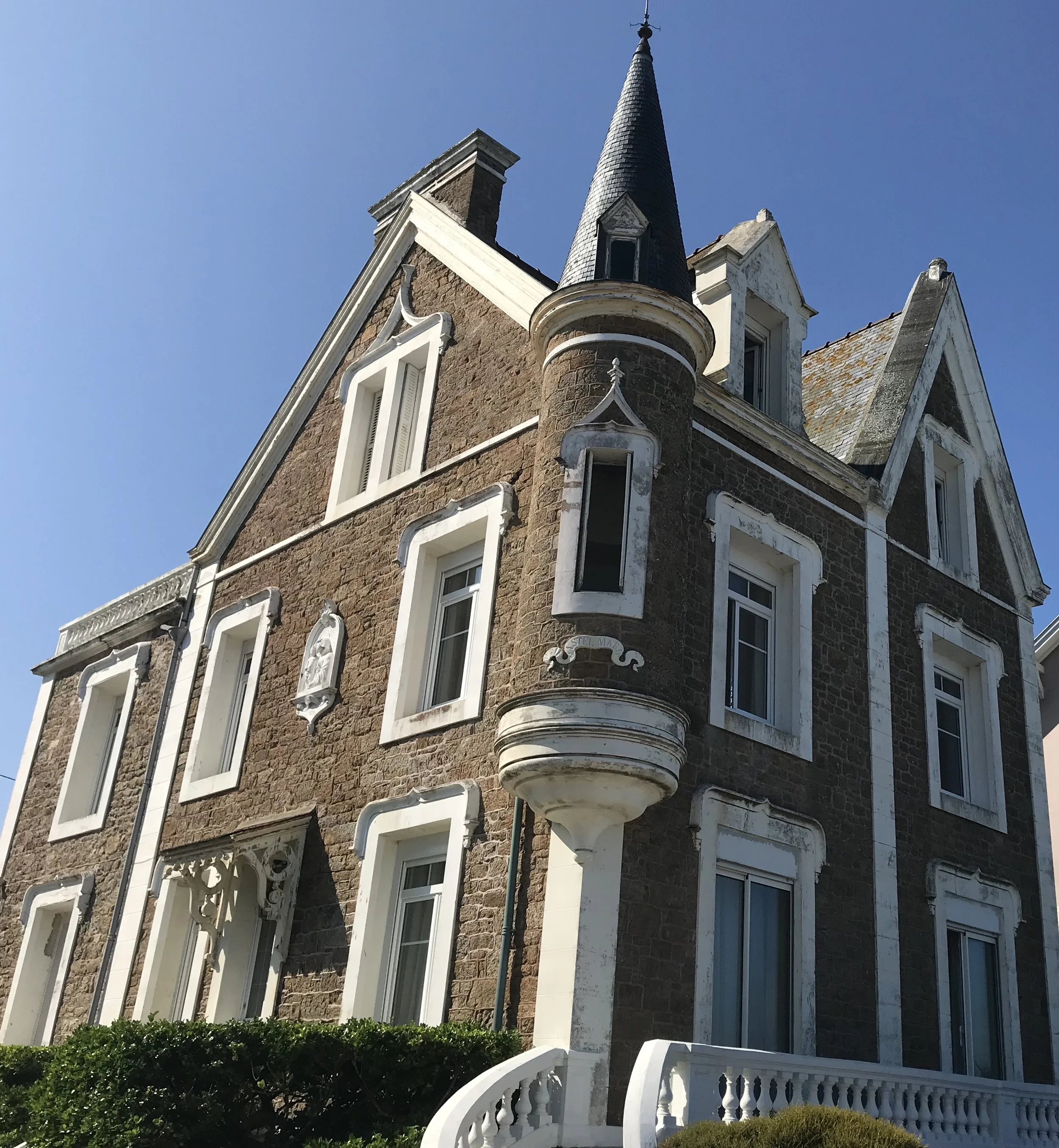
 This house looked like it had survived the war. When I travel, I like to pick out my home in the area. I chose this one. I liked the little tower room overlooking the water.

This house looked like it had survived the war. When I travel, I like to pick out my home in the area. I chose this one. I liked the little tower room overlooking the water.

Thanks to its Pulitzer Prize and subsequent climb on all the best-seller lists, All the Light We Cannot See has led a lot of literature tourists to Saint-Malo. Back in the day, my friend Sarah's grandmother was a member of something called the Jane Austen Society. At the time, I couldn't believe there was enough Jane Austenese-talk to warrant a whole society, yet I was secretly intrigued. And now I've hit the stage of life in which I love visiting a place connected to a book I have read. Truth be told, I think Saint-Malo is the most richly-drawn character in the novel. And no, I didn't do the All the Light tour. I didn't love the book enough. I did love knowing the author Anthony Doerr visited Saint-Malo during a book tour for a previous book, and decided immediately it would be the setting for his next book. It's just that dramatic looking and feeling. When you climb up to the walls surrounding the old city, you step into the shoes of the characters who return to the city after the war: "From the top, they watch the small figures of tourists stroll past shopwindows. She has read about the siege; she has studied photos of the old town before the war. But now, looking across at the huge dignified houses, the hundreds of rooftops, she can see no traces of bombings or craters or crushed buildings. The town appears to have been entirely replaced."
IMG_2367.jpg

Armed with a photograph I had taken of Perros-Guirec, the village where I lived, I looked forward to my trip down memory lane. With a wonderful guide named Samuel, we set off from Saint-Malo. Samuel looked to be about 30 years old or so, so when I told him I was there in 1976, he looked incredulous. It was as if I had announced I was alive during the Stone Age. He patiently walked along the beach with me, trying to help me match my photo up with what we saw. It all looked so familiar to me, and yet at the same time so foreign. Why couldn't I remember the address, or at least the name of the street?  Yet I could tell you what we ate for lunch and I will: I can still taste those pâtés, rillettes, baguettes (we used the stale ones in sword fights) and, of course, Breton butter cookies. He smiled politely when I told him I remembered the night we were allowed to drink a healthy amount of Calvados, an apple brandy found throughout Brittany and Normandy. It was just the kind of smile you might force onto your face when your elderly aunt went on and on about "the olden days". Yes, I have turned into that kind of old lady. 
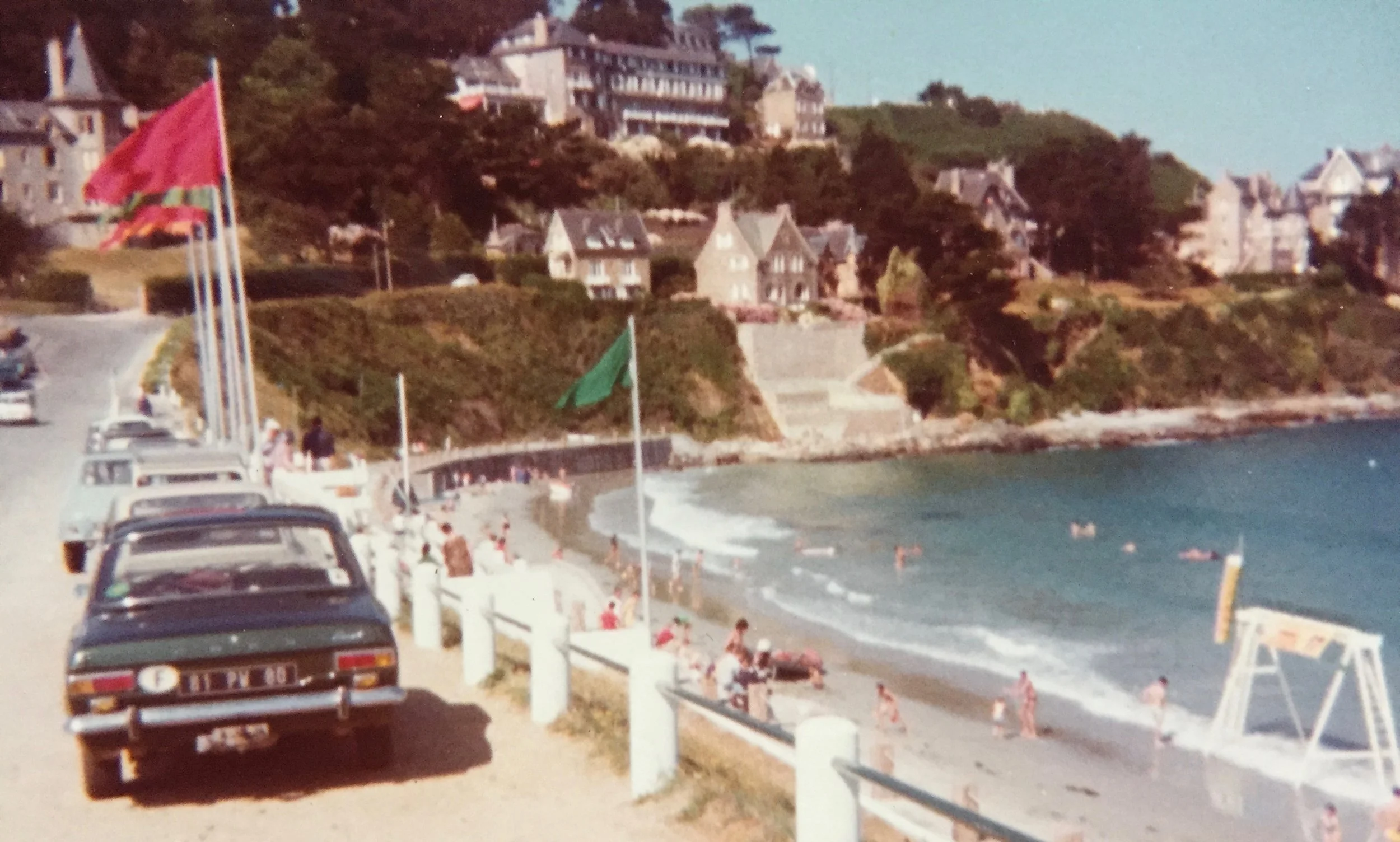
 Here’s a copy of the snapshot of the village of Perros-Guirec circa 1976.

Here’s a copy of the snapshot of the village of Perros-Guirec circa 1976.

 And here it is in July 2018.

And here it is in July 2018.

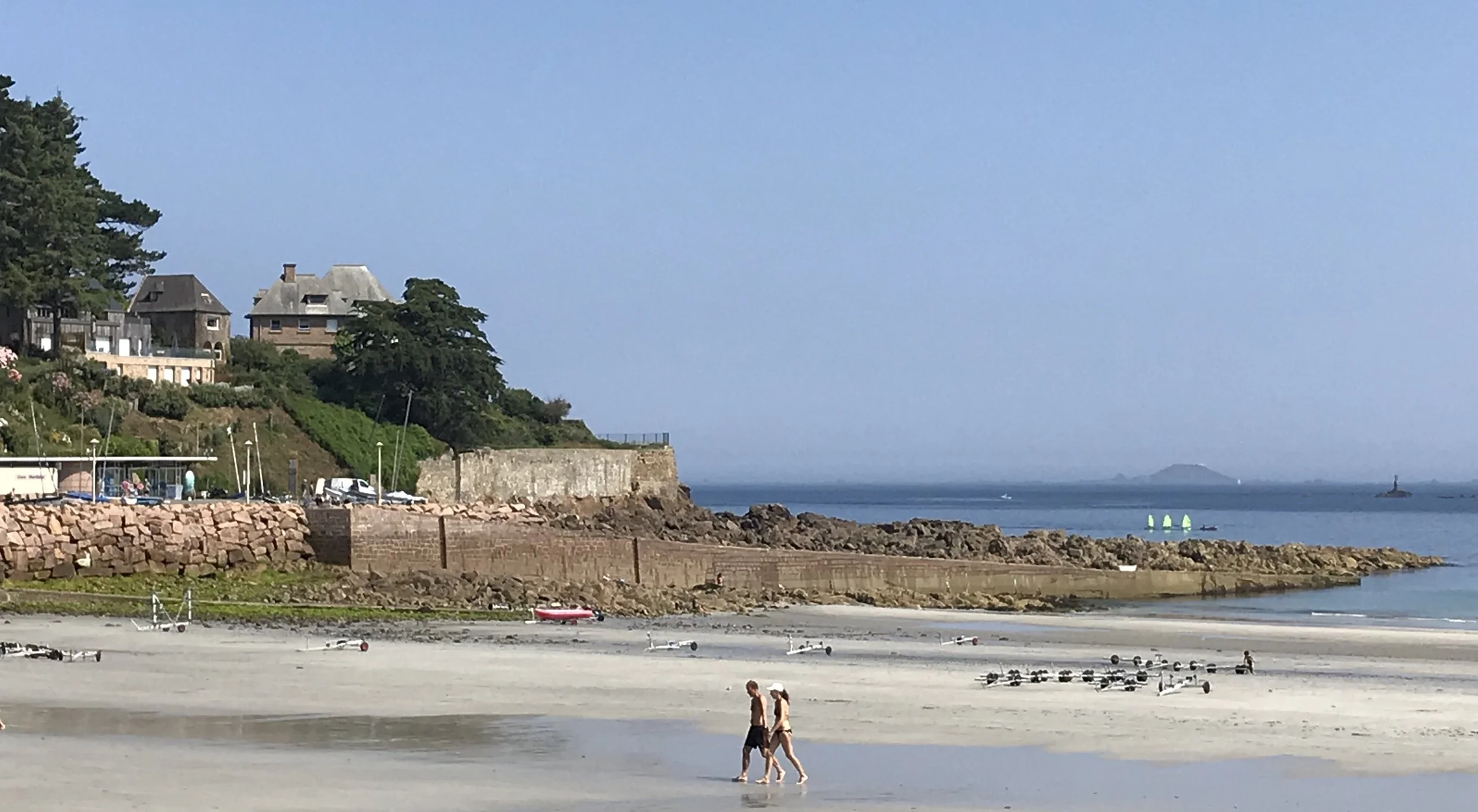
As we walked along the beach, and looked up at the lovely stone mansions perched above, I wondered if I knew at age 16 how lucky I was to be in this place. Probably not. Show me the 16 year old who has that kind of perspective. I feel my old-lady-self emerging. And now she's making one of her pronouncements: "Youth is wasted on the young." Sorry, but it's true.

It was somewhat unsettling to have so little access in my mind to my experiences back then. How does your mind decide which memories to store and which to trash? A friend recently told me about his 86-year-old father's descent into dementia. His dad can't remember what he did the day before, but could talk at length about the people pictured next to him in his high school year book. We also talked about how people with dementia often switch back to a language learned earlier in life. While reading up on that, I also came across some articles suggesting that learning a second language can help you ward off the symptoms of Alzheimer's disease. Now there's yet another reason to plod along with my Dutch. I found my French coming back with much more ease than it had on previous trips to France. Did that have something to do with being in the same place I had been when my command of French was much better? Was my brain tricked into thinking it was 16 again? 
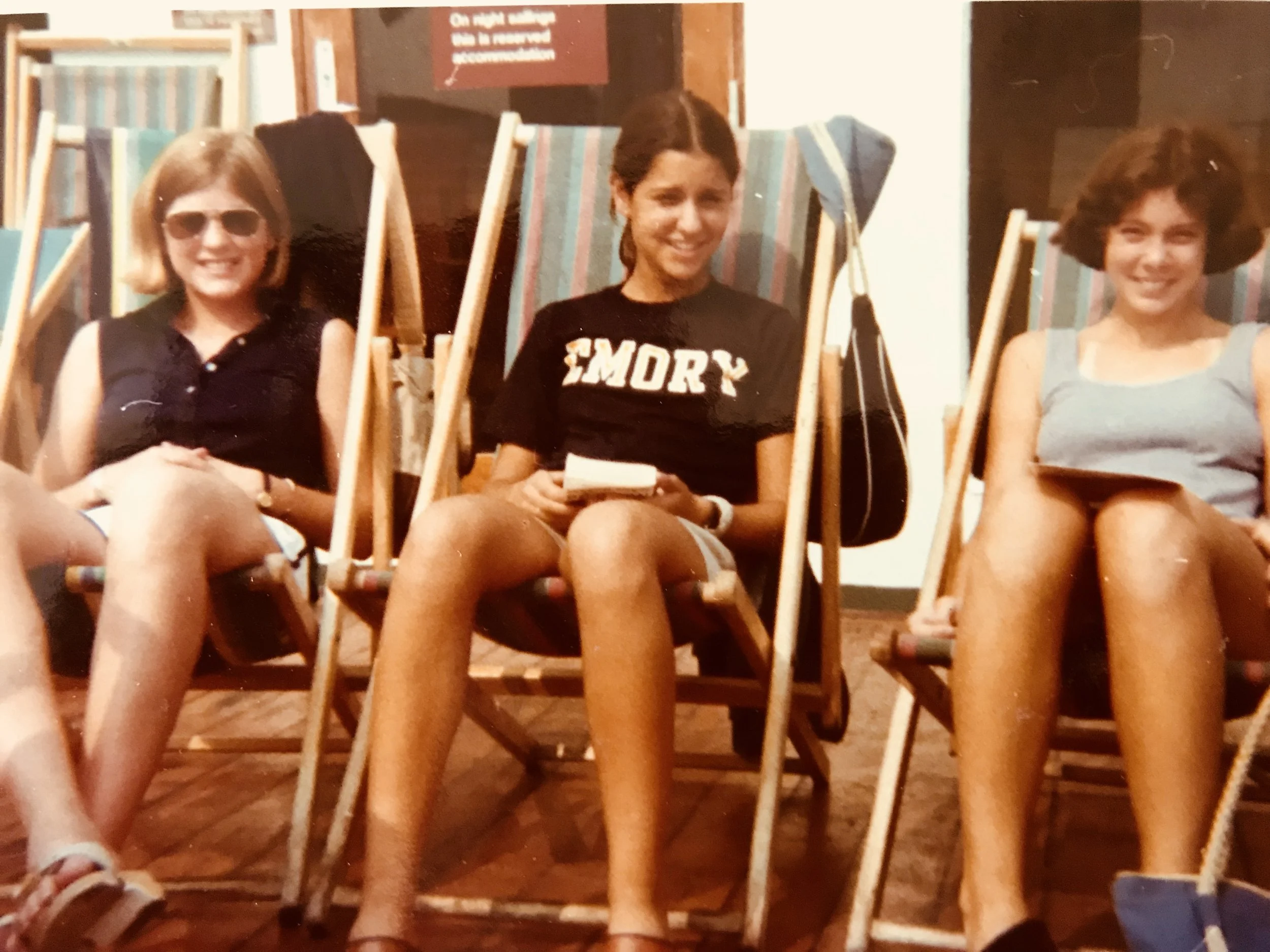
And here is that 16-year-old. We took a ferry from somewhere to somewhere else in Brittany. I lopped off my long curly hair for the summer, opting for what I thought of at the time as a sophisticated bob. Mon dieu!

And here is that 16-year-old. We took a ferry from somewhere to somewhere else in Brittany. I lopped off my long curly hair for the summer, opting for what I thought of at the time as a sophisticated bob. Mon dieu!

With all of this weighing on my mind, it was time to leave the little village I knew and loved, and march on. We hiked on a trail from Perros-Guirec to an even smaller village called Ploumanac'h along the Pink Granite Coast, named for the pinkish-hued rock formations along the way. These rocks have been there since....Can't remember what Samuel said about that. You see how my mind works? Let's just say those rocks have been there for a long, long time and leave it at that.
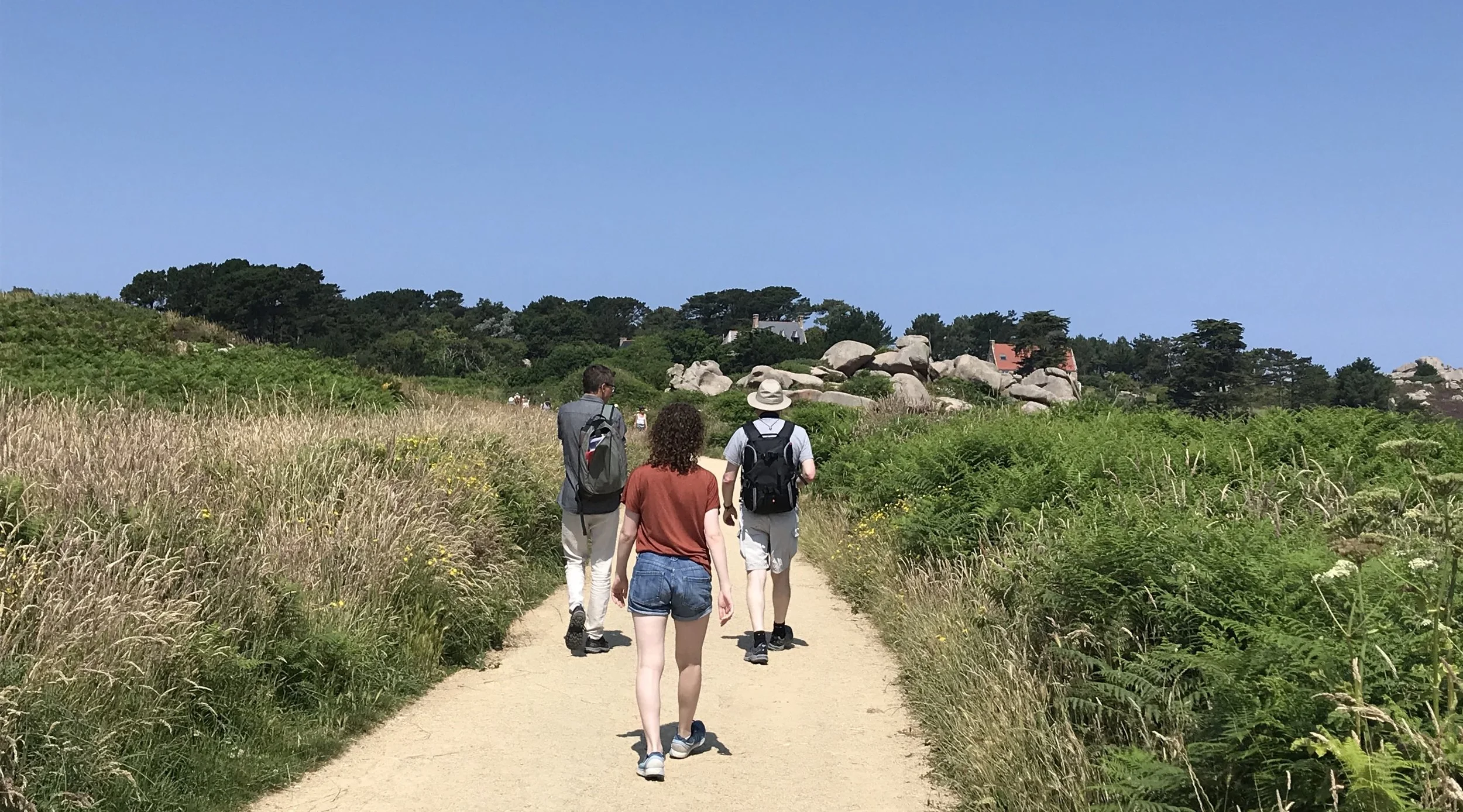
I know she still has a long ways to go, but seeing this gal walk along the trail - when only a year ago she was in a wheelchair - made me so grateful. Hoping for many hikes with you and without any knee pain in the future, Rae.

I know she still has a long ways to go, but seeing this gal walk along the trail - when only a year ago she was in a wheelchair - made me so grateful. Hoping for many hikes with you and without any knee pain in the future, Rae.

Hiking amongst these rocks gives you the chance to use your imagination to see objects and people in the formations. Who knew this process has a name: pareidolia? I sure didn't. But thanks to my ex-Principal Mr. Q. - who wrote on FB of practicing his powers of pareidolia on orchids in Ecuador - I know your mind wants to see the man in the moon, or faces in clouds or orchids. It's all part of our brain's desire to be see patterns and stay organized. 
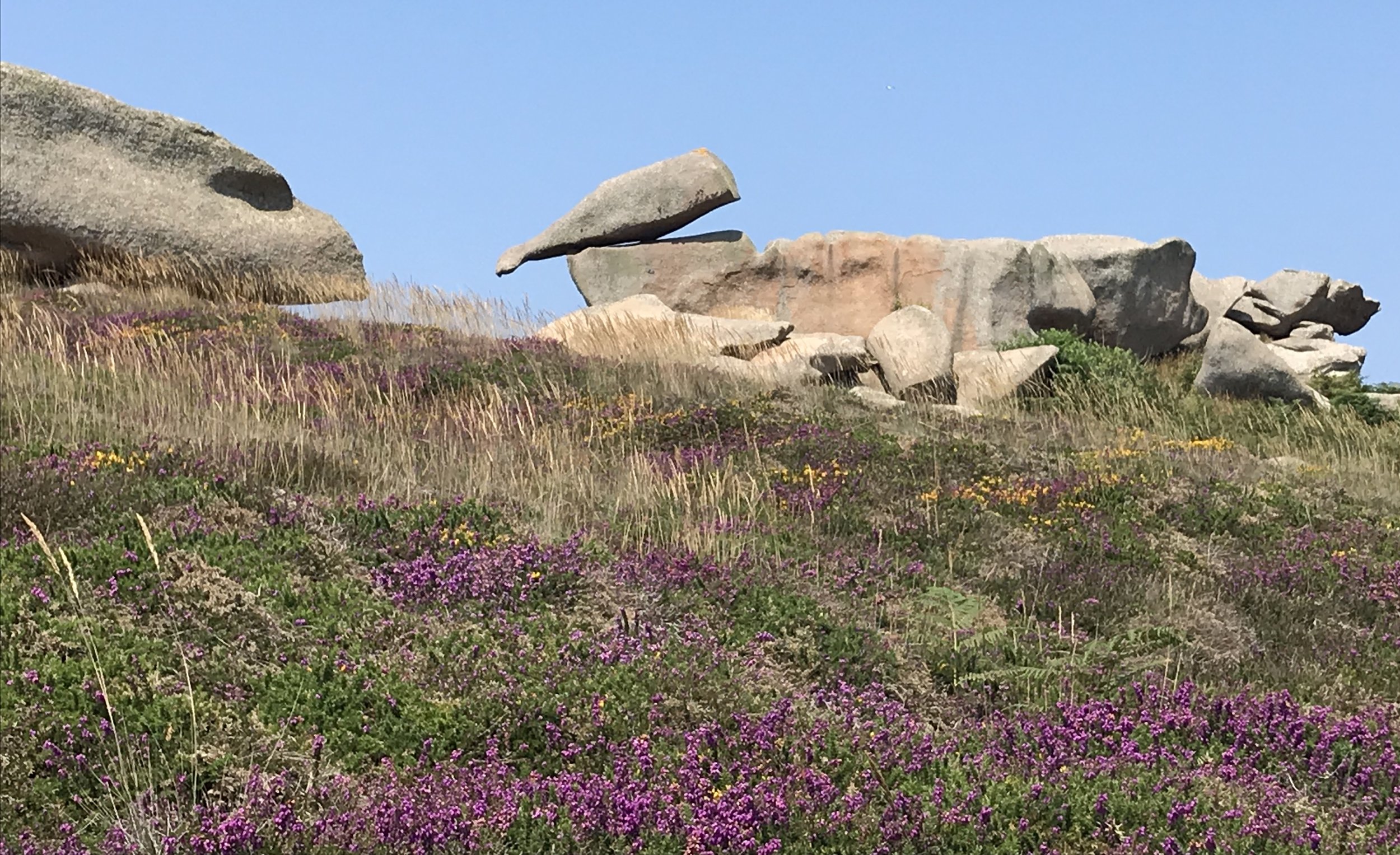
I found it only fitting that in the motherland of good wine, one rock formation shows a perfect bottle of wine, tipped and ready for drinking. 
I found it only fitting that in the motherland of good wine, one rock formation shows a perfect bottle of wine, tipped and ready for drinking. 

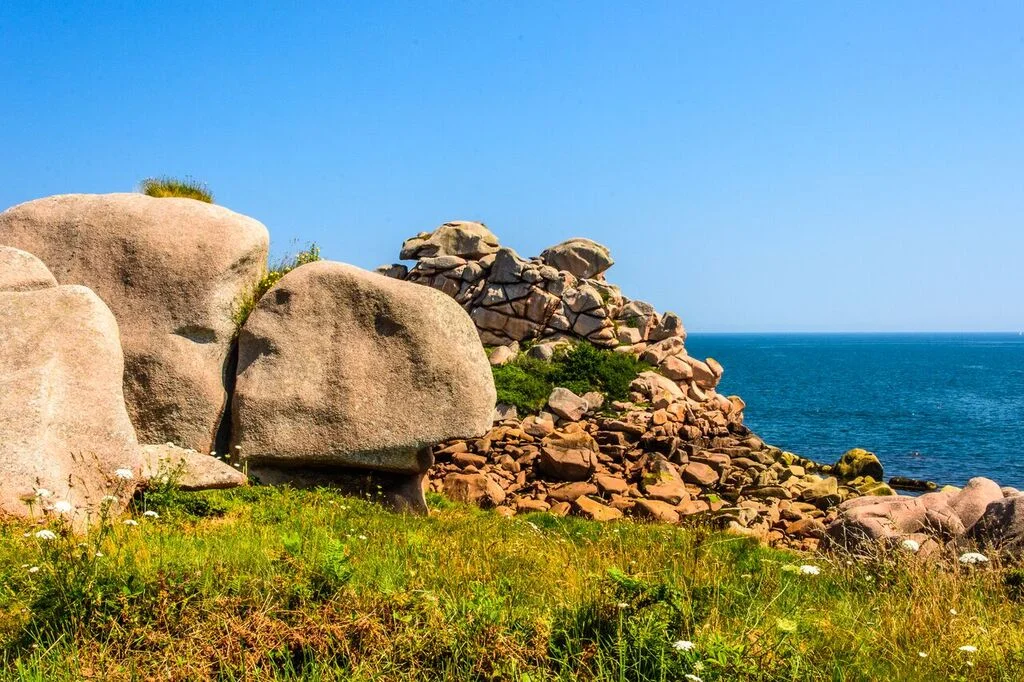
Photo credit to Peter. Is it a turtle's face? What say you?

Photo credit to Peter. Is it a turtle's face? What say you?

Clouds in my coffee. 
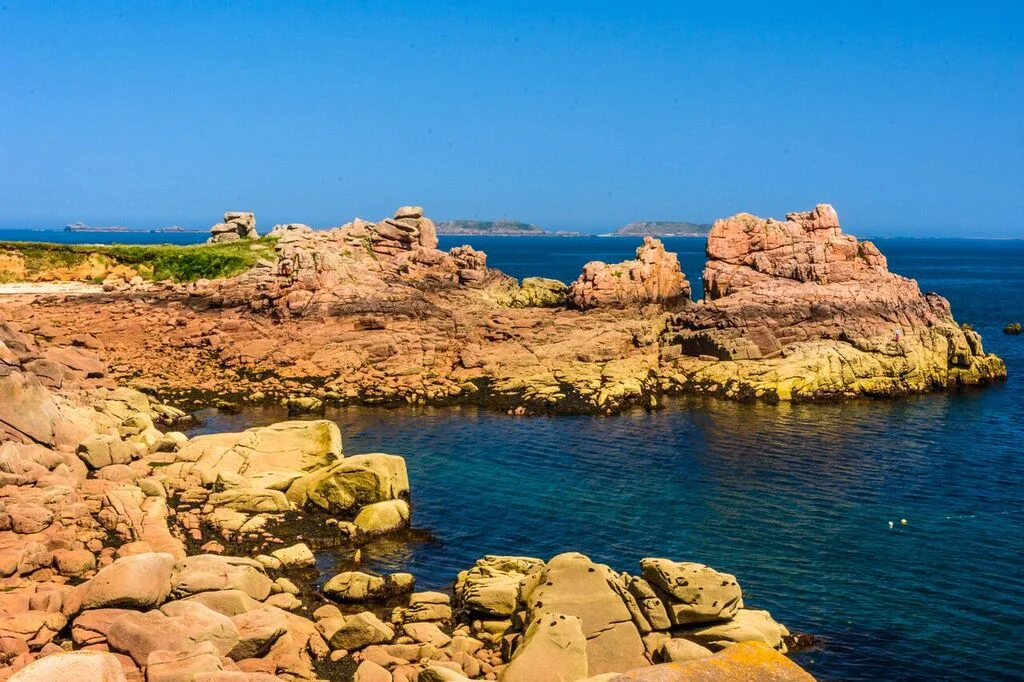
When you are done staring at the rocks, you can just take in the colors of the water. Photo credit to Peter. Beautiful.

When you are done staring at the rocks, you can just take in the colors of the water. Photo credit to Peter. Beautiful.

With all of that walking, one needs sustenance. The Breton buckwheat crêpes - called galettes - were called into service for many of our lunches, and they more than fulfilled the memories I had of them. Funny that I can remember those perfectly, and not where we lived. Not surprising at all to those of you who know me best. I learned how to make them in our cooking class during my long-ago summer there. I even bought a heavy cast-iron crêpe pan which I lugged back to the U.S. That crêpe pan, my mom likes to remind me, saw the light of day exactly once when I made them for the whole family. She claims the pan then beat a hasty retreat into the basement, where it eventually developed a melancholy rust and had to be tossed out. I think it was homesick for Brittany.

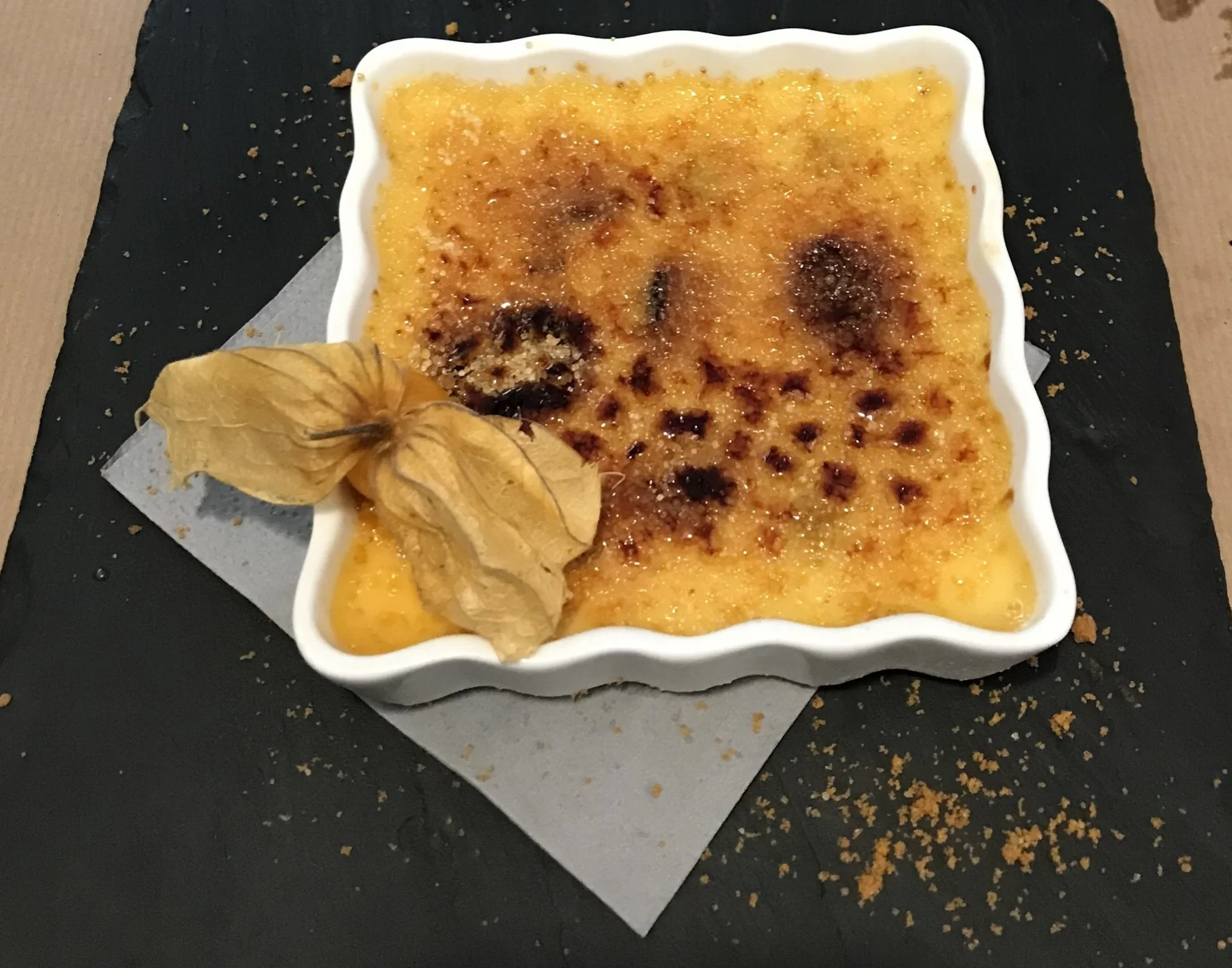
I somehow didn't capture any of the galettes in photos, probably because they disappeared too quickly. But here are a few desserts to keep you happy.
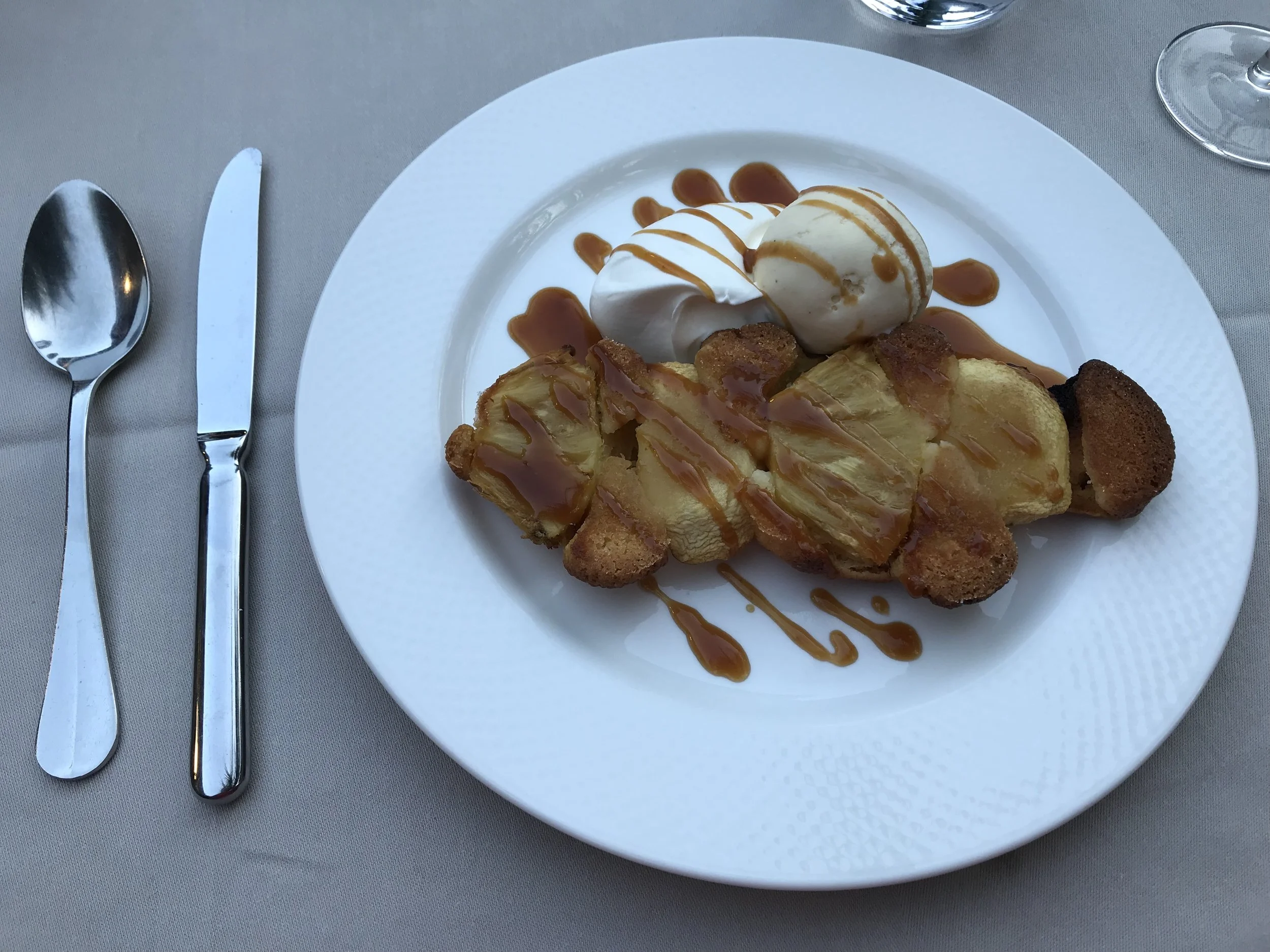
 Some sort of deconstructed apple tarte-tatin. Is there any problem that salted caramel can’t cure?

Some sort of deconstructed apple tarte-tatin. Is there any problem that salted caramel can’t cure?

 And the ultimate fancy comfort food: crème brûlée.

And the ultimate fancy comfort food: crème brûlée.

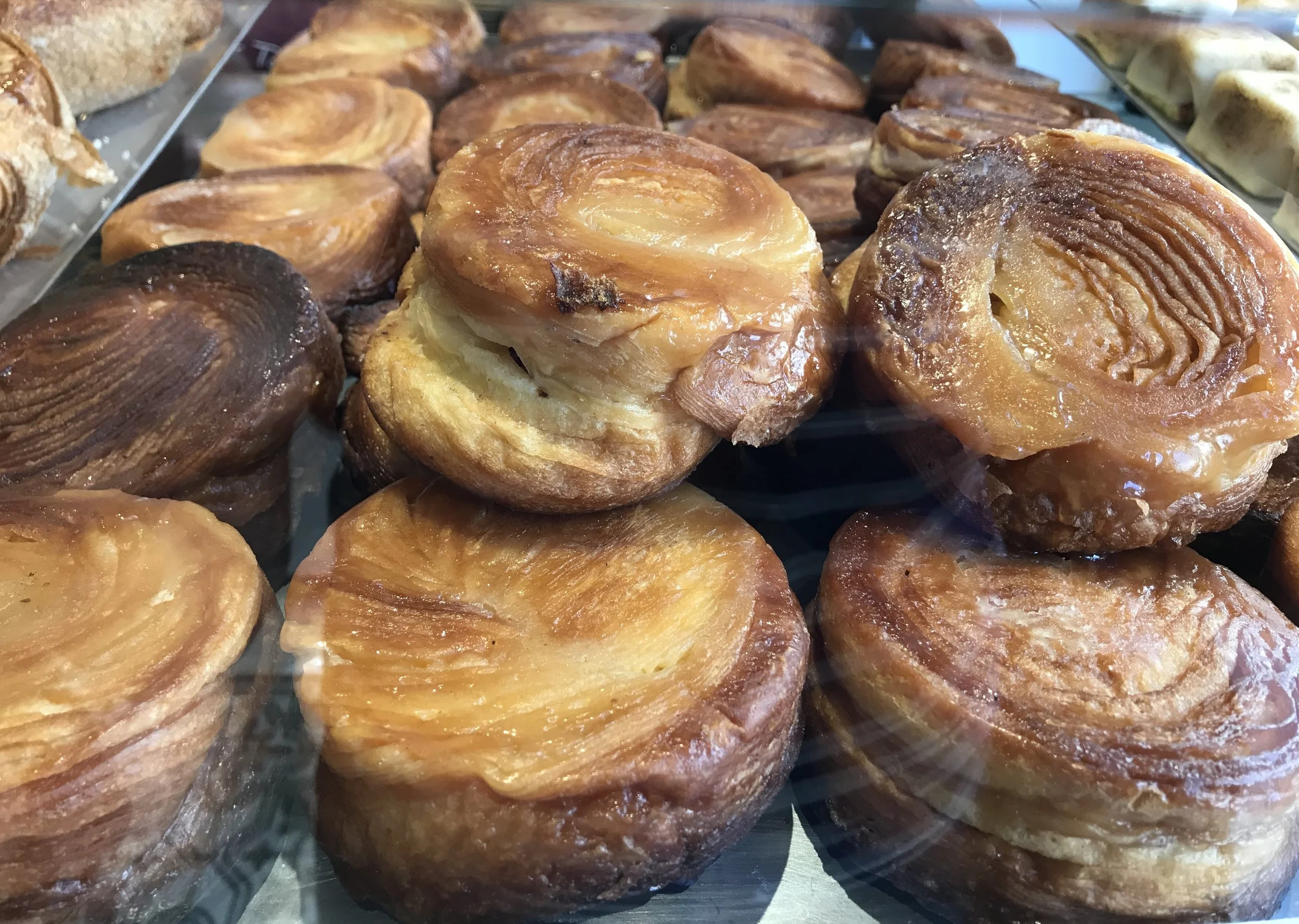
The most iconic Breton pastry is called a Kouign Amann. It's a buttery, flaky specialty found everywhere. You just have to follow the heavenly smell. I couldn't figure out how to pronounce them, so I just called them Kofi Annans, after the former Secretary-General to the UN, much to the dismay of Rachel and Peter. But I learned while doing some research for this post that it's pronounced kween ah-mann, so it will be easier for me to ask for them in the future. 
IMG_2363.jpg

"I'll be good. I wish I could get this message over to you now."

It wasn't all dessert, all the time in Brittany. We had some terrific dinners at small bistros with friendly and mostly-French speaking staff, although they tried their best to sprinkle in some English. Despite our licked-clean plates every night, the wait staff routinely asked if we had enjoyed everything. You'd think the clean plates would have served as a clue, but we always smiled pleasantly and enthusiastically. A little smiling goes a long way in a foreign country. So does eating everything and not being a picky eater. Restaurants really like that in a visitor.

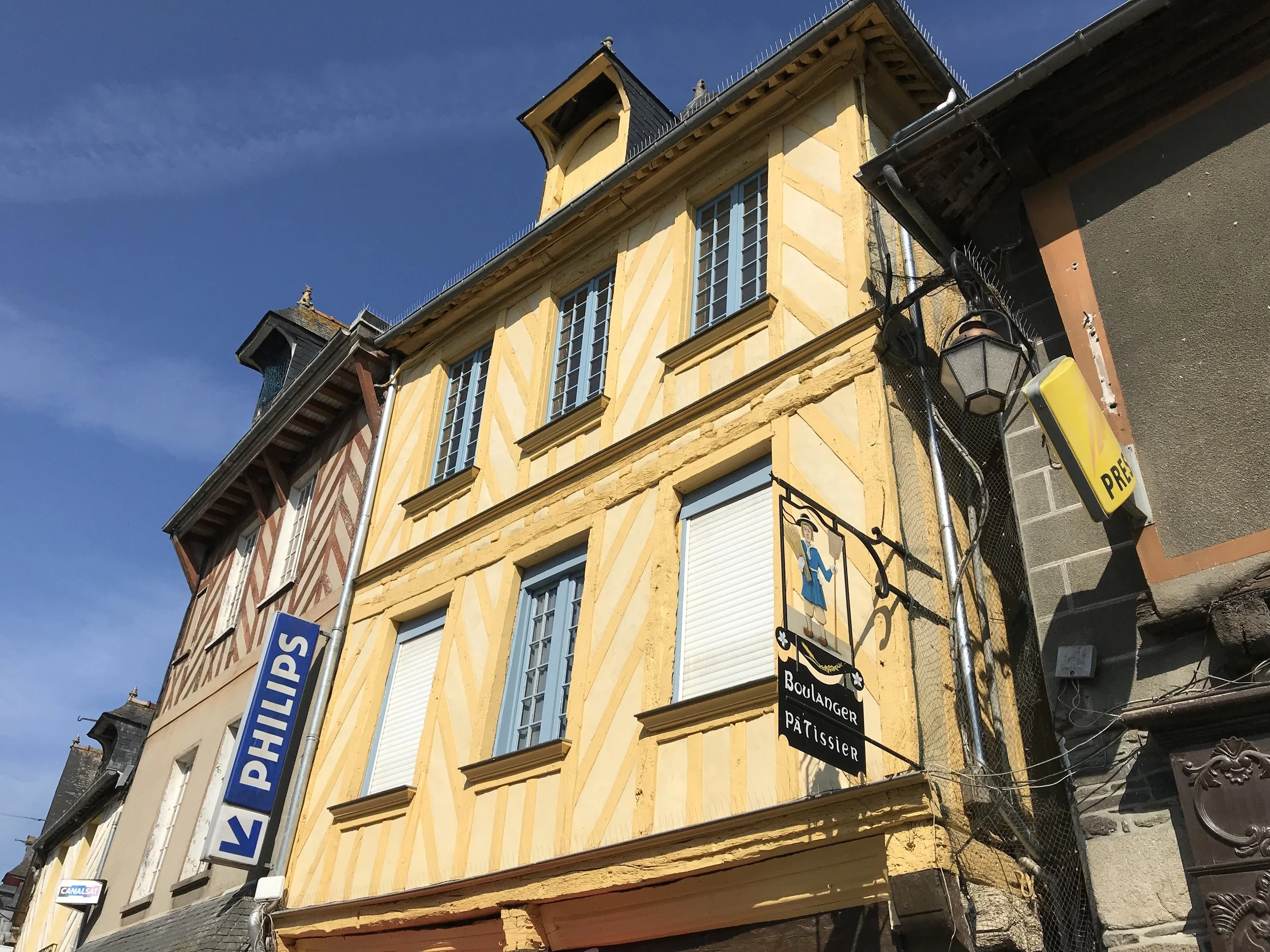
We continued to explore Brittany, including a few spots I didn't see on my original visit. Or at least I don't think so. Dol de Bretagne is a charming village with many original stone and timber buildings from medieval days. Some were untouched, and others had been painted in fancy un-medieval colors. 
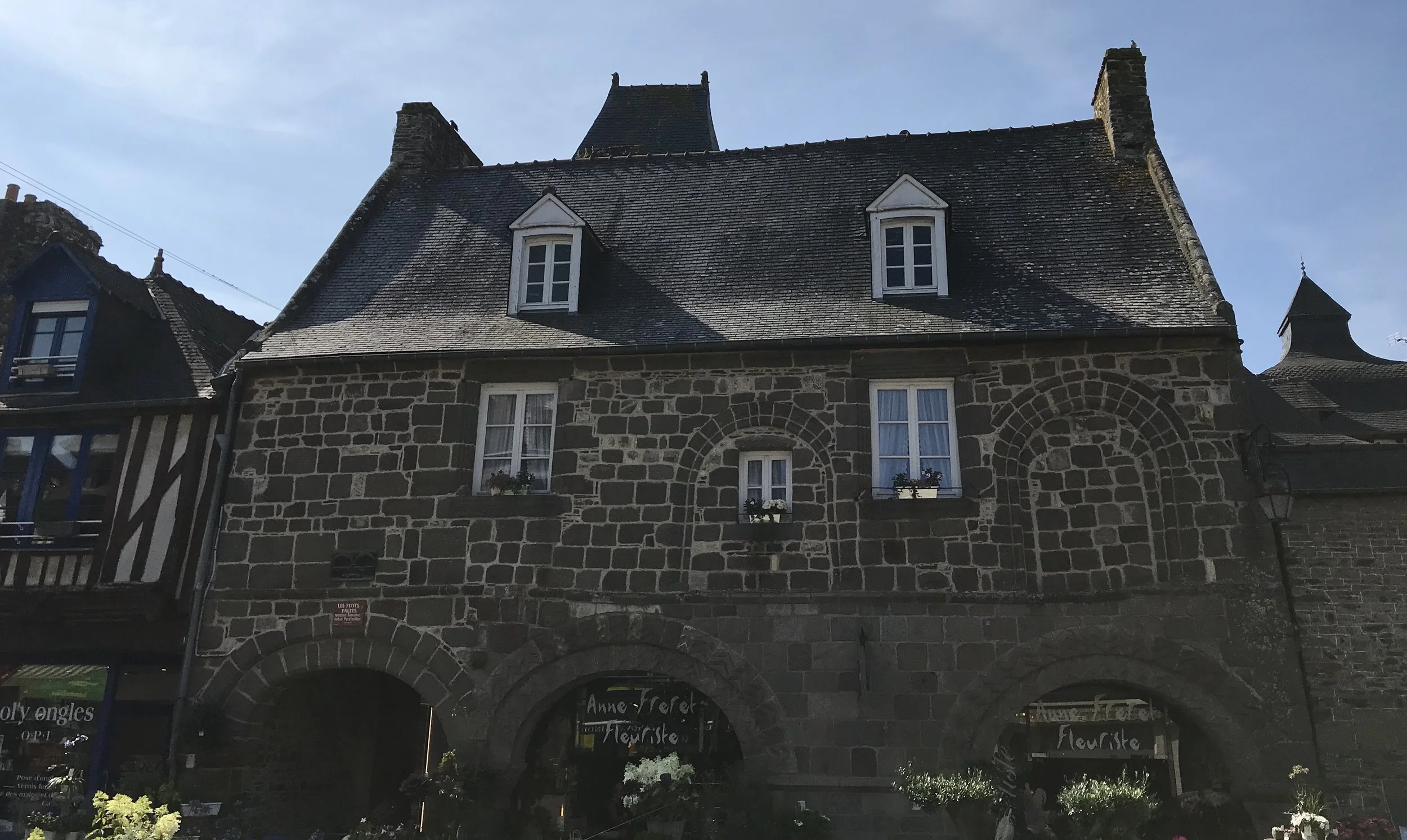
 One of the oldest (or the oldest?) house in Brittany. It’s now home to a lovely flower shop.

One of the oldest (or the oldest?) house in Brittany. It’s now home to a lovely flower shop.

 Here’s an updated house. I think neither bright yellow house paint, nor Phillips was around in medieval times.

Here’s an updated house. I think neither bright yellow house paint, nor Phillips was around in medieval times.

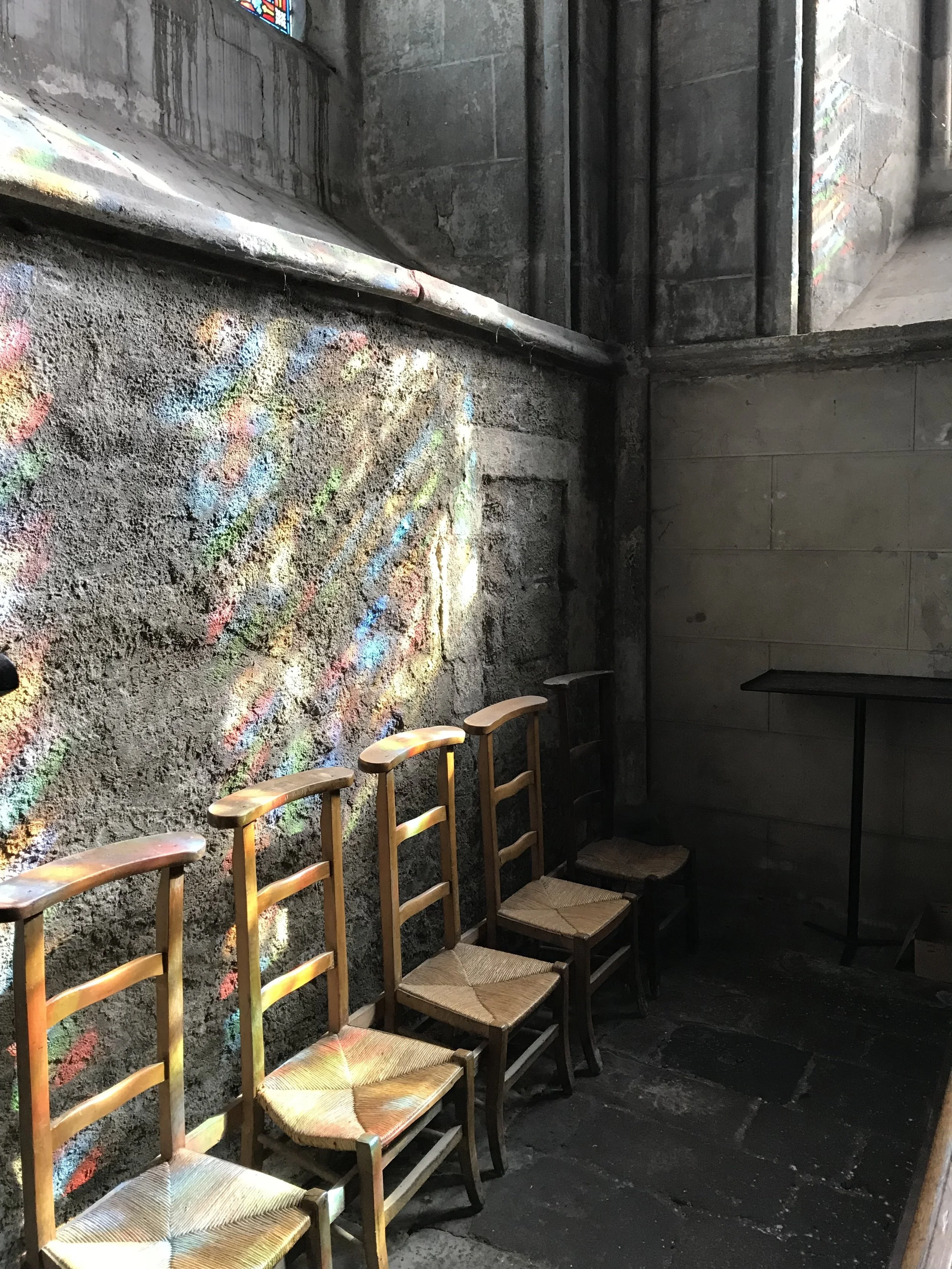
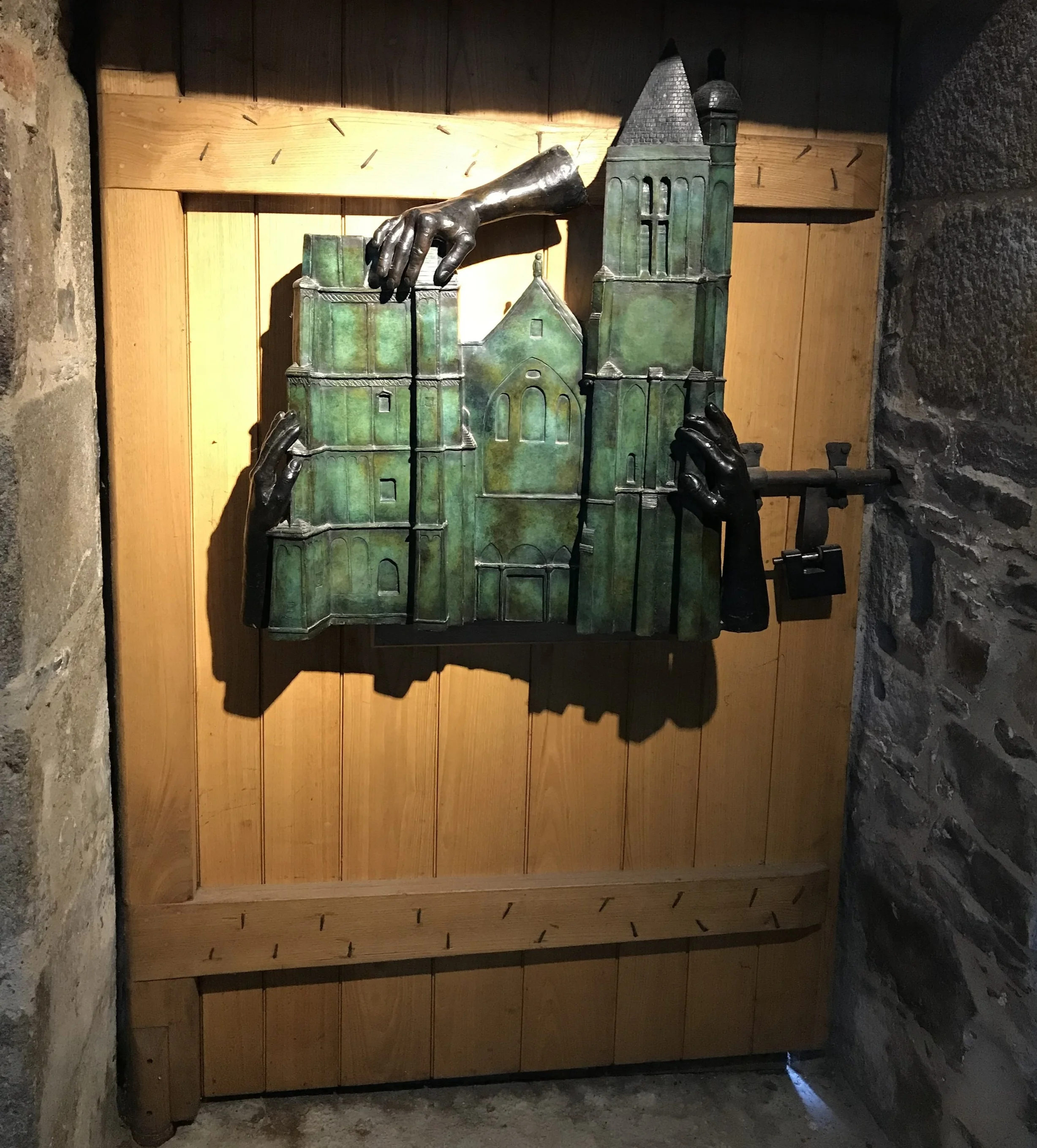
In Brittany, as in many parts of Europe, cathedrals were heavily damaged during WW II. In the cathedral in Dol de Bretagne, there was a moving sculpture dedicated to the heroic efforts to save the church and some of the treasures inside from destruction. Although centuries-old stained glass is forever gone, I also love the more modern stained glass windows replacing the originals. The reflections were beautiful, too. 
IMG_2297.jpg
IMG_2302.jpg

After we bid adieu to Dol de Bretagne, the Tour de Bretagne continued. Who says you can't teach an old dog new tricks? I've always said I'm not an oyster person, but this summer, I finally decided to give them a try. At the urging of my friend Vera, I had my first taste at Zandvoort beach in the Netherlands earlier this summer. That got me ready to visit Cancale, a Breton village where oyster lovers from near and far make their pilgrimages. Even if you don't fancy oysters, you will still enjoy the stunning views, and the chance to shop for striped clothing and really go into full-on tourist mode.  
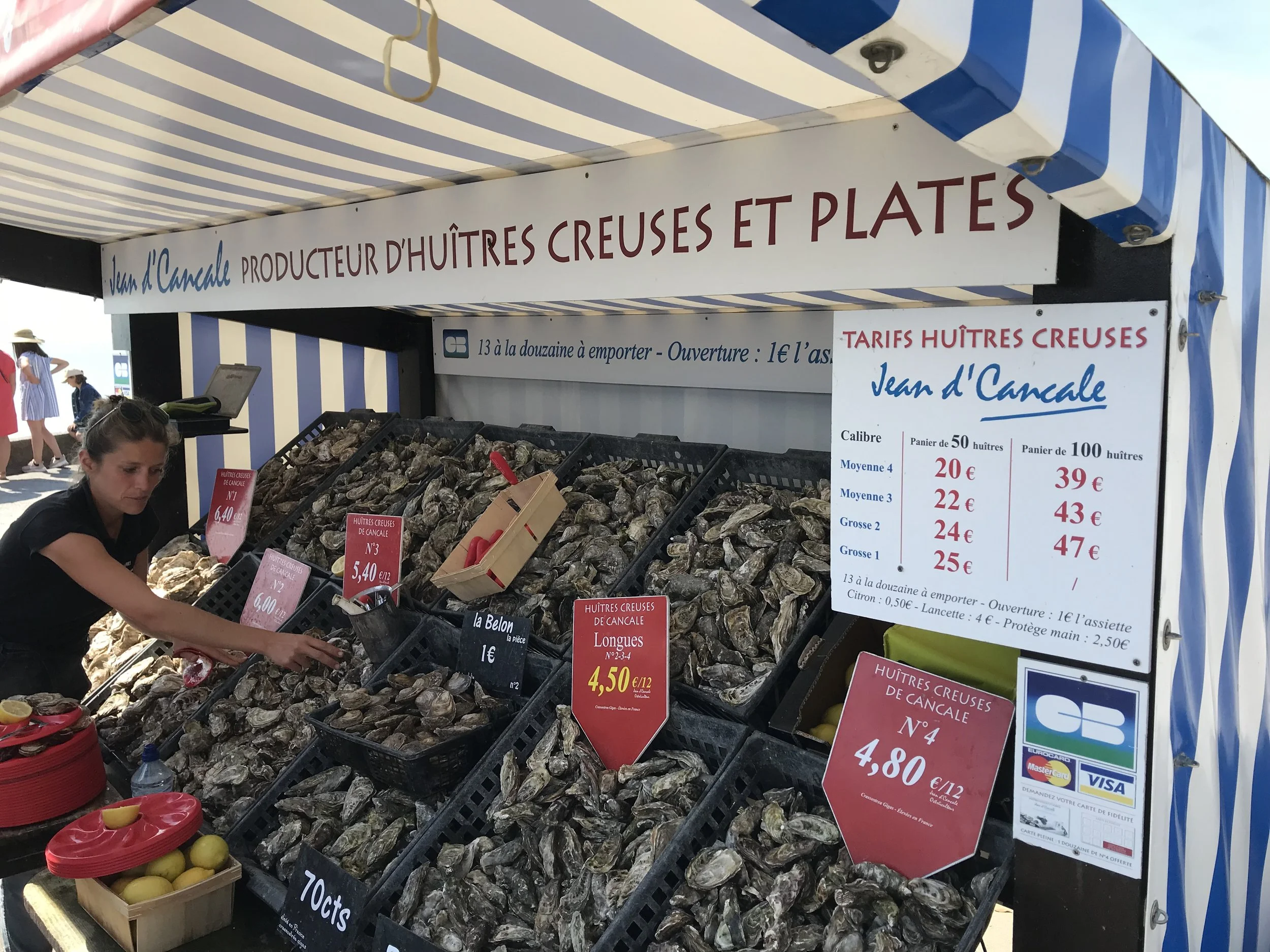
 There were lots of stands selling all kinds of oysters. If you couldn’t wait to get into town and hit a restaurant, you could hunker down on the beach with some treats from the market.

There were lots of stands selling all kinds of oysters. If you couldn’t wait to get into town and hit a restaurant, you could hunker down on the beach with some treats from the market.

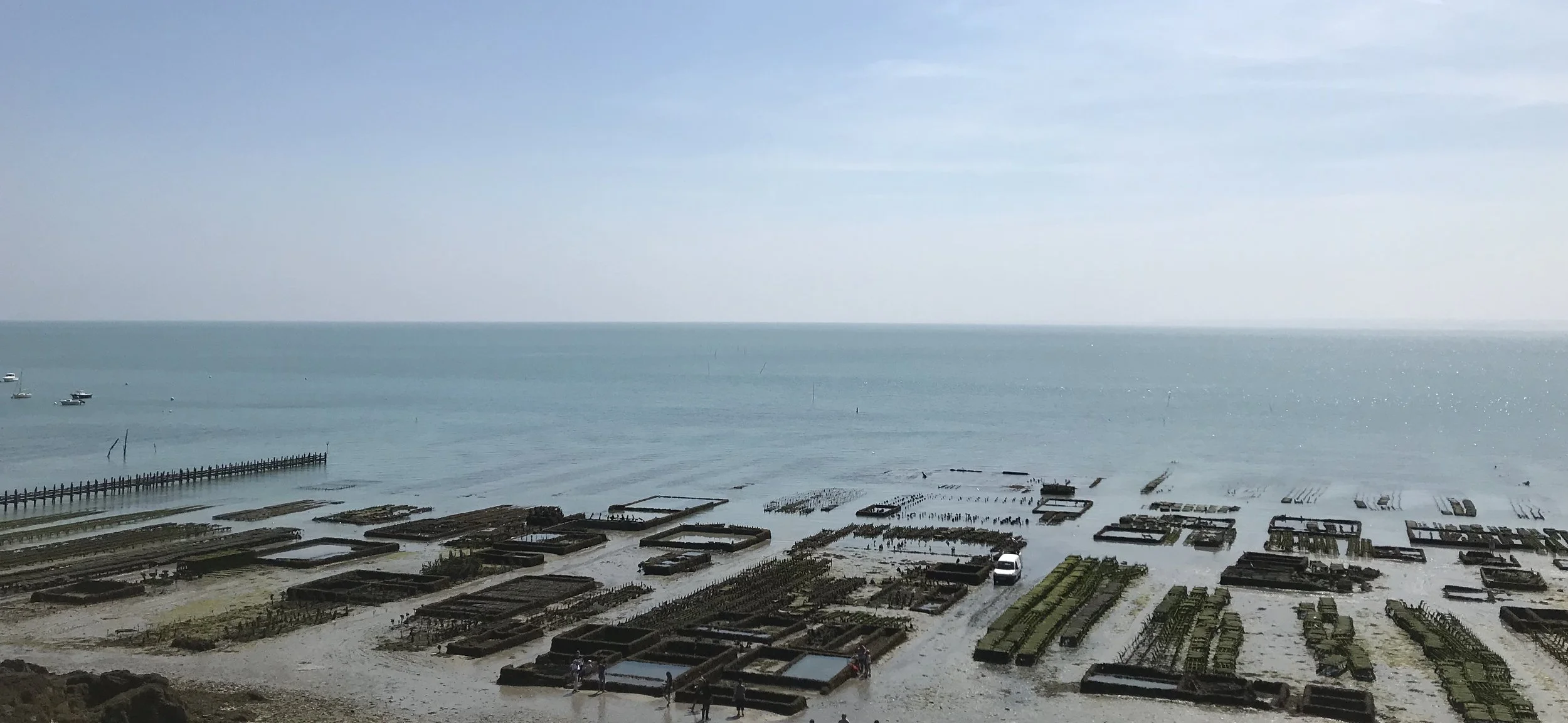
 You can get a good view of the many oyster farms at low tide. We learned all about the different kinds of oysters from our guide, and all of that information quickly went in one ear and out the other. All I can tell you is they tasted like when you

You can get a good view of the many oyster farms at low tide. We learned all about the different kinds of oysters from our guide, and all of that information quickly went in one ear and out the other. All I can tell you is they tasted like when you get jumbled up in a ocean wave and swallow some water. Just that salty and fresh.

As luck would have it, our trip to France was perfectly timed. First off, we were there before schools in England and France had closed, so it wasn't crowded. Also, the early summer weather in Brittany - usually just as unpredictable as Amsterdam's - was as uncharacteristically warm and glorious as the weather we left behind. And most importantly, we were there in time to celebrate both Bastille Day, or La Fête Nationale (National Celebration) on July 14th, and France's glorious victory in the World Cup (more on that later) the very next day. Despite the fact I majored in college in the History and Literature of Great Britain and France, I couldn't recall - as I watched the old and young of Saint-Malo and everyone in between gather to watch the feux d'artifice (fireworks) - if Bastille Day commemorates the start or the end of the French Revolution. Zut alors! 

Turns out, it was neither, and instead marked a turning point in the Revolution. The people of Paris stormed the Bastille, a symbol of the monarchy, and released all the political prisoners. All seven of them. Still, it was and continues to be cause for celebration throughout France. I thought back to Bastille Day two years ago, when Rachel and I had just left Nice and there was a terrorist attack during the celebration there. A Bastille Day without violence was certainly something to celebrate this year. 
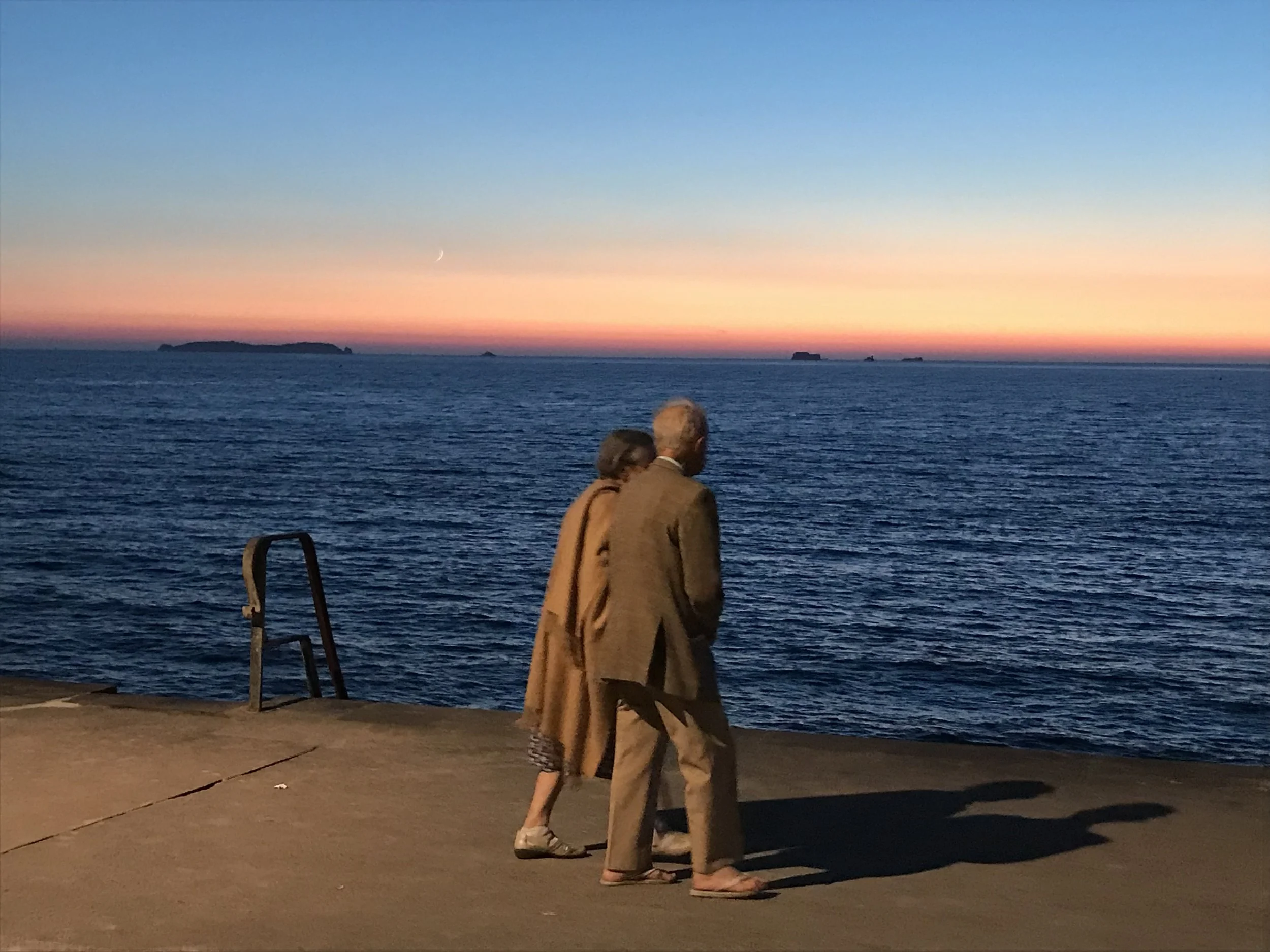
This couple came out for a stroll before the Bastille Day fireworks. I hope this will be Peter and me someday.

This couple came out for a stroll before the Bastille Day fireworks. I hope this will be Peter and me someday.

I seem to be lucky when it comes to France and football (soccer, to my U.S. readers). The same summer Rachel and I were in Nice, France was in the finals of the European Championship. That hot summer afternoon before the game, cars drove up and down the boulevard along the beach, honking and waving flags. It was the same boulevard the truck would use to terrorize and kill so many people just a few nights later. The night of the championship, I ended up back at the hotel, where I watched the game safely indoors. I thought it might be too crazy and chaotic out on the streets, especially at the end of the match. France lost to Portugal 1-0. There was silence afterwards.

Now fast forward to the finals of the World Cup. We left Saint-Malo and arrived in Paris just in time to watch the game. The streets were eerily car-less. In fact, we had to wait for over an hour to get a cab from the train station to the hotel. Everyone, it seemed, was gathering to watch "Les Bleus". But eventually we got a cab, and we made our way to a local café, where folks crowded around the large screen T.V. and celebrated. Afterwards came the cheering and honking and dancing. After all of the terrifying chaos in France over the last few years, they deserved this win and the chance to celebrate together. 
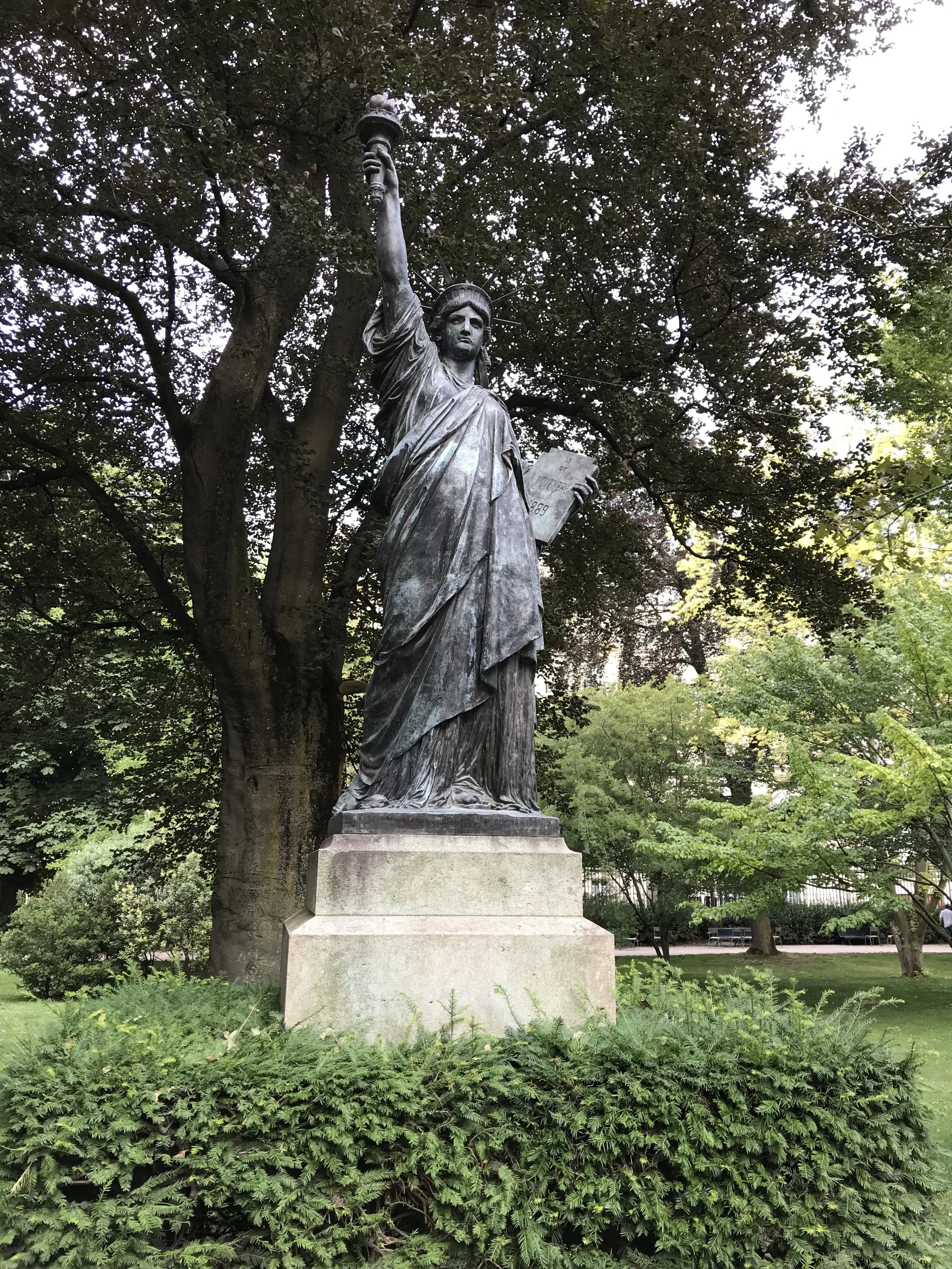
Look who I ran into in the Luxembourg Gardens the morning after the big win. And then while working on this post, the poem about her by Emma Lazarus showed up in my Poem of the Day email. Here's a line I like, although it's less famous than the "Giv…

Look who I ran into in the Luxembourg Gardens the morning after the big win. And then while working on this post, the poem about her by Emma Lazarus showed up in my Poem of the Day email. Here's a line I like, although it's less famous than the "Give me your tired, your poor.." one. "From her beacon-hand. Glows world-wide welcome." We're not exactly living up to that promise in the U.S. these days. 
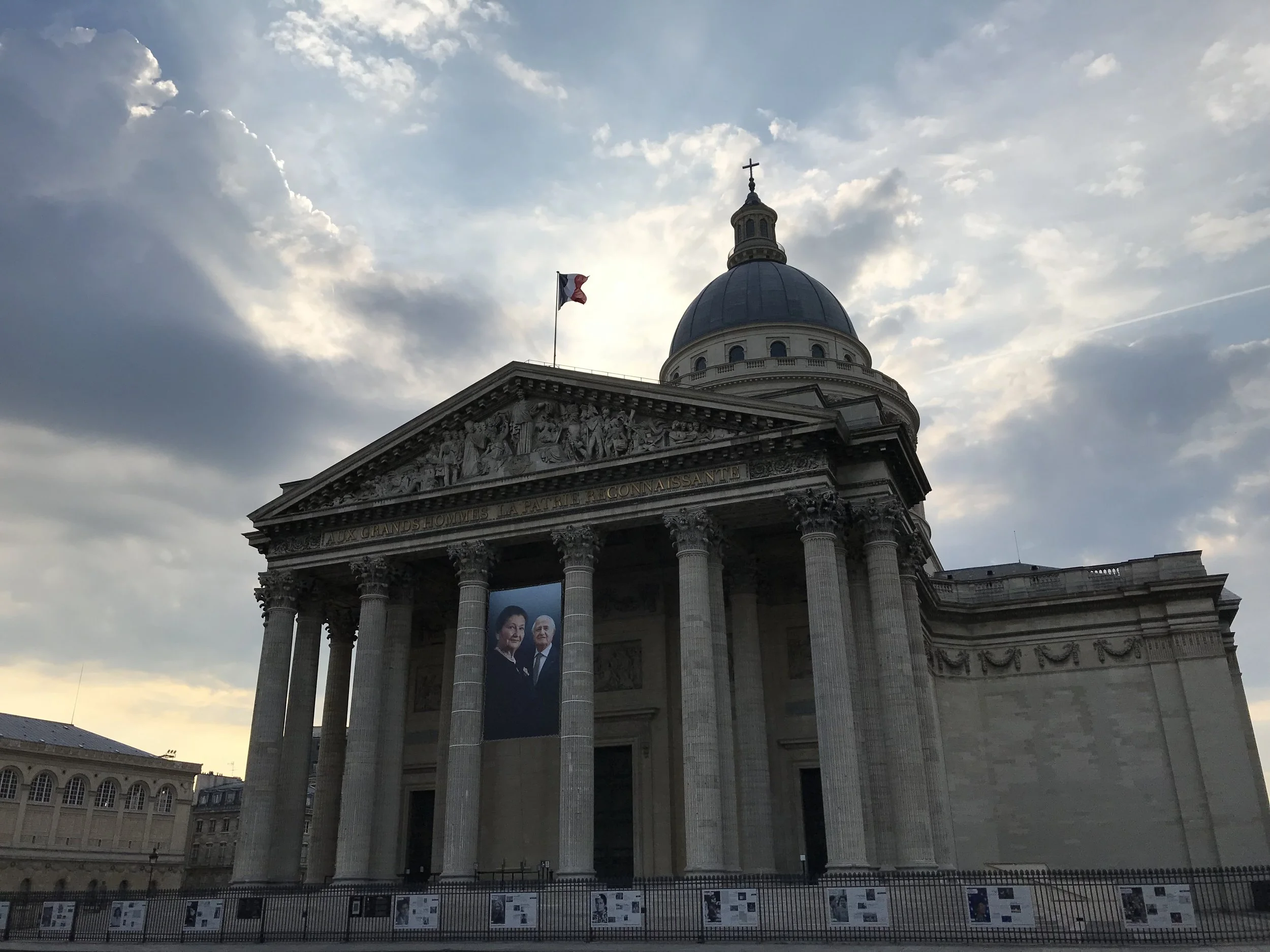
I also ran into a very moving exhibit at the Pantheon about the late Simone Veil. The first woman president of the European Parliament and the French Health Minister responsible for the right to choose an abortion in France, she and her husband were…

I also ran into a very moving exhibit at the Pantheon about the late Simone Veil. The first woman president of the European Parliament and the French Health Minister responsible for the right to choose an abortion in France, she and her husband were recently buried at the Pantheon. She is also a Holocaust survivor and the exhibit told about her efforts to keep her story and the story of her family alive by telling and retelling it. After the recent waves of anti-semitic attacks in France, it was particularly significant to see Simone Veil recognized for her accomplishments, with the ultimate honor of being interred at the Pantheon.

In the end, what did I learn during my return to Brittany? For one, your memories of a place might not exactly match up to what you actually saw long ago. Instead, your memories are a combination of what you wish the place was, and what it is. While I was writing this post, I thought back to a film I saw recently called A Foreign Field. It's about a small group of British and American WW II veterans who return to the beaches of Normandy as old men. It's about aging and memories and regrets and reconnecting to a place. Were it not for the cast, which includes Alec Guinness, Lauren Bacall, and Jeanne Moreau, it would at times have been just a sentimental trifle. But it made me think about what it must be like for soldiers to return to a place they haven't seen in so many years. And, of course, it made me think about my return, too. "Je ne regrette rien," ("I have no regrets.") Enjoy this gem sung by the eternal Edith Piaf.

Thinking back on my twin visits to Brittany separated by forty years, I realize I'm not the same person I was in 1976. Or am I? I thought about a short story I used to read to my students called Eleven, by Sandra Cisneros. The little girl in the story is turning eleven, but the story is about time and getting older, and realizing life is sometimes heartbreaking. At the start of the story, Cisneros writes, "What they don't understand about birthdays and what they never tell you is that when you're eleven, you're also ten, and nine, and eight, and seven, and six, and five, and four, and three, and two, and one." So even when you grow old, you might sometimes feel like the younger person inside of you. And later in the story Cisneros, or the little-girl-growing-up narrator explains, "Because the way you grow old is kind of like an onion or like the rings inside a tree trunk or like my little wooden dolls that fit one inside the other, each year inside the next one. That’s how being eleven years old is." So I went to Brittany and rediscovered the little wooden 16-year-old doll inside of me. That's a really good reason for revisiting some of the places you knew when you were young.

And with Rachel by my side, I became my 16-year-old self back in Amsterdam, too, at an outdoor Kool & the Gang concert. A celebration, indeed. I'm pleased to report they are still doing that happy dance with their feet.
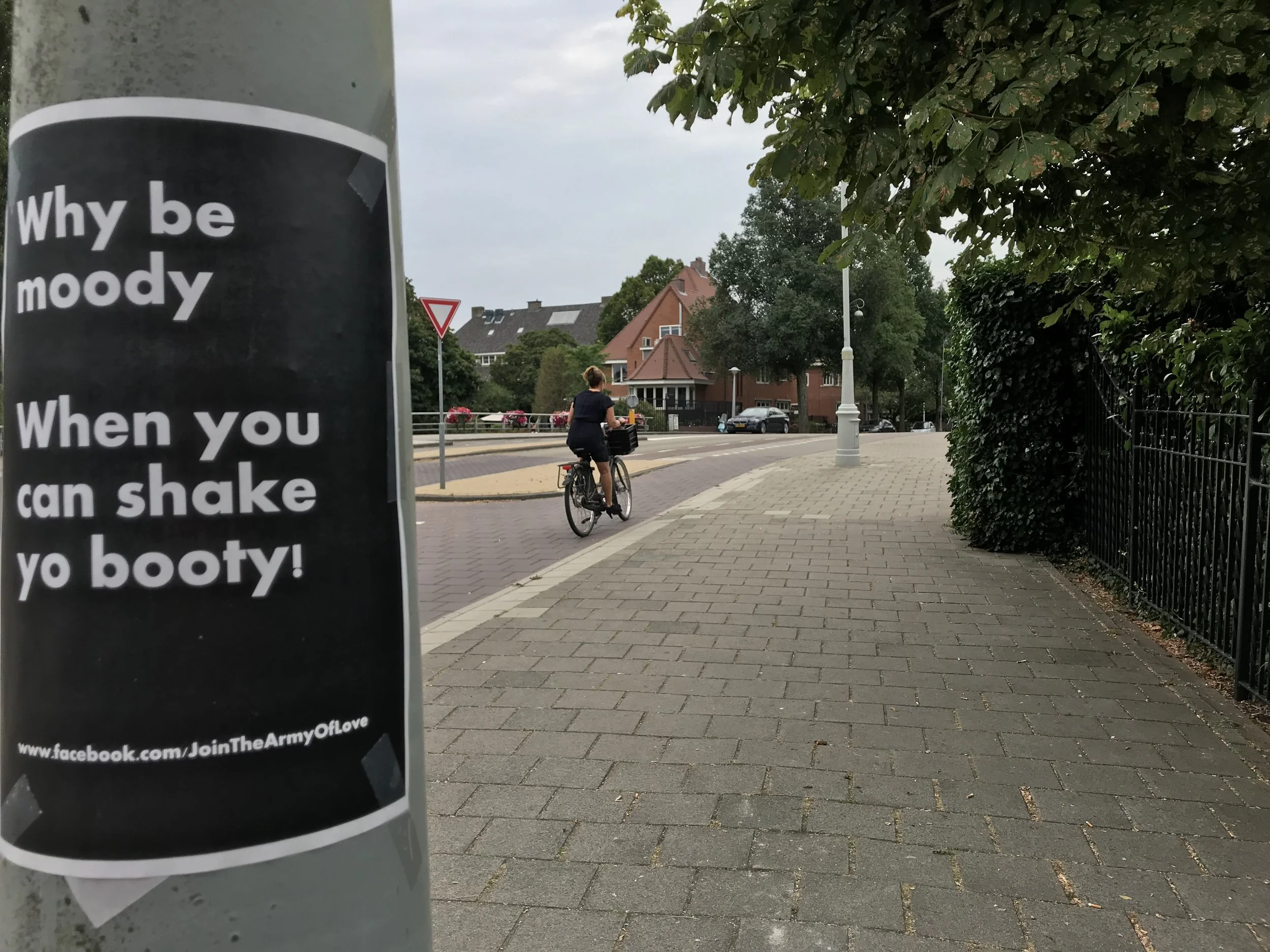
Spotted on my regular dog-walking route. Couldn't have said it better myself.
Spotted on my regular dog-walking route. Couldn't have said it better myself.

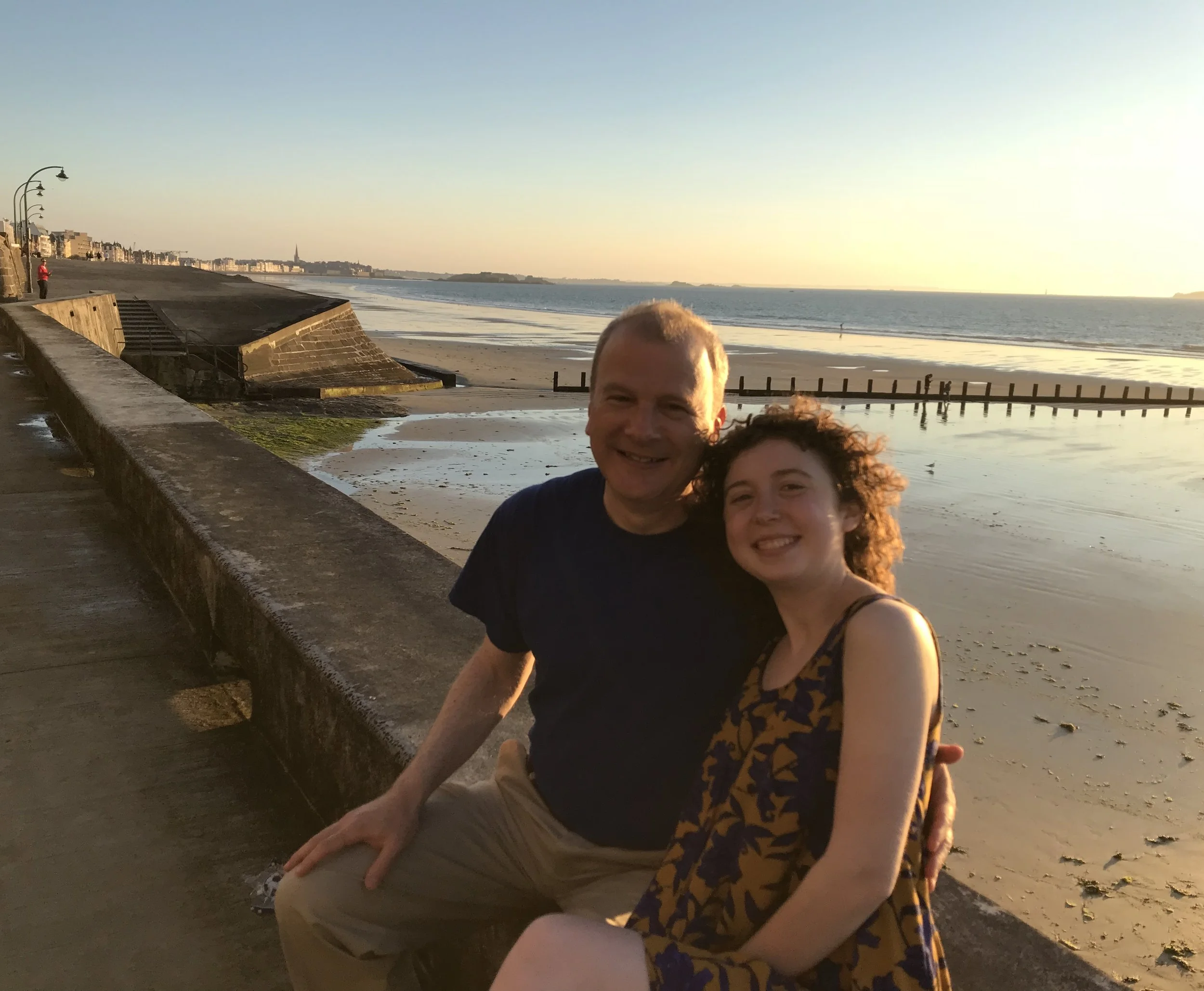
A rare father-daughter shot at the beach in Saint-Malo. Au revoir, Bretagne. A bientôt. Farewell, Brittany. See you soon.

A rare father-daughter shot at the beach in Saint-Malo. Au revoir, Bretagne. A bientôt. Farewell, Brittany. See you soon.

July 28, 2018 /Suzanne Vine
19 Comments
IMG_1719.jpg

Fifty Shades of Green: Getting My Irish On

May 28, 2018 by Suzanne Vine

About a year ago, after a weekend in Dublin, I confessed my secret crush on Ireland to all of you. I promised myself I would get back there, only this time, I'd get out of Dublin and into the countryside. I was armed with the names of towns I had pictured in my mind during a book group read of Colm Toibin's Nora Webster: Enniscorthy, Bunclody, Ballyconnigar, Curracloe. Truth be told, most of the book group members didn't like the book at all. I loved it. To me, it was pure Ireland: the family drama and trauma, the melancholy draped over every moment, the beautiful writing. And those place names.

But what's behind my fascination with this small country? I'm not even sure. It has just always been my thing. Or, as the Isley Brothers sing so perfectly below, it's my thang. And how different could it be from the small country I'm currently living in? Very different, I'd say. Let's take a look at some of the reasons for the crush and the ways I count in which Ireland is a different kind of place from the Netherlands. 

We can start with color. The greens of Ireland, especially in the spring, are like the varied green shades in the big Crayola Crayon box. The country's nickname, The Emerald Island, is well-deserved, but doesn't begin to do justice to what you actually see when you are there. It's not as if the Netherlands isn't green, but because it's so flat, you don't get the rolling hills and valleys that hold the shade or reflect the sun. Those hills make for the family of greens you see from the window of the train, or - if you aren't closing your eyes to ward off panic (more on that later) - from the car windows. 

After the green, you can't help but notice the gift of gab. Again, this is another familiar stereotype about the Irish, but it's one that rang (and rang and rang) true on our trip. We didn't make it to the Blarney Stone, but legend has it that if you kiss the Blarney Stone - as so many tourists line up to do - you will acquire the gift of gab. This gift is not easily bestowed on you. First you have to walk up to the top of the castle. Then you have to lay down and lean your head backwards, gripping onto an iron bar, and kiss the stone while your head hangs upside down. When my parents went to Ireland many years ago, my mother, despite her propensity to get dizzy, insisted on kissing the stone. If there is a person in the world who didn't need that stone in order to gab, it's my mom. But the story reminds me of her indomitable travel spirit, in which she channels her adventuresome, fearless inner-doppelgänger as soon as she hits a different country. We are still listening to the effects of that gift all these years later. 

Back to Ireland. The gift of gab greeted us on the first leg of the journey, a train ride from Dublin to Galway. I now know everything about the woman across the aisle from us and then some: everything from her battles with high blood pressure, to her favorite flavor of yogurt (vanilla). She was full of advice - all of it unsolicited, of course - and frequent explanations about Ireland and the Irish. As the train cut through the green hills, she explained how the yellow bushes we saw everywhere served as natural fences between fields and were "pie-zin" for the cows. After a few requests for her to repeat this insight, we realized she was saying "poison". I knew when it came time to write this blog, I would have to confirm her facts. It turns out that the bush is called furze, and it's definitely not poison. It can be used in salads, and to make tea. In fairness to our train companion, you (or your cow friends) can find yourselves in intestinal trouble if you overeat it. Maybe that's what she meant. But this fact-checking called into question every piece of long-winded advice we got on the trip. It did occur to me: the long Irish tales might just be for the benefit of the gullible Americans, who come expecting the gift of gab, and that's exactly what we get. Who said anything about accuracy? Honestly, this fits squarely with my definition of a story. If you have to bend the truth a little to tell a good story, where's the harm in that?

Throughout the trip, these words from the musical Hamilton kept coming back to me, "While we're talking, let me offer you some free advice: Talk less. Smile more." -from the song Aaron Burr, Sir.

IMG_4160-1.jpg
IMG_4163-1.jpg

At the fabulous Black Pig restaurant in the lovely seaside town of Kinsale, Peter chatted up our servers about the wine. When in Ireland....

I've written before about the difficulty of maintaining expat friendships once someone flies the coop (returns to the motherland). So when our former Amsterdam (now Boston) friends Deb and Marc suggested we meet them in Ireland, we knew we had to say yes. "Whenever you call me, I'll be there" has to be the motto, or your once-solid expat friendships will quickly melt away. I was re-introduced to this song during a recent flight back to the U.S. If you haven't already, see the film Roman J. Israel, Esq. It's memorable mostly for the soundtrack, but also for the chance to watch Denzel Washington disappear into the character. Getting to watch a lot of movies is the silver lining to the cloud of an expat's endless long flights across the oceans.

Our first stop after the gab-infused train ride from Dublin was Galway, a charming small city on the West coast of Ireland. We just missed the English singer Ed Sheeran's swing through town, which from the looks of things was a very big deal. Did he bring Saorise Ronan up on stage with him during the concert? Now that would have made it worth staying up past my bedtime for.

The winds in Galway reminded me of the Netherlands. I was afraid Deb would be picked up and thrown out to sea at one point.

The winds in Galway reminded me of the Netherlands. I was afraid Deb would be picked up and thrown out to sea at one point.

As you may have noticed by now, I like to pick out my apartment wherever we go. I liked this restored stone building along the River Corrib, which also rushed right outside our hotel window. It was loud, but beautiful.

As you may have noticed by now, I like to pick out my apartment wherever we go. I liked this restored stone building along the River Corrib, which also rushed right outside our hotel window. It was loud, but beautiful.

From Galway, we took a bus and then a ferry out to the Aran Islands. After all, when Rick Steves tells you to do something, and you're American, you obey. The long and fairly choppy haul out there all became worth it when we first heard and then saw the waves crashing through the rocks on the island of Inishmore. If you like sheep and cows, and green, of course, you will also love this outing. The islands are more than 350 million years old and are known for their Christian and Celtic monuments. We hiked out to the Black Fort (Dún Dúchathair) named for the black rocks you see, and practically had the place to ourselves. Luckily, the army of middle-school-aged boys on the ferry - who seemed to be accompanied by a single tired-looking young teacher ready to toss them overboard - did not choose this area to explore. Regrettably, we left the island without visiting one of the local cafes and tasting a slice of the Guinness chocolate cake. It came highly recommended by our friend Danielle. When you travel as an expat, you come armed with many, many recommendations from friends who have just been where you find yourself. You can't possibly follow-up on all their leads and still have time to find some on your own. First-world problems.

 Photo credit to Peter. His lack of fear when it came to getting close to the edge for this shot paid off.

Photo credit to Peter. His lack of fear when it came to getting close to the edge for this shot paid off.

 Many thanks to all of the Irish cows for all of the delicious butter we were served.

Many thanks to all of the Irish cows for all of the delicious butter we were served.

 And many thanks to all of the Irish sheep for the sweaters we all bought to remind us of the trip and to stay warm.

And many thanks to all of the Irish sheep for the sweaters we all bought to remind us of the trip and to stay warm.

One thing about traveling with friends is you do things you wouldn't ordinarily do. And that's good. So when Deb suggested we rent a car, something we usually don't do on our trips, we said yes. And then came the time for driving. It was pouring and foggy when Peter and Marc ventured out to pick up the car. When the rental car guy in Ireland tells you he wouldn't dare drive to the Cliffs of Moher in that weather, you listen. Or we did. Which brings me to another important thing about traveling. You always have to have a Plan B. We decided to skip the coastline drive and head inland to our next stop. Time to get this party started on the wrong side of the road and drive. Here's Shirley Bassey making this pop hit into a Bond-like anthem. 

 When your driver looks down at the dashboard as if it’s a foreign language he’s unfamiliar with, you worry just a little.

When your driver looks down at the dashboard as if it’s a foreign language he’s unfamiliar with, you worry just a little.

 But Marc was soon a pro, and knew to stop frequently both so we could get out and enjoy the green, and also so our heart rates could return to normal.

But Marc was soon a pro, and knew to stop frequently both so we could get out and enjoy the green, and also so our heart rates could return to normal.

 Nothing like a little laughter during my immature photo-bombing escapades to make the drive more relaxing.

Nothing like a little laughter during my immature photo-bombing escapades to make the drive more relaxing.

In our American-centric way, we tend to wonder why the Brits insist on driving on the "wrong" side of the road. Of course, the real question is why we came up with a different system after breaking away from them. It seems this left side of the road idea actually makes some sense. Apparently, it started hundreds of years ago, way before the invention of cars. Knights needed to have their dominate hand free to swing their swords at oncoming attackers. Because the majority of people are right-handed,  they "rode" on the left, leaving their right hand free to maim and kill. It seems things changed when Americans became the kings of car manufacturing and we made cars the "right" way. It's a wonder they agree to rent cars to Americans when we come to visit their neck of the woods.

Another nice thing about traveling in Ireland is you don't feel pressured to see this or that. We ambled along the narrow roads and decided to stop for lunch in a town called Ballylanders. It was the only restaurant in town. We felt like locals, until the folks next to us opened their mouths and we heard their Texan accents loud and clear. 

 I love all the church towers or small castles that dot the towns. This one was no longer in use, except as a photo opportunity after lunch.

I love all the church towers or small castles that dot the towns. This one was no longer in use, except as a photo opportunity after lunch.

Next stop: Kinsale. We were attracted by it's reputation as the food capital of Ireland, but we didn't know it would be beautiful, too. For those of you who think Irish food is a lot of potatoes and fried fish, you need to visit Kinsale. We ate like kings there. The town used to be an important shipping port, but that ship has long ago sailed. A few decades ago, the town reinvented itself as a food destination, with restaurants cooperating with each other by planning different vacation schedules and sharing advice. It seems good food has popped up all over Ireland these days, with other towns now proclaiming themselves "The Foodie Capital" of Ireland. I loved the stone boards with food-related quotes outside some of the restaurants in Kinsale. And at Poet's Corner, combining two of the loves of my life (books and coffee) there was this: "Food is meant to be read, books are meant to be eaten." Wise words, indeed.

IMG_1760-1.jpg
IMG_1764.jpg
IMG_1754.jpg

O.K. I know I agreed books are meant to be eaten, but this dessert at Kai Cafe and Restaurant in Galway - where the head chef just earned the best chef in Ireland award - was pretty as a picture and just as delish. This was just one of the masterpieces we were treated to during our visit to Ireland. 

IMG_1673.jpg

The bright-verging-on-garish colors that greeted us on the houses in Ireland were a surprise. Maybe it's their way of cheering things up during those drab grey days, of which there are no doubt many in Ireland. In the Netherlands, you rarely see this kind of color splash on houses. The colors in Kinsale were especially cheerful. We had great weather there, but I imagine in the winter, this eye candy is a really welcome sight.

IMG_1747.jpg
IMG_1708.jpg
IMG_1765.jpg
There was a vintage car show in town, so there was even more color than usual in the Kinsale hood.

There was a vintage car show in town, so there was even more color than usual in the Kinsale hood.

Just as stunning as the food and colors was the friendly, gracious service we found everywhere we ate. It wasn't just the gift of gab in the restaurants which seemed so very different from the Netherlands, although there were quite a lot of words served along with the delicious food. There was laughter at our humor, and plenty of funny banter sent right back at us throughout the evenings. The most outstanding example of the intersection of service, food, and sheer number of words you are greeted with in Ireland came when we stopped for ice cream in Kilkenny. At Murphy's Ice Cream, a few minutes before closing time, I thought the young man in charge might hustle us out and say we were too late to order. Instead, he plied us with samples of 3 or 4 varieties, chatting nonstop all the while. I think he would have continued along that route had we not ordered some Dingle Sea Salt and Irish Coffee and interrupted the flow of free samples. I know many people talk about the magic of Ireland (Celtic ruins etc.) but this was my idea of magic. Let's just say I have never experienced this type of friendly ice cream nirvana in the U.S. and certainly not in Amsterdam.

You can't write about Ireland without touching on the role of pubs in the country. You might think the friendliness I've just written about has something to do with the social lubrication caused by a few pints. On the other hand, would the local-ness of the pubs cause the Irish to ignore outsiders coming in to wreck their insider vibe? Since we were traveling with one of the world's foremost beerophiles (Marc), we had the chance to test these possibilities. In search of some authentic Irish music, we walked into a pub in Kinsale that looked about as local as they come. That was after we passed up the chance to hear a Billy Joel-wannabe delight the crowd at our hotel's bar. We poked our heads into the pub, feeling like Americans-out-of-water, mentally prepared to be ignored. Instead, we were greeted at the door by a man we first thought was a customer who had had a few pints too many. It turns out he was in charge of the place. He found an empty table for us and sent the waitress right over. Soon, we were pretending to sing along with the rest of the crowd. We were part of the family.

Marc is known for his frequent FB postings of the dark beer he adores. Here is a peek into the delicate behind-the-scenes work that goes into all those posts.

Marc is known for his frequent FB postings of the dark beer he adores. Here is a peek into the delicate behind-the-scenes work that goes into all those posts.

It wasn't all candy-colored houses and Guinness in Ireland during our visit. The upcoming vote to repeal (a "yes" vote) or keep (a "no" vote) the abortion amendment to their constitution was hard to ignore. There was something so jarring about seeing the pro and con posters everywhere we went. The further out of the cities of Dublin, Galway, and Kilkenny we got, the more frequent the often graphically disturbing anti-abortion posters seem to get. In an effort to support the repeal, many young people scattered around the world returned to Ireland to vote. They took to Twitter in droves to document their trip and spread the word about the need to vote. I guess they learned from the mistakes of Brexit.

IMG_1650.jpg

Because I took so long to finish this post, the vote is now in. The Irish voted to end the ban on abortion. With a gay prime minister, and previous votes to allow same-sex marriage and divorce, Ireland showed it is not the same place it was even a decade ago. The rest of the world paid attention to this vote, and I probably would have followed it even without the recent trip. But having just been to a place makes news that much more meaningful. Knowing about the debate made me also realize Ireland isn't a perfect place for everyone, by any means. It's easy to romanticize a place when you are only there for a few days. It's quite another to live there. I know. So does everyone living in the U.S.

Now back to the politics of expat travel: I've written before about the joys and sorrows of traveling in groups, something expats seem to do more than the average traveler. One of the advantages of group travel is those little travel mishaps we all experience become fodder for ongoing laughs (rather than arguments) when you are with friends. So when a carry-on bag is almost left behind in Dublin, nearly causing one traveler to miss the train...laughter; when a raincoat is almost left behind in a hotel closet, nearly causing one traveler to experience the catastrophe of Ireland sans raincoat)...laughter; and when the hedges on the left side of road are all neatly clipped by the car as we hurl past and you see the scratches on the car to prove it...laughter. A couple traveling on their own would have come to blows over any one of those events. Instead, they quickly became the travel stories we often repeated and won't soon forget.

One nice side effect of group travel is you have someone to take a photo of the two of you every now and again. Some of my favorite greens from the trip, at Fort Charles in Kinsale. And my favorite traveling companion, of course.

One nice side effect of group travel is you have someone to take a photo of the two of you every now and again. Some of my favorite greens from the trip, at Fort Charles in Kinsale. And my favorite traveling companion, of course.

And who better to share these travel stories with than ex-Amsterdammers? It's difficult work knowing how to maintain expat friendships. You used to spend a lot of time together. Now, what with the time difference, your time spent trying to stay in touch with family and U.S. friends, and your increasingly timid attempts at forging new friendships with expats, you have little time and energy left over for expats who have crossed over to the dark side, i.e. repatriated. Staying connected with re-pats requires a lot of emailing, messaging, and FBing to try to keep some semblance of a friendship patched together until you can see each other in person. We seem to have coopted the kind of screen contact with friends which our kids take for granted. The difficulty of keeping the expat friendship intact explains why so many of them fray after a short time. Traveling together gives you a lot of bang for your buck, and a chance to recreate the old days. You really hope those ex-expats are just the way they were. Or as the Irish Billy Joel at our hotel in Kinsale sang, "The same old someone that I knew." And Marc and Deb were. In a good way, of course. By the way, there's so much to love about this clip of Billy Joel, but my favorite is the hmhmhmhmhm humming. I just wish he had a towel with him up on stage.

The last stop on our Ireland trip was Kilkenny, because you have to see at least one castle while in Ireland, don't you? Kilkenny Castle - built by the Normans in the 12th century - is the main attraction in town, but it's also known for it's design center with lots of Irish-inspired crafts. We happened upon the town in the throes of some important rugby match on T.V., so there were a lot of drunk men stuffed into pubs, drinking and shouting. With all of them occupied inside, we had plenty of room on the streets, and time to stroll around and see the castle, enjoy the gorgeous grounds surrounding it, and take in all we could on our last night.

IMG_1801.jpg
 The type of hurling pictured here is an ancient Gaelic game which is still incredibly popular in Ireland. I’m sure there was some of the other sort after the rugby match ended, but by then we were safely tucked away in our hotel rooms.

The type of hurling pictured here is an ancient Gaelic game which is still incredibly popular in Ireland. I’m sure there was some of the other sort after the rugby match ended, but by then we were safely tucked away in our hotel rooms.

 This truly is the land of redheads. This little girl was celebrating something, I think. There were many more folks dressed up for church on Sunday morning than we see in seemingly god-forsaken Amsterdam.

This truly is the land of redheads. This little girl was celebrating something, I think. There were many more folks dressed up for church on Sunday morning than we see in seemingly god-forsaken Amsterdam.

 The church is getting in on the coffee business, it seems. This sign was posted on the walls of the grand cathedral in Kilkenny. Maybe they realize they need something to lure the new generation into church these days.

The church is getting in on the coffee business, it seems. This sign was posted on the walls of the grand cathedral in Kilkenny. Maybe they realize they need something to lure the new generation into church these days.

After these few days in Ireland, I was already mentally preparing a return visit soon. The green really does do the trick for your soul. I love museums and must-see places as much as the next gal, but a trip to Ireland gives you the chance to leave that kind of travel behind. Instead, you wander and look and take your time getting from here to there. For example, with a few hours to spare before we had to get back to the airport in Dublin, we stopped in a village called Glendalough at the Wicklow Mountains National Park based only on the last minute say-so of the hotel receptionist; we were so glad we followed her advice. We were greeted by mountains (unexpected by me in Ireland) in lovely shades of green (of course). I've waited long enough, but it's time to include this song by Joni Mitchell. I was obsessed with her music when I was in my early teens and fancied myself a musician. Thanks to the wonders of the Internet, I now know the song's about the child Mitchell gave up for adoption when she was only 22. 

In Wicklow Mountains National Park, Marc (bottom right corner) paid me back for my earlier immature photo-bombing.  

In Wicklow Mountains National Park, Marc (bottom right corner) paid me back for my earlier immature photo-bombing.  

Let's get back to the Irish writer Colm Tóibín before I say goodbye to Ireland.  I mentioned him at the start of this post. He's just one of the Irish writers who instilled this love of Ireland in me. In response to a question about the "quiet" style of his novel Nora Webster he said the following: "It’s all to do with landscape. The Irish light, the weather and the slow seasons lend themselves to a quietness of style." So true. In Ireland, it is "all to do" with landscape. Everyone could use a little green, and a little quiet (in between the gab), now and again.

lucky-charms-2.jpg

Maybe my love of the Irish started way before I could handle Irish literature. I yearned for this box on the supermarket shelves. Mom, did you have to insist on healthy cereal? I would have given anything for a bowl of this before school.

A toast to Ireland, to friends willing to travel with you, and, of course, to Irish butter. The best.

A toast to Ireland, to friends willing to travel with you, and, of course, to Irish butter. The best.

Photo credit to Peter. He really captured the magic of Ireland in this shot of Galway, didn't he?

Photo credit to Peter. He really captured the magic of Ireland in this shot of Galway, didn't he?

May 28, 2018 /Suzanne Vine
22 Comments
There are many grand buildings in Brussels repurposed as shopping arcades. This one was especially beautiful. So were the high end chocolates in some of the shops. 

There are many grand buildings in Brussels repurposed as shopping arcades. This one was especially beautiful. So were the high end chocolates in some of the shops. 

"Queen Bees and Wannabees": Why Brussels Doesn't Have a Buzz

April 05, 2018 by Suzanne Vine
Here's the Grote Markt in Brussels, the giant square with ornate guildhalls, the Town Hall, and a building known as the King's House. And a whole lot of tourists. More than a few people have suggested this is the only sight worth traveling to Brusse…

Here's the Grote Markt in Brussels, the giant square with ornate guildhalls, the Town Hall, and a building known as the King's House. And a whole lot of tourists. More than a few people have suggested this is the only sight worth traveling to Brussels to see. Why do so many Amsterdam expats give Brussels such low marks on its travel report card?

Little known fact: Peter is hard at work at this exact moment on groundbreaking research into an issue of paramount importance to all of us. His topic: what makes one place a must-visit, while another spot, sometimes right next door, is shunted to the side? When he's not immersed in this research, which he says may bring him the Nobel Prize, he dabbles in his "other" job, working for Akzo-Nobel, the Dutch company responsible for bringing us here. Let's take a look at his potential Nobel Prize-winning work. (Do they give Nobel prizes for important work like this?) We have to look no further than our own small neighborhood in Amsterdam for Peter's research; here, we can clearly see  evidence of the popularity principal at work.

The Italian restaurant on the corner is always packed. When I walk Casey in the evening, I can peek in and see crowded tables full of happy people. Sometimes, we are among those happy people and someone else is probably looking in at me. Just a short block away, there's another Italian place. There, you can always get a seat - any seat you choose. The owner, a friendly and dashing-looking guy I've nicknamed the Italian George Clooney, in contrast, is often sitting at a table outside with a cigarette while a few couples rattle around inside the largely empty restaurant. We have a special place in our heart for Italian George Clooney (a.k.a Bruno). When we were brand new to Amsterdam, he invited Peter over for a pasta-making play date. That came about because once while eating there, Peter complimented Bruno on the delicious fresh pasta. He admitted that although he loves to cook, he can't seem to master making his own fresh pasta. That led to Bruno inviting him to come learn one afternoon. To be fair, the folks at the popular place are also incredibly friendly. When Rachel was having difficulty walking, they asked every day how she was feeling. Both restaurants have my back when Peter is out of town and I'm in charge of the late-night walk. Especially when we were new in town, these were the people who at least knew who I was, and smiled at me. I'm eternally grateful.

But let's get back to the difference between these two restaurants which becomes even starker in the light-until-10:30 p.m. summer evenings. In the summertime in Amsterdam, when tables spill out onto the sidewalks, a restaurant's height on the popularity totem pole is there in full view for all to see. But just how does a restaurant- or a travel destination - get to the sunny side of the street?

And what explains the difference between the two places? It's not the food, since the food is as good or maybe a tad better at the lonely restaurant. Somehow, the popular place has acquired a buzz, and that buzz is self-perpetuating. You peek in and see it's full, and think, "Hey, that's a place I'd like to go." And when you peek into the other place, you wonder what's wrong, and why it's almost always empty. And then it becomes a self-fulfilling prophecy: the lonely gets lonelier, while the Queen Bee buzzes on. Before I go any further, I just want to let you know I did not make up the Queen Bee/Wannabe categories. They were created by Rosalind Wiseman, who wrote the book about middle school girl cliques: Queen Bees & Wannabes. Thinking about why one place is adored while the other is shunned reminds me of the power structure in middle school. Sorry to dredge up any bad memories you might have of that wonderful time of life.

IMG_1300.jpg
IMG_1301.jpg

Here's the quintessential theme song for those un-loved legions of restaurants, travel destinations, and, of course, people.

Now let's travel to Brussels, Belgium, which we did the other weekend. It's a short two-hour train ride away from Amsterdam, and yet a world away in terms of the buzz. Not a single one of our expat friends recommended we visit Brussels. This may have had something to do with the terrorist attacks in 2016, which certainly crippled tourism there. But fear of terrorism doesn't entirely explain the bad rap Brussels gets, and the bad rep it has. To the expat in Amsterdam, it's all about Bruges. And some of us may venture to Ghent or Antwerp, but never ever Brussels. We’ve heard it called boring and bland, and not worth even a weekend. And why is that? I watched this video when we first arrived in Amsterdam, and it was the first of many slings and arrows I heard slung about Belgium. Keep in mind the video was created by a Belgian.

How can two tiny countries who share a border, and a language - although only partly, since in some parts of Belgium they speak French, not Dutch - be so very different? Let's take a look at some of the ways these fraternal twins part company. First off, there's the Chocolate Tourism. We just don't have the chocolate selection that our neighbors in Brussels enjoy. 

 Loving chocolate as I do elevates Easter into a special time of year for me. I'll put aside the memories of the Easter-egg hunt I was invited to when I was 9 years old. Exhilarated by this new experience, I stuffed dozens of malted-milk balls i

Loving chocolate as I do elevates Easter into a special time of year for me. I'll put aside the memories of the Easter-egg hunt I was invited to when I was 9 years old. Exhilarated by this new experience, I stuffed dozens of malted-milk balls into my mouth as I hunted. That was the last malted milk ball this Jewish gal ever consumed. Lesson learned.

 Here's some anatomically correct chocolate. Let me introduce you to  Mannekin Pis  (roughly translated as Lil' Piddler, although that may just be his rap name). He's a small bronze statue/fountain who sprays water out of his equipment. Periodically,

Here's some anatomically correct chocolate. Let me introduce you to Mannekin Pis (roughly translated as Lil' Piddler, although that may just be his rap name). He's a small bronze statue/fountain who sprays water out of his equipment. Periodically, he's dressed up in various costumes. I'll show you that later in the post. According to the Brussels city website, he's a symbol both of Brussels, and of the Belgian sense of humor. You can find him by following the tourists who come to take his photo. Or you can buy the chocolate made in his image.

 These chocolate tools were so lifelike we had to take a second look to make sure they weren't really tools. The "rust" is cocoa powder. 

These chocolate tools were so lifelike we had to take a second look to make sure they weren't really tools. The "rust" is cocoa powder. 

Brussels also outdoes Amsterdam when it comes to flea markets. The Jeu de Balle Market has something for everyone. We didn't buy a thing, but enjoyed wandering the aisles looking through some nice finds (silver and pottery) and some junk. It's everything you want in a flea market. 

IMG_1239.jpg
 Lots and lots of musical instruments, including violins that made me feel guilty for not practicing.

Lots and lots of musical instruments, including violins that made me feel guilty for not practicing.

 Here, Jesus and GI Joe strike up a conversation. Only at a flea market!

Here, Jesus and GI Joe strike up a conversation. Only at a flea market!

We also visited the antiques flea market, Le Sablon, which catered to a more upscale crowd. The silver is polished and the goods are safely nestled under tents. it's in a lovely neighborhood, so it's worth a look. The manicured gardens in Brussels reminded me of Paris. I think in Amsterdam, we would see climbing equipment for kids, rather than sculpted bushes and statues. 

IMG_1250.jpg
 I don't remember ever seeing statues with their arms draped around each other. Correct me if I'm wrong.

I don't remember ever seeing statues with their arms draped around each other. Correct me if I'm wrong.

While Amsterdam has more than its share of wonderful museums, it doesn't have a lot in the way of street art. Brussels definitely wins on that score. I don't know why there is so little adorning the buildings and walls in Amsterdam. It makes walking around and suddenly coming upon it so much fun. And it adds color to the drab days of Winter. And Spring. And Summer. And Fall.

IMG_1270.jpg
IMG_1272.jpg
IMG_1231.jpg
IMG_1230.jpg
IMG_1273.jpg
IMG_1248.jpg

The architecture in Brussels is like a mash-up of Amsterdam and Paris. There are a lot of Flemish- style buildings, but also the grander ones that remind me of Paris. Hard to choose between the two. It depends on my mood.

IMG_1256.jpg
 These weren't just gargoyles, but full on sculptures adorning this building. Stunning, to quote my friend Vera!

These weren't just gargoyles, but full on sculptures adorning this building. Stunning, to quote my friend Vera!

 Here's the  Grote Markt  in Brussels, the giant square with the stunning architecture. More than a few people have suggested this is the only sight worth traveling to Brussels to see. 

Here's the Grote Markt in Brussels, the giant square with the stunning architecture. More than a few people have suggested this is the only sight worth traveling to Brussels to see. 

What else does Brussels have to offer the jaded expat traveler? There’s beer of every sort, fries, and waffles for low budgets; and shining Michelin stars for high budgets. In fact, a French colleague of Peter’s told us he thinks the restaurants in Brussels are better than what Paris can serve up. Mon dieu! Scandalous words for a Frenchman to utter. We did have some delish French food over the weeeknd. I appreciated the chance to cobble together an understanding of the menus, which were in French and Dutch. I speak passable restaurant-French and restaurant-Dutch. It’s when I have to do something other than eat that I’m often lost. It wasn't just the food, but also the friendly service that stood out in Brussels. I've written quite a bit (O.K., a whole lot) about the somewhat lackadaisical and sometimes curt/rude service in Amsterdam. Even my Dutch friends and colleagues say you just need to cross the border into Belgium and you'll find a world of difference. I smiled when I saw all the buzz this French waiter recently received for his rude attitude. For those of you not following this headline news, a waiter born in France and working in Vancouver was fired from his job for being rude to customers. He filed a complaint against his employers, alleging he wasn't being rude...he's just French. Anyhow, even if this stereotype is still somewhat true in Paris (and some would say it isn't), you can go to Brussels to get your French food served with a smile.

Here's Mannekin Pis, the symbol of Brussels I mentioned earlier. It's also the name of my friend Seanette's favorite frites place in Amsterdam. Now that I  know what it means, I won't think of those fries in the same way again. Ever. 

Here's Mannekin Pis, the symbol of Brussels I mentioned earlier. It's also the name of my friend Seanette's favorite frites place in Amsterdam. Now that I  know what it means, I won't think of those fries in the same way again. Ever. 

Here, Mannekin Pis seems to be dressed as the pope. He has also been dressed as Elvis, Nelson Mandela, and a Tour de France cyclist. Sometimes he's decked out in outfits to call attention to serious issues, like AIDS and the living conditions for farmers in Africa. For those of you with an interest in fashion, here's some photos of him in his various costume changes. 

And when you are too full to fit in another morsel, you can window-shop for lace. I’m guessing there used to be much more of it on display, but now just a few relics hang in there, nudged aside by all of the chocolate, the fries, and the beer. Again, who knows why lace is such a Belgian thing. Didn’t people in the Netherlands also want to get in on the lace-making gig? By the way, I don’t remember seeing a multiracial window display at a lace shop until I happened upon this one in Brussels.  

IMG_1217.jpg

Brussels is also home to the Magritte Museum, with the largest collection in the world of this Belgian surrealist painter's work. Amsterdam may have Rembrandt and Van Gogh, but the Belgians have not just Magritte, but their beloved comic book stars, including Tintin, and the blue guys who made it to American T.V: the Smurfs. In fact, Belgium is known as the birthplace of the comic strip. There's even a museum devoted to comic strips, but we didn't make it there. Even without a trip to the museum, you can spot some of those comic strips right up on the walls of the city, so you can enjoy them as you walk around.

magritte-11768digi-l_small@2x.jpg
magritte-11719dig-l_small@2x.jpg

There's something both unnerving and calming about Magritte's paintings. I don't think I understood the message behind any of them, but I tried.

IMG_1237.jpg
IMG_1235.jpg
Here's a Belgian comic book I spotted at the pharmacy earlier this week. From the looks of it, the term Belgian humor may be an oxymoron (in the same way the phrase "Dutch humor" strikes us Americans as hilarious). 

Here's a Belgian comic book I spotted at the pharmacy earlier this week. From the looks of it, the term Belgian humor may be an oxymoron (in the same way the phrase "Dutch humor" strikes us Americans as hilarious). 

You'd think with its relatively flat terrain, Belgium would share in the bike culture the Netherlands is so famous for. Yet I saw very few cyclists in Brussels and even fewer bike lanes. Actually, the lack of bike lanes probably explains the dearth of cyclists. Brussels is a much bigger city than Amsterdam, so I suppose more people use public transportation to get around. And cars. The traffic was terrible.

Aside from the trivial differences between Brussels and Amsterdam, there is one glaring difference: the homeless problem. In Brussels, there were not just homeless men with sad-looking dogs on many corners, but also families with small children. Heartbreaking. I’m not sure if they were refugees, but I suspect they were. We just don’t see that in Amsterdam. So what is Brussels doing wrong, and why don’t they reach out to their neighbors in the Netherlands for help in addressing the problem? When I feel cranky and complain about some of the annoying habits of the Dutch, I need to remind myself they do take care of people who have nothing. It is rare to see someone here who is clearly homeless, although this article explains that there were 74% more homeless people in the Netherlands in 2016 than in 2010. If that statistic is accurate, then the problem must have been non-existent earlier. So it’s all the more noticeable when we travel - especially in the U.S., but also in Paris and London, and other European cities - that more and more people are living on the streets. They must be doing something right in the Netherlands.

In the end, the decisions we all make about where to go and what to eat aren't even always our own choices. So much of what we "choose" these days is influenced by the endless Instagram posts we see, or the FB and Trip Advisor ones for those of us of a certain age. There are two sides constantly at war within us: the need to experience those good things in life everyone covets, and the desire to forge out on our own and find those things ourselves. I'll admit I'm a bit too swayed by the waves of popular trends. For example, I had to go check out The Avocado Show, that darling of the millennial/Instagram crowd, an Amsterdam restaurant whose trendy menu consists of only avocado dishes. I didn't love it and won't go back anytime soon. Some people decide to consciously go in the opposite direction of the "in crowd", avoiding that ramen place everyone is raving about just because it's that place. 

Speaking of millennial heaven: if you do go to Brussels, check out Peck 47 for brunch. Everything tastes better in a Mason Jar, doesn't it? And what is more hip than a poached egg? This one was served on a savory waffle. I think you don't dare visit…

Speaking of millennial heaven: if you do go to Brussels, check out Peck 47 for brunch. Everything tastes better in a Mason Jar, doesn't it? And what is more hip than a poached egg? This one was served on a savory waffle. I think you don't dare visit Brussels without having at least one waffle. You can get to this terrific little restaurant at the early-bird opening time like we did and avoid the long line that forms later on.

Those avoiders are the same folks who swear they won't see Hamilton. I have to admit when I read about the crazy prices people were paying, I said to myself, "I'm not going to play that game." Then my friends Seanette and Richard, who moved to London, scored some tickets to the show, which opened there in January. Instantly, my resolve to stay out of the whirlpool that is Hamilton all went down the drain. For those who have seen the show, or just love the music, I was not throwing away my shot. Can it possibly be as good as they say? I'll let you know. Future blog post? Back in 2001, the Producers became the first Broadway ticket to top $100. Those were the days, my friend. Peter and I wondered if that show could possibly live up to all the hype, but we treated ourselves to tickets, and are so happy we did. And now we're hoping for the same happy ending after we see Hamilton. The buzz surrounding The Producers would be drowned out by Hamilton's deafening roar.   
I can really relate to this lyric: "You know I'm just like my country: I'm young, scrappy, and hungry, and I'm not throwing away my shot." O.K., I'm not young. But I think I'm usually scrappy. And often hungry.

Who remembers this slightly less famous cultural offering, the movie Mahogany? My friend Sabrina and I chose to see it instead of some highbrow film her parents were going to see. Oh, the choices a pair of fifteen-year-olds can make. "Do you know where you're going to? Do you like the things that life is showing you?" I don't regret that choice one bit, although it does make me smile when I think about it. And nowadays, I don't always know where I am going, but I certainly do like the things that life is showing me.

I'll leave you with one of the great songs about choices, from one of my favorite T.V. shows back in the day (the late 60's): Greenacres. Nowadays, I think they would have chosen that pent-house view. Even when I was a kid, I was bothered by the notion that the husband got to make the choice. "You are my wife" and then the immediate response: "Goodbye, city life." That just wouldn't fly these days. Ideally they would choose the green acres and the city-life. Those folks were rich enough to afford both. 

Expats are known for their lists of want-to-see places, the buzzier the better. Those lists seem to grow longer the longer we stay and the more traveling we do. Peter, by the way, refuses to call these lists "bucket lists". Those are lists for people who are going to soon "kick the bucket", he points out, although this article suggests the original meaning has now evolved- maybe by constant misuse? - to mean the list-of-stuff-you-want-to-do-in-your-lifetime, no matter what your age. For expats, the time frame and scope has shrunken to: the-other-places-you-want-to-visit-while-you-live-abroad. The Bucket List just might just be the subject of a future research project for Peter.

However, before I contemplate the bucket issue, I'm still figuring out what factors lead to the coronation of a queen bee, and what leads another spot to be designated the lonely has-been. Stay tuned for Peter's insightful treatise on the subject. Until then, I say "Take tips from people you trust, but also see for yourself what is out there in the world." We have friends with stronger geographical opinions than mine, who write off places they have been. They usually trot out their anti-recommendations after you have already expressed interest in going: "We didn't like Stockholm... or Berlin." etc. To borrow a sentiment - albeit on a different, racier topic - from Woody Allen's film Manhattan, Peter and I haven't ever had the wrong kind of travel. "The worst one was right on the money." Sometimes you have to seek out your own buzz and give the Brusselses of the world a chance.
This title, and the author's name for that matter, are already taken, so he'll have to come up with something a bit different. We'll keep you posted.

This title, and the author's name for that matter, are already taken, so he'll have to come up with something a bit different. We'll keep you posted.

"I don't want to bore you with my troubles, but there's something 'bout your love that makes me weak and knocks me off my feet." Doesn't get much better than that. I don't want to bore you with my blogs either, but thanks for reading.

Happy Spring, from Amsterdam!

Happy Spring, from Amsterdam!

April 05, 2018 /Suzanne Vine
23 Comments
No one is growing old more gracefully than this guy. He's 15, and although he sleeps more and gets up with creaky slowness these days (I can relate), he can still polish off a bowl of food like a teenager (I can also relate). One measure of how long…

No one is growing old more gracefully than this guy. He's 15, and although he sleeps more and gets up with creaky slowness these days (I can relate), he can still polish off a bowl of food like a teenager (I can also relate). One measure of how long we have been gone, and how old Casey is, are the frequent FB posts about his dog contemporaries dying. Too sad to think about, so I won't.

Growing Old (Gracefully?) in Amsterdam

March 04, 2018 by Suzanne Vine

I usually don't dwell much on getting older, but this birthday seemed different somehow. Maybe it's because my sister - who is only a splash older than I am- recently turned 60. That milestone is soon going to be knocking on my door. Maybe it's because I recently became a great-aunt. The picture I have in my head when I hear the word "great-aunt" is of my Aunt Rose, the matriarch of our family. In our house, she was like Queen Elizabeth to the English people: what she said we instantly respected. In her book, no meal was complete without jello. And because of that wisdom, we suffered through many a meal with various brightly-colored jellos with mysterious sorts of canned fruits suspended in them whenever Aunt Rose was a guest. Maybe my preoccupation with aging comes, well, just because I am getting old. I recently heard someone explain the way her elderly mother's doctor discusses aging. Rather than say, "As we grow older...", he prefaces his elder-care advice with the much more graceful, "As we celebrate more birthdays...". So, in that spirit, I write this month about celebrating more birthdays Netherlands-style. In other words, let's take a look at how the Dutch deal with their residents who have celebrated a lot of birthdays. How a country deals with its elderly population should tell us a lot about that country and its values. 

Before we look at the Dutch, let's take a peek at the aging expat. In some ways, moving abroad has frozen us in time, or even sent us coursing back to our college days. That's because, just like when we were in college, expats live in close proximity to lots of people a lot like them both in terms of age and also in terms of interests. We have free time to explore, go out to dinner, and try out the wines from the countries so close we can practically touch them. So sometimes, you have the illusion you are much younger than your birth certificate - or the mirror - tells you. One big difference is that unlike in our college days, now we have money to spend. I imagine when we move back to the U.S., we will think back fondly on these carefree expat days, forgetting any of the problems, just like we did with college memories. "Those were the days, my friend. We thought they'd never end." I love that upbeat- sounding part of the song. It does get a little more real and melancholy, of course: 

"Just tonight I stood before the tavern
Nothing seemed the way it used to be
In the glass I saw a strange reflection
Was that lonely woman really me?"

You may be thinking my ability to ramble is starting to betray my age. Let's get back to the topic of the Dutch seniors in the Netherlands. They say that 60 is the new 40, or something like that. They also say, "You are only as old as you feel." From the looks of things here, the senior set feels pretty young. I see them riding on bikes, skating (on rinks, not on the canals, Katie Couric) and trudging through the city on foot. While biking has taken hold in the U.S., you certainly don't see many elderly people getting around on bikes there. Here, it's a common sight. Is that safe? It seems that the majority of bike fatalities on the recently popular e-bikes involve elderly riders. For those of you who don't already know, an e-bike is a bike powered by electricity and by your own two feet. It's like having a big hand pushing you forward, just when you need it. Soon after we moved here, I was passed - on what counts as a steep uphill here (a bridge) by two older riders. Once I swallowed my pride and looked closely, I realized they were on e-bikes. It makes sense that there are more accidents involving e-bikes with elderly riders, because they no doubt make up the majority of the e-bike rider population. The head of the Dutch police road safety unit has called for elderly cyclists to take a course to learn to ride their new-fangled toys. Hopefully that will help make e-bikes safer for riders-of-a-certain-age.

I spent a few days in our neighborhood just missing out on photos on all manner of dapper older men and women on bikes. By the time I got my iPhone out to snap the photo, these surprisingly speedy riders were already well past me. I finally managed …

I spent a few days in our neighborhood just missing out on photos on all manner of dapper older men and women on bikes. By the time I got my iPhone out to snap the photo, these surprisingly speedy riders were already well past me. I finally managed to get a shot of this guy. I was particularly impressed by his cycling not just because he was biking on a day that was snow-covered, but also because it was about 20 degrees outside. Maybe old people (notorious for wearing sweaters in the dead of winter in Florida) are at an advantage when there's a polar vortex in town.

In addition to the proposed e-bike classes, there are apparently classes here for learning how to fall safely. This recent article in the New York Times made readers in New York City very envious. Apparently, there are enough such classes now in the Netherlands that the government rates the effectiveness of each. I especially love the last photo in the article, in which a dozen or so elderly people are splayed out on gym mats. They looked like they have dozed off, or worse. I plan on following David Bowie's approach to getting old: "Put on your red shoes and dance." O.K., he wasn't writing about getting old, but it's good advice nonetheless.

Thanks to my Dutch friend Johanna - it's a sad state of affairs that I can count my Dutch friends on a few fingers, but that's a subject for a later post - I have some insider information about elder care in the Netherlands. Unfortunately, she knows firsthand what happens when older people can no longer safely live independently in the Netherlands. She explained to me that in general, the Dutch government wants elderly residents to live at home. Until recently, they provided more money to help pay for that care. Recently, due to budget cuts, the role of "organizer" of all the home-care services has turned into a volunteer position. The Dutch word for the role, is mantelzorger, literally coat-carer. Johanna is the coat-carer for her parents, making contact with all the service providers and ensuring they all arrive when they are supposed to. If the elderly person has no child, this role sometimes fall to other family members, friends, or in some cases, even neighbors. Before her parents entered an nursing home, their insurance paid for home-care. That included someone who came to the home for help with cooking, taking medications, and bathing. The neighbors also came in to help, since Johanna lives in Germany and her parents are in the Netherlands. There were some near-accidents, and then one day, her dad fell down the stairs. At that point, her parents finally reluctantly agreed to live in a nursing home. In the Netherlands, a person must give their consent to living in a nursing home. An official visited their home three times. Had it not been for the fall down the stairs just before the third visit, they may never have consented. Although the Dutch are notoriously non-litigious, families can resort to a court proceeding if living independently at home poses a danger to the elderly relative. I had some notion that nursing homes here were far superior to ones in the U.S. Johanna explained that in her experience they are understaffed, not as clean as she would hope for, and not the centers of activity I imagined. She describes the place she finally settled on for her parents as "a sad place" and wishes she could find a small house for her parents with a live-in care-giver. Unfortunately, she said, those people are hard to find.

It seems my assumption that elder care was far superior in the Netherlands to what we have in the U.S. is not really accurate. U.S. News and World Report ranked the Netherlands #6 on a Best Countries For Aging List. The U.S. comes in at #9. They looked at factors like access to health care, social connections, and financial stability. If those rankings are as suspect as the college rankings they come up with, we should read them with a grain of salt I guess. 

I remember the days when 64 seemed so impossibly far away. Those were the days, my friend.

I'm completely out of my element when it comes to dealing with the elderly. I've spent my working life with children, who also happen to be closer to my maturity level. My sister Jennifer, on the other hand, has devoted her social work career to the other end of the age spectrum. She has been the head healthcare social worker at a retirement community in Towson, Maryland for over 30 years. However, her focus on the elderly began long before that. From the time she was a child, she has followed the habits of the senior set: early-bird dinner time, early bedtime, and early rising. She's probably the most selfless person I know, so being a social worker is part of her DNA. We used to joke that the game we played with the buttons on our clothes: "Rich man, poor man, beggar man, thief, doctor, lawyer, Indian Chief" meant that she was really an Indian Chief, since my brother is a doctor and I was a lawyer. Whether Indian Chief or social worker, her selflessness serves her well when dealing with the endless problems she has to solve on a daily basis. She understands what makes seniors tick, and how to help them enjoy their last act. The world could use more Jennifer Vines.

A lifetime of wearing matching outfits meant I wore mine, then I wore Jennifer's when she outgrew hers. Thanks, mom.

A lifetime of wearing matching outfits meant I wore mine, then I wore Jennifer's when she outgrew hers. Thanks, mom.

My sister is the one who sent me this article about Hogeweyk, nicknamed the "Alzheimer's Village", a residential facility in Weesp, just outside Amsterdam. The common areas are designed so people with memory loss can find their way to places like the on-site grocery store and restaurant. Residents choose from among various "lifestyles", with decor and food to match the style you choose. Your options include "Cultural" (for residents who like art and literature) which means you go to concerts and museums and get wine served with your dinner; "Indonesian" (for residents who have a connection to Indonesia), with Indonesian food served most of the time; and "The Gooise" lifestyle for "posh people". Hogeweyk's website explains that residents who choose The "Gooise" lifestyle "favor French cuisine and enjoy going out for dinner as well." For those of you who don't live in the Netherlands, Het Gooi is a wealthy area about a 30 minute drive from Amsterdam. I "visit" it regularly, thanks to my friend Vera who introduced me (and a bunch of other American gals) to the T.V. series Gooische Vrouwen. It's the Dutch version of Desperate Housewives/Sex in the City, and we watch it (allegedly) to practice our Dutch. If I ever had to live at Hogeweyk, I would definitely not live in "Gooise". I'll take the Indonesian lifestyle with the Indonesian food instead, please.

Another interesting experiment in housing, Amstelhuis, allows seniors ages 70 and above, "with or without care needs" to live right on the banks of the Amstel River in Amsterdam. There, residents have access to cultural, social, and health programs in a shared meeting space which also boasts a spectacular view of  the river. The program is not just a residence for the elderly. It also serves as a "practical environment" for the Amsterdam University of Applied Sciences (AUAS). Students, lecturers and researchers work together to organize activities for the residents, who are part of a "living lab". I recently peeked in the floor-to-ceiling glass windows at the facility and saw a chamber music group playing to a large group of elderly people. Only a few had their eyes closed. Most were completely engaged. It looks like a really nice place to call home.

When I wrote last year about the healthcare system here, I included some information about innovative programs designed to benefit both the elderly and young students. At a TedEx Education conference I attended, a young man spoke about his experiences living in a retirement home. The students live rent-free in exchange for their commitment to interacting with the elderly residents. The purpose of the arrangement is to provide the elderly with contact with young people. Most people praise the young man for sharing his time with the elderly. He explained, however, that he gets back much more than he gives. I'd say it's an even trade.

There are certainly some wonderful places in the U.S. for elderly residents to call home. My sister works in one. The first part of the video, below, shows some music students who live in Edenwald, the facility where she works. It's a similar program to Humanitas, the intergenerational residence in the Netherlands I just described. These lucky music students are both saving money and learning valuable lessons about life from their older roommates. I wish there were more places like this in the world.

As I mentioned earlier in this post, expats can seem to lead a carefree life, a sort of college life 2.0. However, that "carefree" life isn't free from the same issues we would face if we were living in the U.S. We're old enough now that it's sadly common to hear of parents, or even friends our own age, dying. Two dear friends have died since we moved here. This is one huge downside to being so far away: you sometimes can't get back to the U.S. in time for funerals. No one mentions that depressing detail when they talk about the life of an expat, but it's an achingly sad reality. There's also the stress of dealing with medical issues from afar. And those of us lucky enough to still have parents worry about them, even when they aren't sick. We worry from afar, which isn't exactly very helpful to our siblings and other family members who are bearing the brunt of the day-to-day care. 

Just before we made our own move to Amsterdam, my mom moved to a retirement community. Just like I did, she was moving to a new place, where she knew no one. At least I was moving with Peter. I'd say her ability to adjust and make new friends is easily the more impressive feat. At first, she was met with quite a bit of mean-girl behavior, the likes of which are best left back in middle school. She persisted, and has ended up finding her niche, as the go-to person on any political issue. Since the Dutch are not exactly known for their friendliness to newcomers, I can only imagine what goes on when you are the the kid on the block in a Dutch retirement community.

This cartoon is from the simultaneously hilarious and heart-breaking memoir Can't We Talk About Something More Pleasant? by Roz Chast, the New Yorker magazine cartoonist. She chronicles her relationship with her aging parents and will make you laugh…

This cartoon is from the simultaneously hilarious and heart-breaking memoir Can't We Talk About Something More Pleasant? by Roz Chast, the New Yorker magazine cartoonist. She chronicles her relationship with her aging parents and will make you laugh and cry as you connect to her experiences. 

My visits to her place are my American frame of reference as I think about life as an older citizen here. No one rides a bike at my mom's place. Many people ride motorized wheelchairs, but just inside on the carpeted hallways of the facility, not out and about like they do in the Netherlands. My mom worked hard to get her place to install a railing in the long hallway leading to the apartments. We dubbed her campaign, "Railing-gate" because of all the intrigue and behind-the-scenes machinations (not to mention the secret promises and alliances that were formed in opposition to her request). In the end, unlike Richard Nixon during Watergate, she prevailed, and the railings went in. You'd think they would want the older residents to walk around, but they probably think it's safer (and less likely to end in a lawsuit) if they just putter around in wheelchairs. Unlike in the U.S., the hidden fear of a lawsuit doesn't seem to factor in here. Please don't ask my mom about her next foray into political activism, Banana-gate, involving the injustice of being charged extra for taking a banana out of the cafe and into her room. 

There is no plaque next to it, but this is the Myra Vine Ramp. Ask anyone at Stonebridge, her independent living facility.

There is no plaque next to it, but this is the Myra Vine Ramp. Ask anyone at Stonebridge, her independent living facility.

My mom's dream has always been to grow old in New York City, with Broadway, Lincoln Center, and museums at her beck and call. Unfortunately, that dream didn't turn out as she had hoped. She grew up in New York, and often refers to her fighting spirit as "her New York genes". Every time she says it, I can't help but think of Brooke Shields and that sultry ad in which she declared that, "Nothing comes between me and my Calvins". For those of you to young to remember, those "Calvins" were Calvin Klein jeans. I wonder if the elderly residents of Amsterdam treasure being in the city as much as my mom would. Do they feel less lonely and more connected to the outside world than their aging counterparts living in the quiet villages in the Netherlands? Are they willing to put up with the countless steep stairs (actually more like ladders) in their apartments, in order to enjoy the advantages of city life?

More and more, the world seems to be paying attention to the greying population. A museum in Vienna even has an exhibit called Aging Pride . It seems that it's soon going to chic to be old. That's excellent timing for me. Concerts have always been havens for older folks. Amsterdam is no different on that score. I'm going to include this Benny Goodman gem here because we just saw Wynton Marsalis and the Jazz at Lincoln Center Orchestra play at the Concertgebouw. The drum solo alone is enough to take years off your life. Enjoy!

This may look like a baby stroller, but it's actually a walker. This brave soul doesn't seem one bit phased by the maze of construction always taking place in our neighborhood. I think it bothers me more than it does her. 

This may look like a baby stroller, but it's actually a walker. This brave soul doesn't seem one bit phased by the maze of construction always taking place in our neighborhood. I think it bothers me more than it does her. 

This hearty opa (grandpa in Dutch) is rolling around the park with his grandchild. I see so many grandparents out walking and biking with their grandchildren in tow. And like the postman in days of old, neither rain nor snow nor sleet nor hail …

This hearty opa (grandpa in Dutch) is rolling around the park with his grandchild. I see so many grandparents out walking and biking with their grandchildren in tow. And like the postman in days of old, neither rain nor snow nor sleet nor hail keeps these omas and opas from getting out in the fresh air. 

Not all of my stories about growing old in Amsterdam are happy ones. Last year, our elderly neighbor suffered what turned out to be a fatal heart attack. The ambulance showed up along with a fire truck. He was transported to the ambulance not in a stretcher down the many, many steep stairs, but out the window onto the cherry-picker on the firetruck. That was the first time I truly realized those steep steps are more than just a pain when you leave your keys behind, upstairs. They also make life on the 2nd floor virtually impossible for older people, or anyone with mobility issues, for that matter. Sometimes, when an apartment door is ajar, I've peeked in to see those mechanical chairs that slide you upstairs on the banister. You'd think those must sell like hotcakes here.

Here's the view looking down from my friend Danielle's second floor apartment. This is one precipitous climb and descent, at any age. Can you imagine what an elderly person would do on these? Probably never leave the house.

Here's the view looking down from my friend Danielle's second floor apartment. This is one precipitous climb and descent, at any age. Can you imagine what an elderly person would do on these? Probably never leave the house.

The other day, I found a book on the shelf that Rachel gave me years ago. Tucked inside the front cover was the card that accompanied the gift. This is probably the most fitting card I have ever received. The message perfectly describes my philosophy of life. 

IMG_1080.jpg

Well maybe immature isn't exactly the right word. Maybe it's something closer to staying young at heart that keeps you young. Certainly, this opportunity to live somewhere brand new and to experience so many new people, places, and things at a time when I thought I might soon be starting to wind down has kept me young at heart. Amsterdam is a very "young" city, with tons of "young people" enjoying themselves everywhere you turn. Just using the phrase "young people" puts me in the old people camp. I'm at the stage where to some - O.K. maybe just a few -  people reading this, I'm young, but to most of the people living in Amsterdam, I am old. I often get called Mevrouw (roughly, Ma'am or Madame) and I'm even offered a seat on the tram from time to time by some youngster. It's all relative. I'm at the tail-end of the book Moonglow, by Michael Chabon. It's a memoir-ish story about his grandparents; I'm sad to see it come to an end. Anyway, here's a passage from the book that fits right in with my post: "I reflected that it seemed to be in the nature of human beings to spend the first part of their lives mocking the clichés and conventions of their elders and the final part mocking the clichés and conventions of the young." Exactly. I've landed squarely in that second part of life. Here's Neil Young singing about being 24 and realizing, "Old man look at my life, I'm a lot like you were." That's probably what the millenials who offer me their seat on the tram are thinking. 

What really helps you grow old gracefully is to see someone you held as a tiny baby (my niece Alissa) grow up to have her own baby (Simon). We haven't seen my mom glow like this in quite awhile. Being a great-grandmother - or, in my case, a great-aunt - will do that to you. Here's to finding even more grace as the years go on, whether in Amsterdam, or back in the U.S.

IMG_1118.jpg

"For it's hard you will find
To be narrow of mind
If you're young at heart."

-Young at Heart, by Johnny Richards and Carolyn Leigh

March 04, 2018 /Suzanne Vine
20 Comments
IMG_0945.jpg

A Visit to Sicily: An Offer I Couldn't Refuse

January 12, 2018 by Suzanne Vine

A much-beloved joke which pokes fun at European stereotypes always makes me smile: "Heaven is where the cooks are French, the police are British, the mechanics are German, the lovers are Italian and everything is organized by the Swiss. Hell is where the cooks are British, the police are German, the mechanics are French, the lovers are Swiss, and everything is organized by the Italians."  Some would say these popular stereotypes are outdated, including the many brilliant (to borrow a favorite British adjective) chefs who now call London home. However, anyone who has been to Italy recently can attest to the still-alive-and-well organizational deficiencies that greet you from the moment you arrive at the airport. While I can't weigh in on their prowess in the love department, I think I have an explanation for the organization problem. They are so busy talking and gesturing that they can't be bothered about running anything smoothly. But if we were to give out a rating for comfort, the Italians would get my vote. This is a country devoted to making you feel comfortable, welcoming you into its warmth with open arms. So when Peter proposed an end-of-December trip to Sicily, I immediately agreed. Immediately, that is, after first confirming that the island of Sicily - the soccer ball being kicked by the boot of mainland Italy - was indeed a part of my country of comfort, and not its own place. 

Since we re-watched Woody Allen's film Broadway Danny Rose the other night, I have had this tune in my head. Now it will be in yours. The movie is full of some serious Italian stereotypes, but it's also a very sweet story about forgiveness. "Keep Italian in your heart. Let it always be a part of you."

My connection to Italy began early on. In Trenton, N.J., where I grew up, there was a large neighborhood known as Chambersburg, or "The Italian Section", although I'm sure that's not what the primarily-Italian residents called it. The neighborhood is mostly known to folks born and raised in Trenton, although it did get its 15 seconds of fame as the setting of Janet Evanovich's "Stephanie Plum" novels. It was the home of so many wonderful Italian restaurants serving "pencil points" (penne) with "gravy" (tomato sauce), and the best "tomato pie" (Chambersburgese for pizza). But the real home away from home for the Vines was a place called Antonio's, which moved its Italian food to the outskirts of the city, maybe to get away from all the competition. It was the place where we so often gathered around the table together, first with my siblings, and then with our spouses, and finally with all off our children. Through all of those years, my dad always sat at the head of the table right next to my mom, holding court. The waitresses all knew and loved Dr. Vine. They also knew how many "Eddie Kaplan" salads to bring, that my kids wanted the meatballs on the side, and my nieces always got the tiramisu and the lemon sorbet served inside the fresh lemon. Going to Sicily was like traveling back in time to Antonio's, but this time I was really in Italy. 

IMG_0703.jpg

I consider myself a true citrus connoisseur. These beauties alone made the journey to Sicily worthwhile. I bought a kilo (about 10 large "clementinas") for only one euro. That's a lot of bliss for so very little.

Fittingly, our first stop in our first city (Palermo) was at one of the outdoor markets. The produce (and cheese, and fish, and everything on sale) is gorgeous, the call and response from the stall-owners is raucous, and you just wish you could bring it all back in your suitcase with you. Each tour guide who shepherded us around Sicily was proudest of the agriculture. They all sang the praises of the markets, which they told us provide fresh food at reasonable prices to everyone. In fact, many of the items - not just the produce - were priced at five for a dollar, including the underwear. There are no "food deserts" - places where poor people live who don't have access to anything fresh - in Sicily. Apparently, the soil is ideal for growing fruits and vegetables and grapes for wine, and they have Mount Etna to thank for that. Who knew that volcanoes make for fertile soil? 

 These artichokes, or  carciofi  in Italian, were a frequent visitor on my plate during the week. They were shimmering with gold in the market, but are incredibly cheap. 
 And what about these purple cauliflower? Almost too pretty to eat, but I managed.

In addition to the glorious produce, there were Sicilian pastries to ogle everywhere I turned. The Sicilians seem to have a sweet tooth. I like that in a country, or a region if we are being precise. At our first hotel, we were served a slice of cake with breakfast. On my birthday, it came with a candle in it. And dusted with confectioner's sugar. Just perfect. Then there are the cannoli, the signature Sicilian pastry. We learned from none other than Rick Steves that the very best ones are filled as you wait. The filling is not nearly as sweet as the ones I've tried in the U.S. You can really taste the ricotta. Well worth the trip to Sicily to taste these in their native habitat.

I had to work quickly to get this photo, both because Peter is notoriously camera-shy, and also because I knew he would make quick work of his first cannolo in Sicily (yes, that is the correct word for the singular). 

I had to work quickly to get this photo, both because Peter is notoriously camera-shy, and also because I knew he would make quick work of his first cannolo in Sicily (yes, that is the correct word for the singular). 

I started this post with some stereotypes about Europeans. In addition to the ones in the joke (about Italians being great lovers and poor organizers) there is of course the notion that many of them are caught up in the Mafia, especially in Sicily. The guides we had all mentioned the continuing presence of the Mafia in Sicily, and said the government is still trying to figure out how to loosen their hold. In Palermo, our guide lamented the fact that some of her clients only want a "Godfather" tour, and aren't interested in the rich history, art, and architecture that abounds. Actually, there is such a thing for Godfather fans who insist on it. We did not. She did point out that the Godfather III scene, when Al Pacino was shot and his daughter Sofia Coppola met her maker, was filmed on the steps of the Opera House, right across the street from our hotel. Many terrific movies were filmed in Sicily, including Divorce, Italian Style (Divoricio all'Italiana) with the ultimate Italian pin-up, Marcello Mastroianni.

I think he is on Isola Bella, the little island I visited and which you will see later in this post.

I think he is on Isola Bella, the little island I visited and which you will see later in this post.

I think the star of the show here is the sky. The Teatro Massimo in Palermo is the third largest opera house in Europe after Paris and Vienna. I took a tour inside and it was just as beautiful inside as it is out.

I think the star of the show here is the sky. The Teatro Massimo in Palermo is the third largest opera house in Europe after Paris and Vienna. I took a tour inside and it was just as beautiful inside as it is out.

While the Sicilians may want us to move on from the Mafia/Godfather associations, I did notice that the street musicians must not have gotten that memo. I do love hearing all of the street musicians throughout Europe. I can't help but think of my dad, who bought an accordion when he was in Estonia with my mom many years ago. An accordion is meant to be played outdoors, I think. 

If the only thoughts that come to mind when you think of Sicily are Godfather or cannoli-related, then you need to visit. I learned so much from our wonderful guides, who for some reason were all women. They did tell us that the unemployment rates are over 40% and perhaps they are even higher for men. I'm not sure if the high unemployment rate has anything to do with the continuing presence of the Mafia. Is it a cause of the unemployment? Or an effect? Or would it be even higher without it? We were grateful to our guides - Valentina, Chiara, and Francesca - for their treasure troves of knowledge and sparkling eyes. They explained when and how Sicily was invaded by so many different conquerers, who left their mark on Sicilian culture, and luckily for us, also left their ruins behind. It started with the Phoenicians, then the Carthaginians, the Greeks, the Romans, the Normans, the Byzantines, the Moors, the Spanish, the French. I'm sure I've left some of them out. With all of these folks coming and going, it's easy to see why it's in the Sicilian blood to adapt to new people arriving. 

 This statue would not be out of place in Amsterdam, where I feel like someone is always scolding me for something. Perhaps the Sicilians wouldn't mind lending it to me?

This statue would not be out of place in Amsterdam, where I feel like someone is always scolding me for something. Perhaps the Sicilians wouldn't mind lending it to me?

 We climbed the 100 or so steps up to the top of the Palermo Cathedral where it was so windy I had to hold onto Peter (and my iPhone) for dear life. The cathedral is a hodge-podge of different architectural styles, with each new conquerer putting his

We climbed the 100 or so steps up to the top of the Palermo Cathedral where it was so windy I had to hold onto Peter (and my iPhone) for dear life. The cathedral is a hodge-podge of different architectural styles, with each new conquerer putting his stamp on the building.

In addition to hosting so much ancient art, the city of Palermo is also encouraging modern artists. Our tour guide pointed out that in many shops, you can see an orange symbol indicating the city is offering the artist a very low rent in order to maintain the shop. We also saw a lot of street art. It's amazing what a little paint will do to brighten up a street barrier. This was the first place I can recall seeing graffiti painted on the sides of churches. Maybe they say a few prayers before spraying. But speaking of brightening things up, I could listen to that lovely sing-songy Italian accent forever, even with the numerous times I found myself a bit lost. I tried to picture what the guide was saying, to help me, but that often proved no help. For example, when Valentina explained that Saint Rosalia is the patron saint of Palermo, and rose to fame when she rid Palermo of the plug, I was puzzled. What type of plug, I wondered, trying to picture this Sicilian plug. In fact, Rosalie allegedly rid the city of the plague, which is a much bigger deal. And at first I heard that the Vikings were known for their sheeps. Hmm. It turns out Valentina was saying, "ships". Of course. Anyway, back to Saint Rosalia. It is considered a huge honor to carry the giant, heavy, golden statue of Saint Rosalia through the streets of Palermo during the feast days in July. And in the heat, no less.

IMG_0604.jpg
IMG_0544.jpg

The next day found us hurtling through the centuries, from Roman to Greek times. If you do nothing else in Sicily, I recommend traveling to Villa Romana del Casale to see these mosaics, and to Agrigento to see the Greek ruins in the Valley of the Temples. Let's start with those mosaics. Picture for a moment what you would expect mosaics from the 4th century A.D. which haven't always been well-maintained to look like. Now peek below at the photos. It's astounding to go and see both how vivid the colors still are, and also how well-preserved many of the works remain. The villa was the home of a wealthy Roman noble. You really get a sense of how this family and their staff lived when you see these mosaics, which are like photographs documenting their life and culture. Did you have any idea that women in those days participated in athletic competition, never mind that they wore bikinis? 

IMG_0623.jpg
IMG_0621.jpg

One benefit to traveling in the off-season, and waking up at the crack of dawn (7 a.m. on vacation - or let's be honest, any day - is in "crack of dawn" territory for me) is that we practically had the place to ourselves. Apparently, in the crowded summer, it gets so hot they have ambulances stationed outside. Since we don't do well in the heat, we won't ever see if that information is actually true. Going when it was almost empty gave me the chance to test out the time-travel strategies from Time and Again, our book group selection for the month. Although I usually don't "do" time travel books, T.V. shows, or movies, I found myself caught up in this book. I was intrigued by the idea that just by picturing yourself in those long-ago times, focusing on the details, you can actually go back in time. So rather than looking at a bunch of mosaics on the ground, I tried to picture myself back in the 4th century, waiting for my pomegranate to be served to me. This is somewhat easier to do when you aren't surrounded by people pushing you in order to get their iPhone lined up. I'm going to use this time-travel strategy from now on when I travel. I'll let you know how it goes.

From the 4th century, we headed back in time to Ancient Greece in Agrigento, Sicily. I felt like I was in Greece, actually.

 It's hard to believe that these temples, which date back to the 6th century B.C. are in such good shape.

It's hard to believe that these temples, which date back to the 6th century B.C. are in such good shape.

 It's also hard to believe that these two photos were taken on the same afternoon, less than an hour apart. The rainy, quick-changing weather seemed to have followed us from Amsterdam. 

It's also hard to believe that these two photos were taken on the same afternoon, less than an hour apart. The rainy, quick-changing weather seemed to have followed us from Amsterdam. 

The drive from our hotel in Palermo to the Roman and Greek sites was quite long (a few hours), but our guide kept us occupied by weighing in on everything from the agriculture ("Sicilians won't eat fruit unless it has seeds" while Americans tell her all about seedless/tasteless watermelons and grapes), to politics ("Sicily would be rich if we could be independent."). I loved how she prefaced so many opinions with the phrase, "Step by step", or what sounded like, "Step-uh by step-uh". It seems the independence-driven residents of Barcelona may have started a trend. And maybe our guide is onto something and Sicily will at some point try to set out on their own. They do claim to be Sicilian first, not Italian. Stay tuned for Sexit? 

A quick word about the cities we visited and safety. The guide books will tell you that Palermo is perfectly safe during the day, but that you should be watchful at all times for pick-pockets and should not venture off the main streets at night. Perhaps given these dire warnings, I did feel much more on edge than I do in Amsterdam, where I usually feel very safe. I met some older tourists from Canada who told me they were so scared off by the guidebooks that they didn't venture far in Palermo at night. If we had followed their lead, we would have missed out on some fantastic dinners there. But it's definitely a much grittier place than many other cities in Europe. You can just feel it somehow as you walk around. We might have walked around at night a bit more than we should have. I'm hardly a daredevil, so you might feel differently. I'm really "a rebel just for kicks now." And how can I pass up one more chance to listen to the beat in this song? It kept me happy when I drove long distances in the U.S. in November.

While we are talking about walking, attention has to be paid to the Italian style of putting one foot in front of the other. I'm hard pressed to call it walking, because there is often very little forward movement involved. Strolling is more accurate. And they zig and zag across the sidewalk as they stroll. And can't really walk and talk at the same time. They have to stop to talk because talking involves a lot more gesturing and theatrics than most Americans are accustomed to. All that stopping often causes traffic jams on the pedestrian sidewalks.

And now a word about talking. We heard so many more phones ringing and loud conversations engaged in than we ever have. Is this an Italian thing? I'm not sure. They don't seem to be texting very often, but rather shouting into their phones, whether at a fabulous restaurant or inside a stunning church. A sad scene unfolded one night when we had dinner next to a couple with their two teenage sons. In a strange reversal of roles, it was mom and dad who were transfixed by their screens, while their sons stared blankly at their plates. Peter calls this the end of civilization. I hope the pendulum will swing back to a happy day when people had conversations at the dinner table. There is hope. On a different night, we saw several French families enjoying dinner together. The children were all at one end of the table, the parents at the other. No screens in sight. And a Russian family seemed to be enjoying each others' company, aided only by a Rubik's cube that the eight-year-old solved with a few quick clicks. An Italian family lingered over their dinner until well past 10:30 with their daughter. A good night for civilization.

I supposed we would just have to learn to tune out the phone conversations. And so we did. Or tried not to have them interfere with enjoying Sicily, anyway. We ventured the next day to the medieval towns Monreale and Cefalu, along the Mediterranean. There was a wedding going on in the Cathedral, which shows that life goes on even when tourists are in town. Our guide said the extensive mosaics covering almost every inch of the cathedral took only 20 years to complete. How is that possible when it has taken them over three years to finish the building near our apartment in Amsterdam?

IMG_0704.jpg
IMG_0727.JPG
IMG_0705.jpg

From Palermo and our day trips from Palermo, we headed to Taormina. Google Maps said this was a three hour drive, but that estimate didn't factor in that our driver would be Mario Andretti. As the hills of Sicily whizzed past me, I wondered if the Italian love for fast cars might be genetic. They do love their Ferraris, Maseratis and Lamborghinis, after all. They don't love to signal, and surprisingly to me, don't seem to honk. They just drive up on the tail of a car in front and swerve to the adjacent lane at the very last minute. Notice I draw these conclusions after exactly one week in the country. 

The thrilling ride to Taormina was just the beginning of the adventure. This town perched on the sea is absolutely stunning. It has a long reputation as a refuge for artists of all kinds, and more recently, as a playground for celebrities. Back in the day, Liz Taylor and Richard Burton came there to play. The nightclub where they danced was a former church. Like so many buildings in Sicily, it was repurposed when its original purpose didn't fill the room. It has now been recycled back into a church. Other frequent visitors to Taormina include Audrey Hepburn, Cary Grant, and Sophia Loren. Taormina is significantly more upscale than the rest of Sicily we visited. Maybe things were still at their Sunday-best after Trump's visit to the G7 talks in May. I'm glad to report the town seems to have recovered nicely after such a stable genius came and went. 

This was the view from the little patio in our hotel room. Just as gorgeous as any celebrity.

This was the view from the little patio in our hotel room. Just as gorgeous as any celebrity.

 The triangular tile is the symbol of Sicily. The symbol is on their flag, and adorns many homes and shops. We were told a few versions of what the symbol actually means. The common demoninators were agriculture, and the shape of Sicily. The face in

The triangular tile is the symbol of Sicily. The symbol is on their flag, and adorns many homes and shops. We were told a few versions of what the symbol actually means. The common demoninators were agriculture, and the shape of Sicily. The face in the middle is sometimes a sun, and sometimes Medusa. One explanation for the continuing significance of Medusa is that if you mess with a Sicilian, she could turn you into stone, or worse.

 I hiked down to the little island to the right,   Isola Bella  . It has been turned into a nature reserve, and clearly lives up to its name, which translates to Beautiful Island. 

I hiked down to the little island to the right, Isola Bella. It has been turned into a nature reserve, and clearly lives up to its name, which translates to Beautiful Island. 

 We had this Greek Amphitheater almost to ourselves at sunset, once the man barking into a cellphone had the good sense to leave. In another bit of Sicilian architectural recycling, some of the columns from the Greek amphitheater can be found inside

We had this Greek Amphitheater almost to ourselves at sunset, once the man barking into a cellphone had the good sense to leave. In another bit of Sicilian architectural recycling, some of the columns from the Greek amphitheater can be found inside the cathedral in Taormina.

 Our guide in Taormina pointed out the hidden signs that Jews were once a large and prominent part of Sicilian life. If you look at the top of the church, you can see Jewish stars, indicating this was probably a synagogue at one time. Although o

Our guide in Taormina pointed out the hidden signs that Jews were once a large and prominent part of Sicilian life. If you look at the top of the church, you can see Jewish stars, indicating this was probably a synagogue at one time. Although our guides didn't know we are Jewish, they all included information about how important and prosperous many Jews were until they were expelled in 1493. 

Pickpockets, vestiges of the Mafia, chaotic driving: we've gotten a little far afield from the comfort I promised Sicily would bring. Let's get back to that, shall we? We celebrated my birthday at a restaurant idolized by the New York Times, Osteria Nero D'Avola. As you may have figured out by now, I'm a gal who likes to do her restaurant research in advance of a voyage. Nero D'Avola has everything I want in a restaurant: simple, fresh food, deliciously prepared; a chef who comes out of the kitchen to chat; and, well, a home away from home. This home went from great to perfect when the chef began to play Chopin on the piano at the end of our dinner, while we tucked into some amazing birthday cannoli. When he invited me to play, I almost chickened out, but thought of my Dad - an avid amateur jazz pianist - who would have been thrilled at this turn of events. This was as close to Antonio's - the Italian restaurant in Trenton, N.J. I grew up loving -as it gets, just with better food. While I can't play like my dad, the chef, Turi Siligato, seemed happy with my rendition of Eric Clapton/Derrick and the Dominos' Layla and asked me to jot down the name of the song. Or else he was being very polite. 

IMG_0804.jpg

After such an evening, New Year's Eve had a tough act to follow. In fact, our New Year's Eve began with disappointment. (Luckily, the story has a happy ending). We started off the evening at a fancy restaurant at 9 p.m. This time, it wasn't loud phone conversations that interrupted the mood, but rather a 2-ish-year-old whose young parents gave her their iPhone to amuse her, and she had it cranked to full volume. [Side note to parents of young children: please, I beg of you, either eat early, or get take-out, but don't go to fancy restaurants at 9 p.m. on New Year's Eve with your kids. You will thank me for this advice when you, too, are old and grey and in your late 50's]. We abandoned ship and wandered a bit, until we decided to see if our friends at Nero D'Avola (see restaurant, above) had room at the inn for us. As soon as we walked in, we were welcomed, shown to a table, and made to feel at home. And what's not to love about a restaurant which sends you home at the end of another lovely evening with a large bar of Sicilian chocolate from the famous chocolate town, Modica? 

No article about Sicily can possibly overlook the food. While we had some nice dinners, the "street food" is equally delish. Another tip I got from the New York Times piece about Taormina was to get arrancini at a place called Da Cristina. To say that arrancini are fried rice balls just doesn't do justice to these glorious round pillows filled with rice and extras like eggplant, or pistachios (another Sicilian specialty and in just about everything you order), or spinach. So we got three of them to share for lunch one day and sat outside and enjoyed. 

Picnic view. The presence of the palm tree was confirmation (along with those arrancinci) that I was in paradise. 

Picnic view. The presence of the palm tree was confirmation (along with those arrancinci) that I was in paradise. 

Now that we're on a comfort roll, I can tell you about a lunch spot we stumbled on in our next stop, Catania. Unlike Taormina, Catania is a big city, a little rough around the edges, but full of treasures. One such treasure was a tiny little place tucked away on a side street. The name of the restaurant was La Pigna Verde but it felt more like we were in someone's kitchen than in a restaurant. The place consisted of about five small tables, all presided over by an older woman who served, and a man who poked his head out of the kitchen to grunt at her from time to time (the cook). At one point, his torso emerged from the window to the kitchen so he could show off a bowl of fresh anchovies to the table next to us, inhabited by what seemed to be regulars. Minutes later, after the fish were cleaned and fried, one of the regulars ate his anchovies, making what Peter called a "died-and-went-to-heaven face" upon taking his first taste. Other than us, everyone else in this place was a local. We talked quietly so our "American" didn't disturb anyone's digestion.

I had to work quickly to get this shot because I didn't want them to see me taking photos. On the opposite wall was a shrine to what I assume was their grandchildren, with photos of the boys' lifetime highlights like being an altar boy and winning a…

I had to work quickly to get this shot because I didn't want them to see me taking photos. On the opposite wall was a shrine to what I assume was their grandchildren, with photos of the boys' lifetime highlights like being an altar boy and winning a soccer tournament. In Sicily, I'm not sure which of those triumphs is considered greater. 

Knowing that our trip was coming to an end, we quickened our pasta-eating pace, eating an enormous plate for lunch and another at dinner, although at the evening meal the pasta was bookended by a starter and a main course. Often, my pasta of choice was Pasta Norma, the signature Sicilian dish with eggplant and ricotta salata. Comfort in a bowl. You can also find Pizza Norma everywhere, and I tried that as well. Also wonderful. Telling you all of this just gives me the golden opportunity to play yet another tune from the movie Broadway Danny Rose. This one is called Agita and it's the best song I know about eating, or to be more precise, overeating. Enjoy!

As I started off explaining at the beginning of the post, Mount Etna is the pride and joy of Sicily. Historically, it serves to organize the dates in Sicilian history as either pre- or post- huge eruption. It's the highest active volcano in Europe and one of the most active volcanoes in the world. Eruptions occur on a regular basis. The biggest downside is that the airport in Catania (where we departed for Amsterdam) is often closed if there is too much ash in the air. One of the largest eruptions was in 1669, and at that point, the Sicilians learned to build trenches to divert the flow of lava away from villages. In modern times, its responsible for a lot of the tourism to Sicily. Like so many others, we first saw Etna from afar. We came to Catania for the last leg of our trip, looking forward to a trip to Mount Etna on our last full day of vacation. Alas, it was not to be. We got up early and waited with great expectations in the lobby. Then we got a call saying that due to high winds, the trip would have to be cancelled. Like all good travelers, we made the best of things, hiding our disappointment from each other as best we could. We walked up and down the city, and climbed to the top of the cathedral to get the view that opened this post.

So what's a gal to do when a much-anticipated trip to Mount Etna is cancelled? Why, she must pay tribute to Saint Agatha. This patron saint of Catania wanted to devote her life to God. A man fell in love with her and when she remained steadfast in her vows, he brutally tortured her, by among other things, cutting off her breast. I tell you this only because it helps explain my story. The Sicilians created a pastry called a Cassata di Sant'Agata, which resembles a woman's breast, as a lasting tribute to Saint Agatha. I was told I needed to try one. I put it off until the last day. Frankly, I felt a bit uncomfortable, especially when I saw the pastry in person. But the people recommending the little tart were all Catholic, so I decided it was all going to be O.K. Indeed, it was a religious experience. If you hurry, you can get to Sicily in time for the feast of Saint Agatha, which from the sounds of it is celebrated with something akin to the fervor with which Americans kneel down and pray to the Super Bowl gods. The feast of Saint Agatha is celebrated every year at the beginning of February.

The server must have misunderstood me, and thought I also wanted my espresso to-go. He neatly packaged up my thimble-full of coffee so I could take it into the park along with my Saint Agatha pastry.

The server must have misunderstood me, and thought I also wanted my espresso to-go. He neatly packaged up my thimble-full of coffee so I could take it into the park along with my Saint Agatha pastry.

As I previously mentioned, many buildings in Sicily are repurposed when needs and times change. Many former palaces (palazzos) are now offices, or swank hotels, or, in this case, a middle school. I can't think of a population more oblivious to their…

As I previously mentioned, many buildings in Sicily are repurposed when needs and times change. Many former palaces (palazzos) are now offices, or swank hotels, or, in this case, a middle school. I can't think of a population more oblivious to their surroundings than most middle-schoolers, but imagine walking into this building each morning. Inspiring!

This gazebo is in Giardino Bellini in Catania, a lovely park with views of Mount Etna. On a sunny day, it was full of families, folks walking their dogs, and lots of zig-zagging strollers. This is the park where I had my bosom pastry and espresso pi…

This gazebo is in Giardino Bellini in Catania, a lovely park with views of Mount Etna. On a sunny day, it was full of families, folks walking their dogs, and lots of zig-zagging strollers. This is the park where I had my bosom pastry and espresso picnic.

IMG_0932.jpg

Take a last peek at Mount Etna through one of the gorgeous gates leading into and out of the city. Ciao, Sicily. We will be back. Now what do you we tell our friends about visiting? A surprisingly few of our expat friends, who seem to have been everywhere, have been to Sicily. There's always that delicate balance between a place being just discovered enough to feel safe, and yet not so discovered that you are plagued everywhere by Americans with their noses buried in Rick Steves guides and Trip Advisor reviews. Sicily struck that right balance for us: an adventure, someplace we felt like we were exploring, and still full of soul. For me, it hit that sweet spot where it felt comfortable, but still a little gritty. Part of that comfort lies in the food. Certainly, pasta is one of the signature comfort foods we all return to when we need it most. And for me, there was also the comfort of looking around and seeing familiar names everywhere: Farina, DePalma, Messina, Sartori. These are the Italian names of friends who live in or hail from... N.J., of course. In fact, many of the Italian families who settled in N.J. and N.Y. have roots in Sicily. Now back to your upcoming visit to Sicily. I'm sure residents of Sicily feel the tension between wanting to attract more tourists and their dollars (and euros) while still staying true to itself. So my advice to you is to go. They want you there. They still need you. That could change someday soon, so don't wait too long.

A few parting shots:

IMG_0697.jpg
IMG_0636.jpg
IMG_0810.jpg
IMG_0701.jpg

Frank has to at least put in a quick appearance here, doesn't he?

LIVE

I'll end here where I began: back in Trenton, N.J and my family's favorite haunt: Antonio's Restaurant, scene of so many special dinners. At one of those dinners, then-nine-year-old Rachel passed the time until her pasta arrived by reading my dad some poems she had recently written. He came up with the idea of setting one of her poems to music he would write, co-creating a song. While I may not like time-travel books, I do love the idea that by thinking of all the details of place and people, and sounds and smells, you can transport yourself back to a particular time. Thinking of all those details helps me picture my dad singing this song, sitting at the head of the table at Antonio's. I listen to it in amazement each time: that a nine-year-old could write those astonishingly wise lyrics, that I can actually hear my dad singing and playing the keyboard. "First comes love, and then you'll find the world is yours forever." The song makes me feel like he is here forever.

[This post is dedicated with love to my dad, and to our dear friend Paul. Paul left this world far too early last month. Both of them would have loved Sicily, and Sicily would have loved them right back.]

January 12, 2018 /Suzanne Vine
20 Comments
  • Newer
  • Older

Powered by Squarespace