Suzanne Vine's Old and New to Somerville etc.

  • Blog
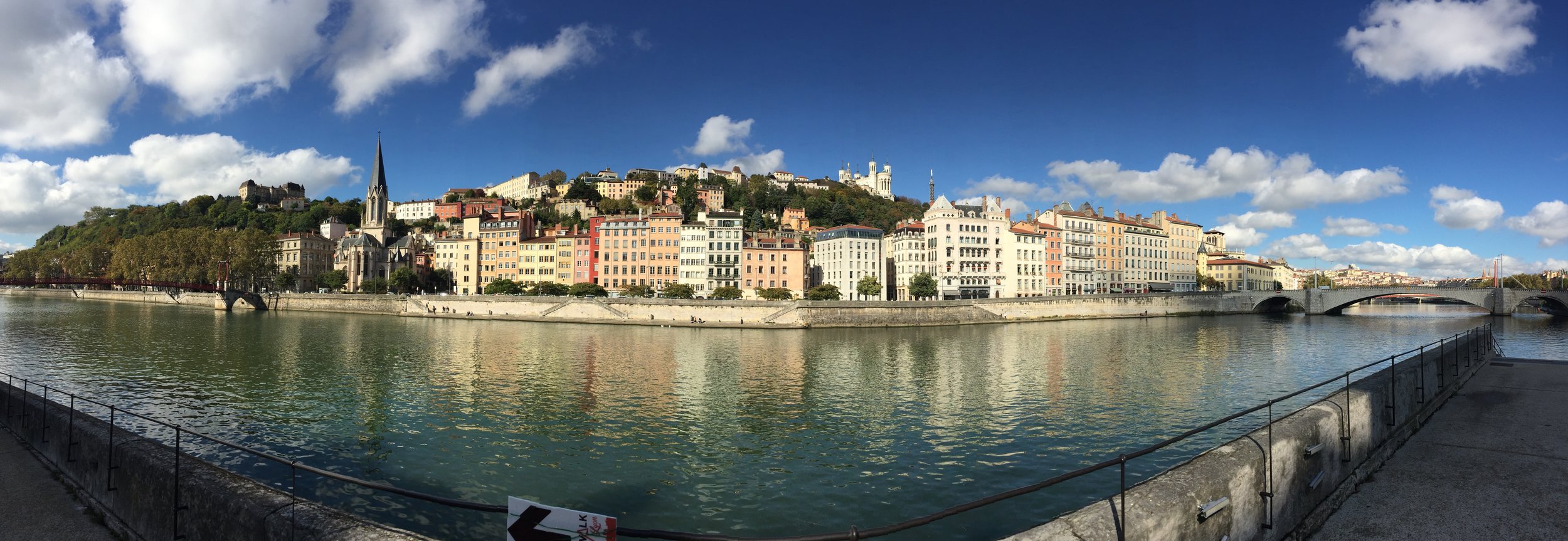
Here's Lyon: two rivers running through it, gorgeous architecture, and oh, the food....

Here's Lyon: two rivers running through it, gorgeous architecture, and oh, the food....

An American in Lyon: Old and New Memories of France

November 02, 2016 by Suzanne Vine

I know, I know: in a blog about Amsterdam, I manage to get you out of the city quite a bit. Believe it or not, compared to some of our rolling stone expat friends, we travel relatively little. A few weeks ago, Peter and I spent a weekend in Lyon. What's in Lyon? you ask. I certainly did when Peter first asked me if I wanted to go. As those of you who know Peter well know, he has been a "foodie" since before it became a term. Actually, the term "foodie" - which makes me think about a person who drops names about wines and Michelin-star restaurants - doesn't really describe his relationship to food. He just likes to cook and is really good at it. A favorite Saturday or Sunday for him is spent watching cooking shows on T.V., then scouring his many cookbooks for recipes inspired by all that viewing. Next there's the trip to the grocery store for ingredients, the preparation, and then finally the eating. He doesn't go in for those fussy meals with stacked-up food, foams, and garnishes. It's all just really plentiful, and delicious. So for Peter, going to Lyon, France's third largest city, the "food capital of the world", was like an avid scuba diver visiting the Great Barrier Reef, or a book lover going to Powell's Books in Portland, Oregon. It was a chance to go to the epicenter of food and find out if it had truly earned all the heaped upon praise.

And who was I, the most frequent guest at Peter's restaurant, to pass up the chance to eat myself silly in the Mecca of good food? Those who know me well know that I am a very appreciative audience when it comes to food. This has always been a part of who I am. Here's a little known piece of Vine-Drucker foodlore: soon after I met Peter in law school, he invited me to come over for Chinese food. I assumed that meant we would order in, or if he was really fancy/wanted to impress me, he might stir-fry some random vegetables together. Imagine my surprise when he presented me with homemade soup (in my memory bank, he served it in a tureen, but I don't know if that's really true or a dream), chicken with walnuts, and a whole fish. You might have some serious doubts about a person who remembers in such detail a meal she ate 30 years ago. The ability to recall those details with such clarity might have something to do with how many times I have told that Chinese food story. On the other hand, you might be impressed by this person's sharp memory. I can assure you that she can remember long-ago food experiences like they were yesterday, but has trouble recalling the plot of a book she finished last week. There are books written about this subject. I think I have even written in this blog about this ability of mine to conjure up my food-connected memories. I can't really remember. More on this later in in the blog post when we get to a discussion of Proust. Excited?

Back to the present day and the Lyon trip: A first-thing-in-the-morning flight meant we hit the ground running in Lyon by 10 a.m. We made our way to the outdoor markets along the Saône River, where regular folk like us shop alongside famous chefs. I imagined that the leeks splayed on the wooden table with abandon might grace my dinner plate that night. We immediately bought some slabs of quiche and ate them American-style - as in right away as we walked along the market stalls. There's a special place in my heart for the bread we ate in Lyon. Sorry to say, Amsterdam, but your bread just can't hold a candle to Lyon's version: just the right ratio of crunchy exterior to soft but not cottony interior. It was just right on the money in each and every restaurant we visited. The food in France is just, well, sexier, than what we are used to in Amsterdam. I found myself thinking back to one of my old time faves, Justin Timberlake's Sexyback. In this cover by Corrine Bailey Rae, the sexiness is a little more subtle. Feel free to also take a listen to the original as you think about French food. 

IMG_6829 (1).jpg
IMG_6830 (1).jpg
Just in case you aren't into food, or think it's odd that our entire weekend revolved around it, here's one of the many bookstores we saw during our wanderings. I wished I could have had a classroom door that looked like this. 

Just in case you aren't into food, or think it's odd that our entire weekend revolved around it, here's one of the many bookstores we saw during our wanderings. I wished I could have had a classroom door that looked like this. 

Where did this love of all things French - except maybe their lack of interest in daily showering - begin? For me, I have to go all the way back to 5th grade to trace my fascination. As I mentioned in my post about trying to learn Dutch, I loved learning French. That may have something to do with the fact that Madame Echevarria slipped us candies throughout the lessons. I think it was also because I just liked the sound of it. The French could be arguing about a parking spot and manage to make it sound interesting, intelligent, and most of all, beautful. In addition to my early success with learning French, the film The Red Balloon had a huge influence on me, no doubt. Every single person around my tender age must remember watching that film on "public TV", don't you? Each time I watched it, I wanted the little boy to escape those bullies and save his precious red balloon. Each time I hoped, just this once, he would. Watching him walk through the streets of Paris must have planted the seeds for my love of wandering the streets of French cities. 


The third road leading to my France-love began when I spent the summer I turned sixteen in Brittany, in a little town called Perros Guirec. I went on a summer study program with a bunch of other American teenagers. We had French lessons in the morning, then spent the afternoons learning to cook, sail, and play tennis, all in French. No wonder I'm not very good at any of those things. Mostly, I remember the food: the baguettes we tore open and ate with squares of chocolate, the Breton crêpes, the butter cookies we called "Mad Holes" (help me out, French friends. Trou Fou?). This all took place way before the days of iPhone photos and Facebook posts. Thank god for my box of old photos, which I have somehow managed not to lose. I must have had a premonition that one day, I would need to show this photo to others, to prove how beautiful Brittany is and that I was actually there. And thank god for the Internet. It helped me find a recipe that looks like a close friend of Mad Holes. 

The colors of the water don't quite match my memories. I remember so many shades of blue. I also remember that it was freezing. I kept a journal in those days, not a blog. Too bad it's in storage, or I could bore you with more details from the point…

The colors of the water don't quite match my memories. I remember so many shades of blue. I also remember that it was freezing. I kept a journal in those days, not a blog. Too bad it's in storage, or I could bore you with more details from the point of view of a 16-year-old, instead of the ones from a 56-year-old.

We didn't eat like this every night, but are you getting a sense of why I would turn out to harbor this love of French food? Also, what 16-year-old wouldn't love a country in which you were served wine every night?

We didn't eat like this every night, but are you getting a sense of why I would turn out to harbor this love of French food? Also, what 16-year-old wouldn't love a country in which you were served wine every night?

You can't mention a cookie in a post about France without mentioning the most famous cookie ever to appear in literature: the madeleine in Proust's Remembrance of Things Past. For those of you who care, here is one passage from the book about that cookie and its effect on the character's memory: 

She sent for one of those squat, plump little cakes called "petites madeleines," which look as though they had been moulded in the fluted valve of a scallop shell. And soon, mechanically, dispirited after a dreary day with the prospect of a depressing morrow, I raised to my lips a spoonful of the tea in which I had soaked a morsel of the cake. No sooner had the warm liquid mixed with the crumbs touched my palate than a shudder ran through me and I stopped, intent upon the extraordinary thing that was happening to me. An exquisite pleasure had invaded my senses, something isolated, detached, with no suggestion of its origin. And at once the vicissitudes of life had become indifferent to me, its disasters innocuous, its brevity illusory - this new sensation having had on me the effect which love has of filling me with a precious essence; or rather this essence was not in me it was me. I had ceased now to feel mediocre, contingent, mortal. Whence could it have come to me, this all-powerful joy? I sensed that it was connected with the taste of the tea and the cake, but that it infinitely transcended those savours, could, no, indeed, be of the same nature. Whence did it come? What did it mean? How could I seize and apprehend it?

If I go back to Brittany (and that's on the to-do list while we are in Amsterdam) I plan on finding those Breton butter cookies and having the taste instantly transport me back to my 16 year-old-self. I'll keep you posted.

I could go on and on: telling you about how I loved to watch Julia Child on The French Chef on Saturday afternoons with my mom, and how I adored Maurice Chevalier. I had the easy-play songbook for Gigi. Somehow, my rendition on the piano never sounded as smooth as his voice. And then there was his accent.... And that smile....

That was a very long trip down memory lane. Let's get back to Lyon. After our visit to the outdoor food market, we visited the indoor market/temple of fine food: Les Halles de Lyon Paul Bocuse. For those of you who don't follow food news, Monsieur Bocuse is the Ted Williams of the food world. (Since it's World Series time, I went with a baseball reference. Those of you who follow baseball even less than food will just have to miss the analogy). He's a classic. He's been at it forever, and he shuns the fussy stuff in favor of traditions. 

Here he is, reverently half-covered in shadow. I really wanted Peter to pose in front of this mural, but as you can well imagine if you know Peter, that was never going to happen.

Here he is, reverently half-covered in shadow. I really wanted Peter to pose in front of this mural, but as you can well imagine if you know Peter, that was never going to happen.

 So many bottles. So little time.

So many bottles. So little time.

 This kind of candy is really too good-looking to eat.

This kind of candy is really too good-looking to eat.

 Not all the food was upscale. This shop had all kinds of goodies, like Skippy peanut butter, Fluff, and these goldfish crackers. When you're in the mood, they are every bit as good as mousse au chocolat, right?

Not all the food was upscale. This shop had all kinds of goodies, like Skippy peanut butter, Fluff, and these goldfish crackers. When you're in the mood, they are every bit as good as mousse au chocolat, right?

The neighborhood was brimming with food-related shops. Peter loves kitchen stores, and this one didn't disappoint. I'll tell you what was disappointing: his refusal to try on the chef's chapeau so I could snap his photo for the blog.

I had to settle for this surreptitious shot of him searching for the perfect sauté pan. The search continues, by the way.

I had to settle for this surreptitious shot of him searching for the perfect sauté pan. The search continues, by the way.

To ready ourselves for our first Lyon dinner, we climbed up and up the hill to see some Roman ruins: the ancient theater of Fourvière. The theater was built starting in 15 B.C. We felt silly complaining about the steep walk up the hill when we thought about the Romans trudging from Italy to France with huge slabs of rock to build this thing.

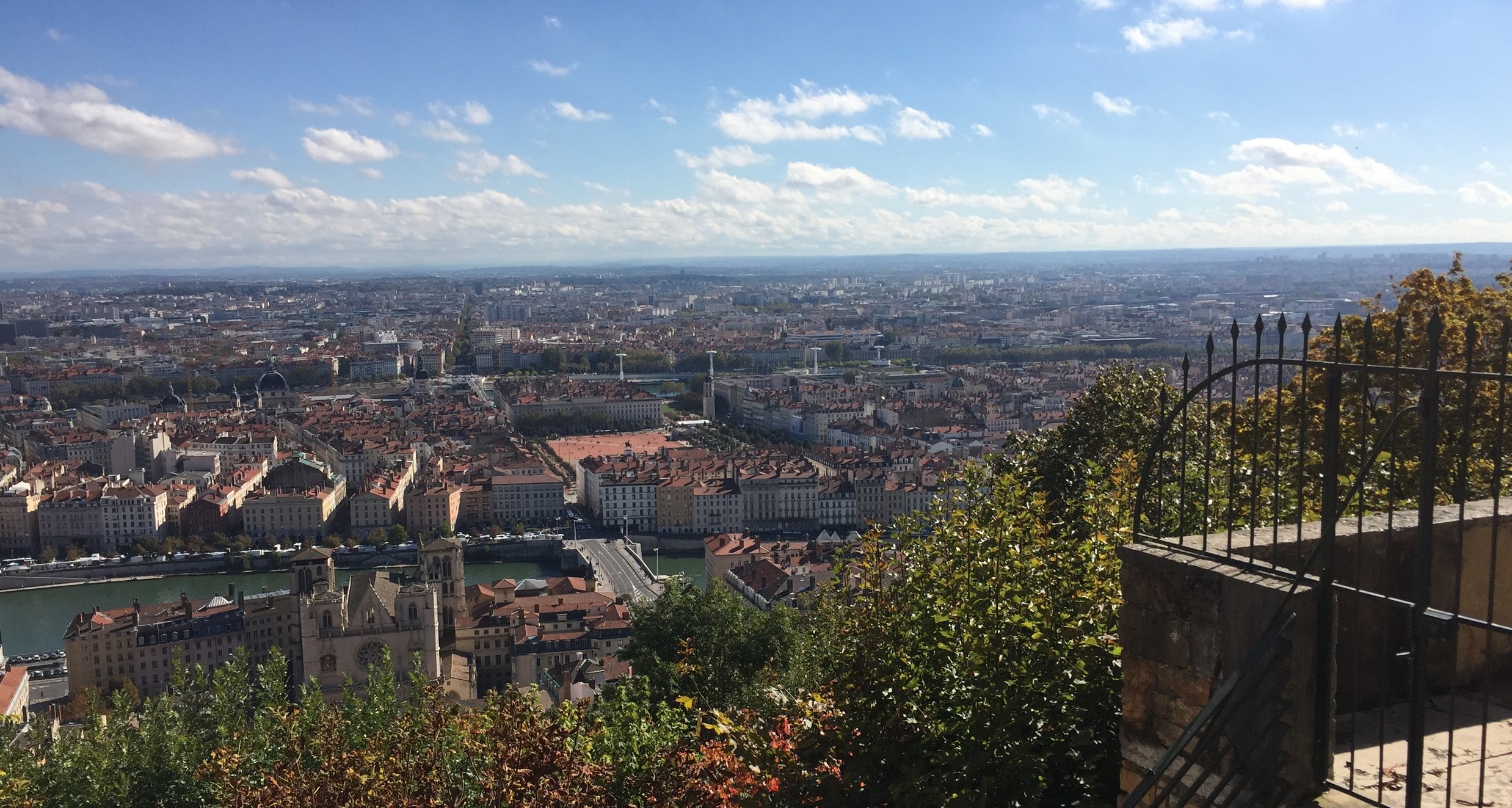
 We rarely see a sky this color in Amsterdam. I found it every bit as grand as the theater.

We rarely see a sky this color in Amsterdam. I found it every bit as grand as the theater.

 One thing about steep climbs: they usually result in some awfully nice views. This one did not disappoint.

One thing about steep climbs: they usually result in some awfully nice views. This one did not disappoint.

After our long walk over the twin rivers, the Saône and the Rhône - I'm loving the chance to add that circumflex over the o's in two words in one sentence - we were ready for anything our restaurant chef was ready to throw our way. The sense of anticipation was almost visible in the air outside Daniel and Denise. It's one of the most beloved Lyonnais bouchons, restaurants serving typical food from the region: duck paté, sausages, and other mystery meats. I was determined not to ask too many questions about what came from which part of the animal and just enjoy. We all waited patiently for the doors to open at 7 p.m. for the first seating. 

Somehow, the restaurant managed to gracefully seat the crowd, which grew and grew after I snapped this photo. Even more amazing was the way they made each of us feel welcome and special.

Somehow, the restaurant managed to gracefully seat the crowd, which grew and grew after I snapped this photo. Even more amazing was the way they made each of us feel welcome and special.

 The hardest decision to make was whether to order three, four, or five courses. What do you think we chose? Hint, there was both a cheese and a dessert course.  

The hardest decision to make was whether to order three, four, or five courses. What do you think we chose? Hint, there was both a cheese and a dessert course.  

 In my book, bread pudding is the ultimate comfort food. So I couldn't pass up the chance to order it in the capital of food. My oh my. Or rather, Ooh la la!

In my book, bread pudding is the ultimate comfort food. So I couldn't pass up the chance to order it in the capital of food. My oh my. Or rather, Ooh la la!

After a long and luxurious meal that included some of those fabled Lyonnais specialties, we walked back to the hotel. The city was all lit up, as if to say, "Take that, Paris. I'm just as glam."

IMG_6859.JPG
IMG_6861.JPG
IMG_6863.JPG

Day Two in Lyon found us taking a break from food tourism to check out the huge flea market in Villeurbanne. It's a bit of a trek on a tram, and then a walk, but you know you're getting close when you see cars jammed up against each other along the side of the road. We wandered up and down the aisles of stalls - reportedly around 400 of them designed for you to find that perfect bargain - along with families with kids and dogs, hipsters, and probably a few tourists like us.  

 I saw many accordions, and thought of my dad, who picked one up while he and my mom visited Estonia. When he returned to the U.S. with his accordion in tow, he proudly serenaded his grandchildren, who were too polite to tell him how out of tune

I saw many accordions, and thought of my dad, who picked one up while he and my mom visited Estonia. When he returned to the U.S. with his accordion in tow, he proudly serenaded his grandchildren, who were too polite to tell him how out of tune it sounded. No matter. It made his face light up when he played it.

 There were plenty of bike lanes in Lyon, and an active city bike program. I felt right at home when I saw all these used bikes for sale.

There were plenty of bike lanes in Lyon, and an active city bike program. I felt right at home when I saw all these used bikes for sale.

 There were lots of dishes and pots and pans for purchase by the other aspiring chefs, in addition to Peter, wandering around.

There were lots of dishes and pots and pans for purchase by the other aspiring chefs, in addition to Peter, wandering around.

 And there were lots of items for sale that you never knew you needed.

And there were lots of items for sale that you never knew you needed.

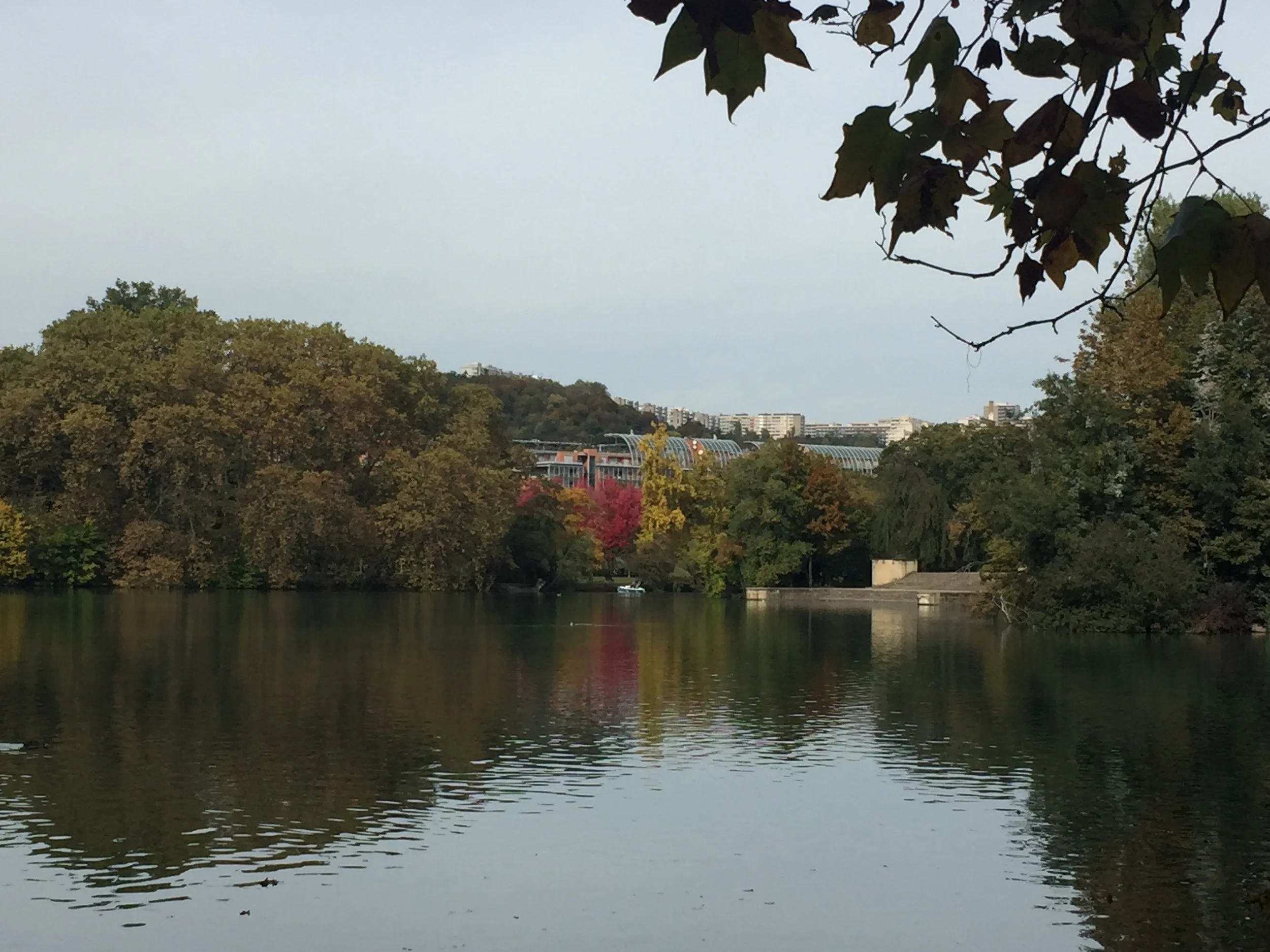
Then, in advance of our second Lyonnais dinner, we walked to and around the gorgeous Park de La Tête d'Or. A Sunday afternoon in the park felt like a very French thing to do.  The park was filled with people walking, running, biking, and even one fellow walking on a rope stretched between two trees. I assumed everyone was walking off one meal and getting ready for the next. Isn't that what everyone is doing in Lyon?

IMG_6875.jpg
IMG_6880.jpg

All that walking put us in good stead for our dinner at Carré Royal. The server/owner was delighted to hear me speak a little French. So delighted, actually, that she launched into a full dissertation in rapid-fire French on the different white wines on the menu. When we finally stopped her to admit that I didn't quite understand all of her wonderful descriptions, she happily switched to English, calling one of the wines "fat". We later realized she meant "full-bodied". The place was gorgeous, the food was delicious, the price for those four courses really reasonable, and best of all, it was open on a Sunday, which most of the other restaurants were not. 

Here's the full-bodied wine with the local cheese, served to us along with a long tale about where it hailed from. Since the story was in French, I can't pass on many details. Anyway, I preferred to think of the wine as big-boned, not fat. If m…

Here's the full-bodied wine with the local cheese, served to us along with a long tale about where it hailed from. Since the story was in French, I can't pass on many details. Anyway, I preferred to think of the wine as big-boned, not fat. If my food photography seems rushed, it's because it was. I didn't want to be one of those Americans who is so busy snapping photos that she doesn't enjoy her food. 

We spent the last day in Lyon at the Musée Des Beaux Arts de Lyon, a grand old museum with a lovely courtyard inside. And we managed to squeeze in one more delicious meal, a late lunch, before boarding our plane back to Amsterdam. We were surrounded by tables of French couples and groups, chatting away over their long, luxurious meals. This was in stark contrast to a typical lunch scene in Amsterdam, which mostly involves sandwiches. The tradition in the Netherlands is that you only have one "warm" meal a day, usually at dinner time. Americans I know who are married to Dutch men verify that their in-laws say that if you have a warm meal at lunch, you need only eat a sandwich at dinnertime. Imagine the French (or Spanish or Italians) foregoing either the long, warm lunch or the longer - and equally warm - dinner. We could chat about whether those warm and unhurried lunch traditions have had an affect on the economic productivity in countries who follow that custom, but that's a subject for another post. 

Inside the museum, I actually saw someone reading a book by Nietzsche. I have this impression that every French woman and man is incredibly well-read. Veronique, a member of my book group here, certainly proves that theory true. 

Inside the museum, I actually saw someone reading a book by Nietzsche. I have this impression that every French woman and man is incredibly well-read. Veronique, a member of my book group here, certainly proves that theory true. 

Even the name of the airport, Lyon-St. Exupéry, brought me back to another memory from my Francophile childhood. I loved this book, even if I had no idea what it meant. "And now here is my secret, a very simple secret: It is only with the heart that…

Even the name of the airport, Lyon-St. Exupéry, brought me back to another memory from my Francophile childhood. I loved this book, even if I had no idea what it meant. "And now here is my secret, a very simple secret: It is only with the heart that one can see rightly; What is essential is invisible to the eye." Very deep thoughts for a 5th grader to unravel. 
 

 I think my love of pottery and china also began during that teenage trip to France. We took a day trip to a town called  Quimper , best known for its  distinctive pottery . I'm guessing some of the other teens were bored silly, but I loved it. It re

I think my love of pottery and china also began during that teenage trip to France. We took a day trip to a town called Quimper, best known for its distinctive pottery. I'm guessing some of the other teens were bored silly, but I loved it. It reminds me of some of the Dutch pottery. Maybe the seed was planted all those years ago for me to move here?

 If you visit me in Amsterdam, I'll take you to this place along the Herengracht canal. Here, the phrase, "I feel like a bull in a china shop" turns from a mere simile to a reality.

If you visit me in Amsterdam, I'll take you to this place along the Herengracht canal. Here, the phrase, "I feel like a bull in a china shop" turns from a mere simile to a reality.

I'm not sure what this next song is actually supposed to be about, but it reminds me of my main job in a house where I'm not the main chef: doing the dishes. I heard this song in a recent spin class, and if you sing it in your head as you wash, it makes the time and the task go by really quickly.

I wasn't sad about returning to Amsterdam. However, I felt a little guilty to tell the truth, as if I had been unfaithful somehow. I had spent the weekend with some sexy French food, and was more than a little wistful about leaving it behind. As you can probably tell from some of the photos, Peter was in heaven. For a man who can spend an entire dinner conversation talking about the relative merits of different styles of Southern barbecue, this was a chance to taste some foods he had read about, but never had the chance to get fully acquainted with over dinner. I was happy to be his companion on this journey to his happy place. 

I couldn't help but wonder what life is like for American expats living in France. Do they take for granted their perfect baguettes, the musical language, the grand buildings? Do they look forward to a change of pace and come to Amsterdam for the sandwiches, the coziness, the small-scale beauty? Maybe the grass is always greener on the other side of the plate.  

I found this place in Amsterdam after we returned from Lyon. So I'm not the only one harboring a secret crush on French food?

I found this place in Amsterdam after we returned from Lyon. So I'm not the only one harboring a secret crush on French food?

This Dutch man was sporting a beret, which shows that maybe the line between the French and the Dutch isn't so wide after all. 

This Dutch man was sporting a beret, which shows that maybe the line between the French and the Dutch isn't so wide after all. 

Years ago, I wrote to my great-aunt Sue, my grandmother's sister. She was living in a nursing home in New York City. She wrote back with the following words, which have stayed with me: "[Your letter] brought back pleasant memories. I would give up a million tomorrows for just one yesterday." That struck me as so sad - both at the time I received the letter when I was in my 20's - and now. I'm thinking of my friend Kelly, who died 19 years ago today. She would have given anything for just one tomorrow. I'm not sure what all of this means about the importance of memories. Maybe when you are old, they loom larger because they are the only times of joy you have. But memories are important not just to those at the end of their lives. Our friends and family stay with us, long after they are gone, because of all the memories we so carefully and lovingly save of them. And while those shoe-boxes of memories are important, so are the chances to create new ones, with exciting tomorrows. 

An image to carry with you whenever you need your spirits lifted. I picture Kelly just like this.

An image to carry with you whenever you need your spirits lifted. I picture Kelly just like this.

November 02, 2016 /Suzanne Vine
8 Comments
Yes, that's an IV bag along with its owner, out for a stroll in the park. I love that everyone is out and about here. Whether you are sick and/or old, you use your wheels to get out and around.

Yes, that's an IV bag along with its owner, out for a stroll in the park. I love that everyone is out and about here. Whether you are sick and/or old, you use your wheels to get out and around.

In Sickness and In Health: Medical Journeys in Amsterdam

October 14, 2016 by Suzanne Vine

The unpredictable weather, the "laid-back" service in restaurants, the seeming inability of the Dutch to line up correctly: these are just a few of the topics that expats in Amsterdam like to bore each other kvetching about. Most of us also have a story or two to tell about our experience with the healthcare system here. In the U.S., folks generally wait until they are getting on in years before oversharing about their medical ailments and trips to a slew of doctors to seek to cure what ails them. Here, set adrift in a country with new rules, and new attitudes towards sickness and health, even young and spry expats can sound really old really quickly. I suppose my interest in doctors runs deep: as the daughter and sister of doctors, and granddaughter and great-niece of many, many dentists, I have always been interested in medicine. It's just that my tendency to feel faint at the sight of blood interfered with making it my life's work. Oh, and then there's the matter of taking Organic Chemistry...or any chemistry. I think writing about medicine suits me just fine. 

So much to love about this scene, including: 1. The fact that a motorized wheelchair is out and about and not just in the corridors of a hospital or a nursing home; 2. The "Recycled Ferrari" sign on her chair, and 3. The ornery dog going the wrong w…

So much to love about this scene, including: 1. The fact that a motorized wheelchair is out and about and not just in the corridors of a hospital or a nursing home; 2. The "Recycled Ferrari" sign on her chair, and 3. The ornery dog going the wrong way.

My experience with all things medical in Amsterdam has been fairly typical. Our first year here, I basically had a cold that lasted all year. Like the good expat girl that I am, I found a doctor soon after we arrived. "Just in case", because "Vine's law", as we like to say in my family, dictates that if I didn't, I'd get sick. Many people rely on their U.S. doctors back at home, hoping their illnesses somehow correspond with their trips back across the ocean. I decided to jump right into the Dutch medical system. With some advice from another expat (of course) I picked a huisarts, or general practitioner, right in my hood. That doctor is the gatekeeper. You need to see her or him before you can go to any specialist, just like in the bad ole days in the U.S. when everything required a referral. At one point, after my cough had stretched into the third month, I went to see my huisarts. Expat friends with experience told me I should not expect an antibiotic. Getting a prescription for an antibiotic is as easy here as finding the holy grail. That proved to be  case for me. My huisarts looked at me like a know-it-all teacher scowling at her timid student and reminded me that since this was my first year in the country, my body was just getting to know all the new germs.

Here's John, our friend from N.J., posing with a glass of verse muntthee, or fresh mint tea. Apparently, this magical brew, which is just fresh mint leaves with boiling water, is good for your health. It helps with digestion, improves your memory, a…

Here's John, our friend from N.J., posing with a glass of verse muntthee, or fresh mint tea. Apparently, this magical brew, which is just fresh mint leaves with boiling water, is good for your health. It helps with digestion, improves your memory, and can even get your knoflooklucht (garlic air) out. Read all about it here, in Dutch. Or just ask John. The only trouble is that it's mostly served in a glass mug, so it's too molten hot to pick up for a long time. You can eat the Easy-Bake Oven-sized cookie while you wait.

Rather than doling out antibiotics like candy, like some doctors in the U.S., the huisartsen are known for being very stingy with it. Note that in an informational website for expats, the question, "Where can I get anitbiotics?" appears front and center in the FAQ section. The attitude towards antibiotics here is the medical equivalent of the old lady at Halloween who grudgingly gives you a tiny box of raisins when what you really want is a giant Hershey's with almonds. In this case, the tiny box of raisins is a suggestion to take some Paracetamol, which I think is just Tylenol but sounds distressingly like a parasite of some kind. On the other hand, if you are a dog, you have easy access to antibiotics. When Casey was bitten on the ear shortly after we moved here, he didn't have to beg for his prescription. Maybe I should start borrowing from him if I need something stronger than Dutch Tylenol. Most expats just stock up when they go back to the U.S. to visit, returning with their illegal meds stowed away in their luggage. 

Other than Paracetamol, the most common "medicine" doctors recommend to expats seems to be Vitamin D. Because of the lack of sunshine during the long winter months, you need to get in the habit of taking Vitamin D religiously. I'm not sure if the locals take it. They do seem to enjoy their vitamins and health potions, and also their brightly colored fresh juices. However, I've noticed a few contradictions in the approach to good health: bike riders puffing away on cigarettes, an employee at the nearby "biological" grocery taking cigarette breaks next to the organic produce, tanning salons abounding, even at my gym. Perhaps the Dutch would find just as many contradictions lurking in the American approach to health if they lived in the U.S and blogged about it. Certainly, they don't seem to be dealing with an obesity crisis here. I'd chalk that up to the bikes and the cigarettes. On the other hand, my hair dresser - a fountain of information - tells me if you go out into the poorer sections of the city, you'll encounter both more fast food and more U.S.-style physiques. I hear what she is saying, but can also say that even in those areas, you just don't see the number of morbidly obese people you see in the U.S. 

 In general, the portions here are smaller than what you find in the U.S. For those of my readers who live here,  here's the name of the restaurant  with this amazing hummus, pita, and shakshuka. You know you're going to ask me!

In general, the portions here are smaller than what you find in the U.S. For those of my readers who live here, here's the name of the restaurant with this amazing hummus, pita, and shakshuka. You know you're going to ask me!

 In one case, an Indonesian  rijsttafel,  small portions don't equal a small meal. That's because there are just so many bowls of small portions. You'll have to come and discover this for yourself. Laurie did a fine job of helping me polish off

In one case, an Indonesian rijsttafel, small portions don't equal a small meal. That's because there are just so many bowls of small portions. You'll have to come and discover this for yourself. Laurie did a fine job of helping me polish off most of the dishes pictured here.

Here I am with Vera and some really therapeutic medicine.

Here I am with Vera and some really therapeutic medicine.

My closest encounter with the medical system here came when my teeth suddenly let me down this summer, after a lifetime of doing a good job of getting the job done with a minimum of drama. It turned out I would need a wortelkanaalbehandeling. Luckily, I had made a pitstop to visit my U.S. dentist the day I flew back here. His bad news, in English, didn't sound nearly as horrible, and was certainly less of a mouthful. I would need a root canal. He also gave me some good news: he was flying me back with an antibiotic in tow. Yes, I had scored! Once back in Amsterdam, I had a helluva time convincing the receptionist at my Amsterdam dentist office that my request for an appointment was an emergency, but she finally relented. In the few days leading up to the appointment, I was regaled with tales from other expats about their dental woes: crowns that didn't quite fit, wisdom teeth removed without novacaine, and of course root canals gone horribly wrong. Oh my! 

The actual procedure went smoothly. I entered a swank office and an hour and a half later, had two of my canals cleaned, widened, and improved. That seemed quite fitting as I walked back to the tram, along one of the non-dental Amsterdam canals. I could have done without the running commentary from the endodontist, who insisted on telling me in detail (thankfully, in English) exactly what he was doing throughout the procedure. I noticed when the going got rough, he spoke in Dutch to his assistant. When I left, the receptionist seemed genuinely stunned that I needed to pay up front and then submit the bill for reimbursement. This return to the old days of insurance coverage is one part of the expat experience I do not enjoy. Then she actually apologized for the amount of the bill. I guess that means that Dutch insurance covers most dental procedures and she was unaccustomed to presenting patients with large bills. 

Believe you me, I thought of visiting a coffeeshop to deal with the tooth pain, and maybe find some extra happiness to boot. It turns out that medical marijuana is legal in the Netherlands. In the countless coffeeshops that are sprinkled throughout …

Believe you me, I thought of visiting a coffeeshop to deal with the tooth pain, and maybe find some extra happiness to boot. It turns out that medical marijuana is legal in the Netherlands. In the countless coffeeshops that are sprinkled throughout the city, marijuana is not technically legal, just completely tolerated. 

 The photo doesn't do justice to the beauty of this dentist's office. For starters, it's right on the  Keizersgracht , one of the swankest canals.

The photo doesn't do justice to the beauty of this dentist's office. For starters, it's right on the Keizersgracht, one of the swankest canals.

 There's this lovely little garden in the inner courtyard. I wasn't asked if I wanted to recuperate in there. 

There's this lovely little garden in the inner courtyard. I wasn't asked if I wanted to recuperate in there. 

 And really? Coffee at the dentist's office? In the U.S., my hygienist had to spend 45 minutes scraping the coffee stains off my teeth. Here, they realize that some things are more important than pearly whites, namely, a good cup of coffee.

And really? Coffee at the dentist's office? In the U.S., my hygienist had to spend 45 minutes scraping the coffee stains off my teeth. Here, they realize that some things are more important than pearly whites, namely, a good cup of coffee.

Sadly, after two years here, I haven't been able to get a definitive answer to the question, "Do we need to buy Dutch health insurance?" (to supplement our expat coverage from the U.S.). You would think this is a straightforward question which would have a straightforward answer. Try asking ten expats that question, and you will get answers that range from, "Absolutely not! You just need some health insurance," to, "Definitely yes!" to, "It depends on what your company's HR department says." So we may actually be carted off to Dutch prison (where, you may recall from a previous blog post, there are many empty beds) or fined for not having Dutch insurance once we figure out what the real answer to the health insurance riddle is. I'll keep you posted.

[Just an aside: how do you feel about Bob Dylan getting the Nobel Prize for Literature? If they were going to give it to a singer/songwriter/poet, my vote would have gone to Joni Mitchell.]

What exactly is included in your Dutch healthcare package? For one thing, something called, "exercise therapy". And for another, "smoking cessation therapy". After the Michael Moore documentary, Where to Invade Next, folks in the U.S. were both stunned and jealous to learn that in Germany, if you are "stressed" by your job, your doctor can prescribe anywhere between one and three weeks of spa treatment. Sadly, in the Netherlands, "treatments at spa resorts are no longer reimbursed". A close reading of that revision tells me that at one time, they were. Nice. I arrived just a little too late. 

So you mean under the old rules, we could have submitted Vera's going-away party for reimbursement? 

So you mean under the old rules, we could have submitted Vera's going-away party for reimbursement? 

Who better than Dr. John to tell us about being in the right place at the wrong time? Just an aside, but my 13-year-old self loved Dr. John's raspy voice, especially this song. And, after all, isn't he a doctor?

All kidding aside, the Dutch approach to healthcare has led to some amazing innovations. First, there is the "Dementia Village", De Hogeweyk, in the town of Weesp. The entire village is specifically designed for people with dementia. Then there's the nursing home in the town of Deventer that allows students to live rent-free, in exchange for interacting with the residents. At an education conference I attended last year, a 22-year-old student spoke about how most people applaud him for brightening the lives of the elderly people he lives with. He told us that instead, he feels he gets back much more than he gives, gaining a wider perspective on life than he would otherwise have. At the end of his talk, he introduced us to his friend, an elderly gentleman who sat at the end of my row. I wasn't alone in having tears in my eyes when we all stood up to give both friends a standing ovation. Bravo to the Dutch for not just having the idea, but putting it into practice. The idea which may have begun from a sense of thriftiness and practicality, but it has such deep and meaningful implications for society.

Some would say that the permissive Dutch laws on euthanasia should not be added to the list of healthcare innovations the U.S. could learn from. It's a difficult issue, and perhaps the Dutch have pushed the freedom to choose to an dangerous ledge. Allowing a 16-year-old to make this decision without parental consent? But allowing a person a person who is "suffering unbearably" to write an advanced directive without fear of a spouse or doctor being arrested? That's a different story entirely. Recently, the health and justice ministers have proposed allowing elderly people who feel their "life has been completed" to be able to choose to die. It certainly gives you something to think about.

A recent exhibit at the Van Gogh Museum documented various doctors' attempts to diagnose Van Gogh's mental illness. It was a fascinating exhibit, and made me think about not just Van Gogh, but also about my friends and family members struggling to l…

A recent exhibit at the Van Gogh Museum documented various doctors' attempts to diagnose Van Gogh's mental illness. It was a fascinating exhibit, and made me think about not just Van Gogh, but also about my friends and family members struggling to live with mental illnesses for which there are no easy cures. Many mental health services are covered by Dutch insurance. What if Van Gogh lived in the Netherlands today?

Thankfully, I don't know anyone who has explored this aspect of the healthcare laws here. At the other end of the cycle of life, I do know several young women who have given birth here. Let's just say it's a very different experience than in the U.S. Many women here give birth at home. That's not really most American gals' cup of tea. It is not routine to give you drugs, although I'm told if you insist, you can get your epidural just like in the U.S. All new expat moms, however, love the system here of caring for the mom after she gives birth. A kraamzorg, sort of a Mary Poppins for a new mom, comes to your house for about a week after you give birth. One friend told me her kraamzorg made lunch every day, making sure to prepare her favorites. I wouldn't mind a kraamzorg of my very own. 

Other than having babies, those near and dear to me have also experienced the following medical journeys: 1. screws taken out of a broken ankle (the screws presented as a parting gift after she was out of recovery); 2. a hernia repair (the cab ride to and from paid for by the hospital); 3. open-heart surgery (most scary by far, and luckily, a story with a very happy ending). All of these medical events took place in a ziekenhuis, my favorite Dutch word by far. It means hospital, but as with so many Dutch words, it literally means, "house for the sick". I love this literal language, even if it is so very difficult for me to master. Anyway, in each of the cases listed above, the experience was not what we are used to back in the U.S. When you're sick, you don't want different, however. All you want is to be in your own bed. It makes sense that when you are sick and in need of medical attention, you would most miss your roots back home. You are out of your comfort zone when you need it most. So while our American healthcare system is no paragon of perfection, it's what feels familiar. When you're under the weather, familiar is all you really want. 

Here are the items in the goody bag my friend Seanette received after her surgery.

Here are the items in the goody bag my friend Seanette received after her surgery.

Although it's only very loosely connected to the theme of this post, I'll end with a tribute to my favorite teacher of all time. I promise I'll try to tie up that loose connection for you. If not, it will be a chance to introduce you to an important person who would have loved this blog, I think. Parry Jones was a feisty,  brilliant Welshman who was my teacher in several high school history courses. More importantly, he taught me to love learning. His unorthodox style of teaching might not fly today in our world of helicopter-parenting and test-score mania. He growled at us when we offered up an incorrect answer, but also endeared himself to us by instructing us without warning to push aside the desks for an impromptu how-to on rugby. During other breaks in the action of studying history, he entertained us with tales of his many world travels, and taught us to sing a Welsh drinking song. I can still sing the song, in my best imitation of Mr. Jones. Too bad I can't remember more about the particulars of European history, or Asian history, two courses I was lucky enough to share with Mr. Jones. Here are the lyrics in case you want to sing along: 

Here's a health to the King, and a lasting peace
May faction end and wealth increase.
Come, let us drink it while we have breath,
For there's no drinking after death.
And he that will this health deny,
Down among the dead men, down among the dead men,
Down, down, down, down;
Down among the dead men let him lie!

So what does Mr. Jones have to do wth the subject of Dutch healthcare? First off, I think the Dutch would certainly appreciate Mr. Jones' freestyle approach to teaching. Also, from what I have observed, the Dutch believe that a good beverage (be it a fresh juice, a crisp wine, or a genever - a kind of Dutch gin) can produce good health. Mr. Jones shared that philosophy. He once poured me a tiny glass of sherry during the school day because I was so distraught over losing my stack of notes written on index cards and essential for writing a soon-due term paper. The cards showed up within a few days, but that memory has stayed with me. I think the Dutch would raise a glass to Mr. Jones' approach to problem-solving. Thank you, Mr. Jones, for showing me that a good teacher can stay with you for life. 

In addition to teaching us the rules of rugby (which came in handy when I played on the first women's team at my college, senior year), he also schooled us in the fine art of arm-wrestling. That was all in between teaching us to read critically…

In addition to teaching us the rules of rugby (which came in handy when I played on the first women's team at my college, senior year), he also schooled us in the fine art of arm-wrestling. That was all in between teaching us to read critically, write clearly, and most of all, think for ourselves. 

"Here's a health to the king, and a lasting peace." The rule at this establishment, Wyand Fockink, which serves genevers and liquers, is that you must lean over and slurp up the first sip without your hands. Mr. Jones would have been proud. Try…

"Here's a health to the king, and a lasting peace." The rule at this establishment, Wyand Fockink, which serves genevers and liquers, is that you must lean over and slurp up the first sip without your hands. Mr. Jones would have been proud. Try pronouncing the name of the place after you finish. 

Fall has finally arrived after an unusually warm September. Happy Fall and a happy and a healthy New Year to everyone.

Fall has finally arrived after an unusually warm September. Happy Fall and a happy and a healthy New Year to everyone.

October 14, 2016 /Suzanne Vine
18 Comments

Ain't No Mountain High Enough: Hiking in Italy and Switzerland

September 16, 2016 by Suzanne Vine

My brother and sister used to call me "Bookworm" as if that were an insult. I spent a lot of my childhood (and my grownup life, for that matter) with my face buried in a book. I especially loved historical fiction with spunky girl characters who lived outdoors much of the time on either the frontier (like Caddie the heroine of the marvelous Caddie Woodlawn, or Laura in the Little House on the Prairie series) or in the mountains (like my idol Heidi). They seemed to have more than their fair share of adventures involving either "wild Indians" or tempestuous weather. 

I tell you all this because I realize now that reading gave me - just a girl with freckles from a small city called Trenton, N.J. - the chance to live a life of adventure and experience a vicarious thrill. And living in Amsterdam - so close to some rather amazing places - that girl from Trenton has had the chance to make good on the research she did all those years ago about living that adventurous life. 

This photo was taken at the height of my bookworm era. I took a day off from my antics on the prairie to take part in School Picture Day at Princeton Day School. 

This photo was taken at the height of my bookworm era. I took a day off from my antics on the prairie to take part in School Picture Day at Princeton Day School. 

So off we went to The Dolomites, or Dol-a-mee-tays as they are pronounced in Dutch. We were looking for a nearby place to hike for a few days, and the Dolomites fit the bill. First I had to figure out via a Google search where they actually were. I discovered they are in Italy, within spitting - or at least viewing distance - of the Austrian Alps. My inner Heidi was thrilled. 

We decided to travel with a hiking company, since we planned the trip just weeks in advance. That meant a van was there to greet us when we arrived at the airport in Venice. I've always wanted to be one of those people greeted at the airport with a sign bearing her name. Now I could experience the thrill for myself. More importantly, that meant someone else would be negotiating the hairpin turns on the road for us. The three hour drive to the hotel took far longer than the barely hour-and-a-half flight from Amsterdam.

We were the only Americans staying at our little hotel. The hiking company was run by Brits, so it made sense that we were surrounded by British, Australian, Irish, and Scottish accents. At times, their accents proved as incomprehensible to me as Dutch, I might add. We were also bombarded by questions about Donald Trump, which relented only when we asked about Brexit. But this Heidi was there to hike, so I ignored the questions and concentrated on the main events: the spectacular mountains and the wildflowers. 

 The hiking company employed a wildflower expert, a balding man in his 60's who knew a lot about both wildflowers and jazz. He was like a kid in a candy shop at the end of the day when we all returned from our various hikes with photos of flowers we

The hiking company employed a wildflower expert, a balding man in his 60's who knew a lot about both wildflowers and jazz. He was like a kid in a candy shop at the end of the day when we all returned from our various hikes with photos of flowers we had seen. Identifying them for us seemed to be a joy to him akin to my love of dark chocolate. I was happy to indulge his passion with my photos.

 A hut that Heidi herself could have called home.

A hut that Heidi herself could have called home.

IMG_6314.JPG
 This was our merry band of hikers one day. Peter is on the far right. Rachel is next to him, grabbing a quick nap along with the other young staff members who were there to keep you from wandering off towards Austria.

This was our merry band of hikers one day. Peter is on the far right. Rachel is next to him, grabbing a quick nap along with the other young staff members who were there to keep you from wandering off towards Austria.

Something about the position of the Dolomites in the area leads to unsettled weather, especially mid-day. During one hike, we were accosted by a storm so intense that I was brought back to my childhood days at sleep-away camp. I remembered the summer lightning storms we were sometimes caught out in that turned me into a sprinter. I was always the first one back to the bunk, pretending it was just because I liked to run fast, and not because I was almost literally scared to death. So when the storm interrupted our hike, I took off for the nearest refugio, the name for the series of hikers' huts that serve coffee, beer and wine, and plain but delicious food. While some of our group stayed put on the patio to watch the spectacular lightning show, I went inside with Rachel and waited it out. Perhaps I should have done some research before we arrived. I would have found out that intense lightning storms are common during the summer in the Dolomites, I also might have chickened out of going had I known. Here is yet another occasion where ignorance was, well, if not bliss, at least better than packing my anxiety along with my hiking boots. Better to do the research après-hike, from the safety of my home while writing this blog post.

I think this was taken right before the world came crashing down around us. 

I think this was taken right before the world came crashing down around us. 

The hikes weren't all so anxiety-filled, but they were all spectacular. There were surprisingly few people on the trails, but when we did see people, they came in all ages, from children to seniors. There was an impressive public bus system to ferry you from your hotel to the trail heads, which meant fewer cars on the roads. We also saw quite a few dog-hikers. It seems as if even the dogs in Europe are more fit and active than their U.S. counterparts. 

I wish I were in half-as-good shape as this Golden was. I also wish my teeth were half as white.

I wish I were in half-as-good shape as this Golden was. I also wish my teeth were half as white.

There's something about hiking that encourages you to talk, and it was nice to spend time catching up with Peter and Rachel. From Rachel, I heard stories about Nepal and Colgate that might not have spilled out had we just been sitting at our dining room table. So I was grateful to her for proposing a hiking holiday instead of a city visit to Stockholm or Berlin, our initial plans. 

It turned out that we didn't even have time to miss the mountains. Two days after returning home to Amsterdam and flat soil, we were off again, this time to Switzerland. This trip had been on the books for months, and was another big adventure for us. We were breaking with tradition and heading off with three other couples. Four couples traveling together? So much opportunity for standing around and debating instead of doing, you might think. We certainly did. But we decided to give the group-travel idea a chance. After all, when in expat-land, do as the expats do, right? I had to revise my deep-seated fears of the group travel religion that so many expats seem to practice. For reasons I will now share with you, I am so glad I converted. 

You might look at this photo and think, "They all look so happy!" My mom looked and wondered why I was the only one not protecting my skin with a hat.

You might look at this photo and think, "They all look so happy!" My mom looked and wondered why I was the only one not protecting my skin with a hat.

The trip wouldn't have worked without someone in charge at the helm, shepherding us around. Too many cooks spoil the broth, or something like that. Since Darlene and Rob had lived in Switzerland for five years, they were the trip planners, and the lighthouses in the fog. Darlene would probably have preferred those metaphors to the one we chose: we called her "Mom" and peppered her with questions just as any other bratty kids would: "Are we there yet?" and "Can I get some ice cream?" It was funny to us each time we called Darlene "Mom". I'm not sure she saw it that way.

We took a lot of trains in Switzerland, and they lived up to their reputation. They departed on time almost each and every time. The one time a train left the station two minutes late, it was nearly cause for a national crisis. In addition to the trains living up to their Swiss reputation, so did the hotel rooms and public bathrooms: all immaculate. 

This was just one of the many scenic views from the window of a train. Ordinarily, I love to either sleep or read when I'm on a train, but with views like this careening by, I couldn't enjoy either of those favorite train activities for long.

This was just one of the many scenic views from the window of a train. Ordinarily, I love to either sleep or read when I'm on a train, but with views like this careening by, I couldn't enjoy either of those favorite train activities for long.

In a tribute to Swiss engineering, one of the trains we took - the Jungfrau Railway- sliced straight through a mountain, and then up and up to the top. It's Europe's highest-altitude train station. While on the train, we were informed that each day, a railway employee walks the 9.2 kilometers of tracks and checks to make sure they are in tip-top shape. Let's just say that mechanical failures like the ones New Jersey Transit passengers experience almost daily would not be welcome, unless you are a roller-coaster fan. 

This train was resting before beginning its hike up the mountain. 

This train was resting before beginning its hike up the mountain. 

The view from the top of the Jungfrau was spectacular. It looked like I imagine the moon might look, if it were covered in snow. We found it surprising that many of the tourists who joined us for the ride were Japanese and Arab. We wondered which gu…

The view from the top of the Jungfrau was spectacular. It looked like I imagine the moon might look, if it were covered in snow. We found it surprising that many of the tourists who joined us for the ride were Japanese and Arab. We wondered which guidebooks had touted the beauty of Switzerland to them. I don't think the Swiss are known for their acceptance of cultural differences. In this case, I think money talks, and if tourists come bearing cash, the Swiss are happy to welcome them.

In addition to traveling by train, we also used our own two feet. I got to stretch my Heidi legs on a few gorgeous hikes which were preceded by gondola rides up the mountain. For some reason, the older I get, the less I like dizzying heights, but since this was part of the tour "Mom" arranged, I took deep breaths and tried to enjoy the ride. I even looked down (sometimes).

IMG_6348.jpg
 This bridge seemed to balance on the side of the mountain without much support. I pretended inside my head to be strolling in flat-as-a-pancake Amsterdam and made it out and back with no problem. 

This bridge seemed to balance on the side of the mountain without much support. I pretended inside my head to be strolling in flat-as-a-pancake Amsterdam and made it out and back with no problem. 

You learn a lot about your friends when you travel together. For example, who knew that Seanette (in the far background, seated, next to one of her cow friends) loved cows and that her husband Richard, although initially afraid of them, turned into a bit of a cow whisperer himself? Deb and Marc, on the right, looked as appropriately skeptical of the new friendships as I, hiding behind my iPhone and at a safe distance away.

These cows had far better balance than I, and were often perched up on hillsides at impossible angles. The constant low-level din of their bells was the musical accompaniment to our hikes. So were our constant check-ins with each other over bum ankles and fear of heights, as in, "Everything O.K. back there, ______ ,?" [Names omitted to protect our fragile aging identities].  

With all of that hiking, you need sustenance. Luckily, the Swiss were at the ready with endless combinations of cheese, potatoes, and cream. The entrées may have different names, and the ratios may change slightly, but that's basically the heart and soul of Swiss food. One lunch consisted of the obligatory potato-cheese delight, with a dotting of spinach, a rare sighting of an actual vegetable during our five day stay. Otherwise, a pickle on the side or a sprinkling of chives qualified as a vegetable serving. If it was good enough for Heidi, it was good enough for me. This was carbo-loading at its most dizzying, delicious heights.

Yes, I finished every last morsel.  

Yes, I finished every last morsel.  

Those chunks of apple in this Swiss confection? That's your fruit serving for the day.

Those chunks of apple in this Swiss confection? That's your fruit serving for the day.

Another way you can really get to know your friends is by bunking up with them. Since we are still good friends with our traveling companions, suffice it to say that some of them broke the sound barrier with their nocturnal sounds/snoring. The idea of sharing a hiking hut with each other proved far more enticing then the reality. Still I consoled my sleepy self the next day with the notion that I'm still open to adventure, even at my ripe old age.

 Lined up like sardines, trying to sleep amidst the roar of our snoring and the opening and closing of the door as eight 50+ year olds used the bathroom in a steady stream that night. Ah, the joys of travel as you reach your twilight years!

Lined up like sardines, trying to sleep amidst the roar of our snoring and the opening and closing of the door as eight 50+ year olds used the bathroom in a steady stream that night. Ah, the joys of travel as you reach your twilight years!

 There were, of course, the obligatory laughs over the signs. This was a particularly good one. Laughing made me feel just that much less respectable.

There were, of course, the obligatory laughs over the signs. This was a particularly good one. Laughing made me feel just that much less respectable.

I may be a "pillar of society" now, but I can still spend one night on a bunk bed like in the old days. Maybe I'm not so respectable after all? Perhaps the question is: how much suffering are you willing to put up with in order to have a good story to tell for years to come? I think the answer for me, without question, is...a lot!

From the scenic mountains, we made our way to the scenic city of Luzern. Some highlights included a boat ride around the lake, a walk around the Old City, a concert by some hipsters with some giant horns, and a dinner at the iconic Old Swiss House restaurant, where a brick of butter was used to prepare our wienerschnitzel table-side. For those of you who haven't yet been introduced to wiernerschnitzel, it's thinly pounded veal with a ton of bread crumbs that then does time in that butter. Swiss dining at its absolute buttered best. 

IMG_6392.jpg
IMG_6403.jpg
IMG_6408.jpg
IMG_6387.jpg

Another highlight was a visit to the The Rosengart Collection, a small museum that houses the private collection owned by the late Siegfried Rosengart, and now his 86-year-old daughter. How often have you gone to a museum and skipped right over the film they want to show you? Who needs it? Lucky for us, we didn't skip it this time. The film gave us the history of the museum, including the fascinating story about a young girl, her art-adoring father, and their then young and relatively unknown artist friends like Chagall and Picasso. After watching the film, we wandered the wide and mostly empty galleries looking at the gorgeous paintings. I saw an older, aristocratic and beautiful woman who looked familiar. That's because it was Angela Rosengart herself. Had I skipped the film, I would have skipped right past her, too. Since I respected the museum's rules about no photography, I had to pull this one from Google. Here she is next to one of Picasso's paintings of her. Seeing her right there in the museum and chatting with her about how much we adored the museum was truly special. It ranked right up there with the time I saw Chubby Checker in concert when I was in college. At that point, Mr. Checker was well past his prime. Nonetheless, when my friend Pam and I found ourselves near his dressing room trailer and managed to invite ourselves in, I swear he pointed to his cheek and I planted a kiss there. Truth be told, (sadly) Pam can't confirm that story, so it may have been a figment of my imagination. Angela Rosengart, however, was not. We met Luzern's royalty that day, and what a treat it was.

Angela Rosengart remembers that her father said about the paintings, "We don't have a collection. We just have nice paintings." Very nice paintings, indeed. 

Angela Rosengart remembers that her father said about the paintings, "We don't have a collection. We just have nice paintings." Very nice paintings, indeed. 

From soup to nuts, "Mom" planned an amazing trip. This also included tickets to see the young jazz/R & B/soul singer-songwriter Corrine Bailey Rae in concert at the oddly-named Blue Balls Music Festival. This was truly a concert for folks our age. Just like the Swiss trains, the concert began strictly on time at 8 p.m. By 9:45, we were outside and on our way to get ice cream. What could be better? I remember when my parents started to notice that everyone was so very young: people running for office, doctors, our teachers. That time has arrived for me. Corrine Bailey Rae had a gorgeous big voice, and she looked like she was eighteen. She is actually 37. How did she get so wise already? I loved this song, Stop Where You Are, about appreciating the moment. 

Wonder why you wish your life away
Waiting for the perfect boat to take
Waiting for the perfect wind to sail away

Life’s shining around you
Don’t miss a day
If you’re caught up in the chase
You hold your happiness away from you

Those words really resonate for me as I live here, trying my best to appreciate the time we have. For example, when the offer came to travel with other couples to Switzerland, we said yes. When would we get another chance to go? I'm so glad we did. In fact, the morning after we arrived home, I wandered downstairs for my coffee. I didn't see my travelling companions, and I have to admit, it felt lonely. Luckily, 30 minutes later, while out for a walk with Casey, I ran into Seanette, one of the Switzerland 8. We walked together and talked over the great trip that "Mom" had planned. 

As I wrote earlier, there is something about hiking that opens up the lines of communication. You really get to know folks a lot better after spending a few days going up and down skinny paths in the mountains. I recently read a short piece written by an Indian author who lives in the U.S., Karan Mahajan, about how Americans deal mostly in small talk rather than developing the close relationships people from Eastern countries experience. He writes, "In the East, I’ve heard it said, there’s intimacy without friendship; in the West, there’s friendship without intimacy." Friendship without intimacy: how sad for us Americans. Maybe the sped-up friendships we have as expats put intimacy on the fast track, too. I hope so. It certainly seems that way.

I've always liked hiking, but just haven't done much of it since we had kids. I'm wondering if you enjoy it more as you get older because it can give you the illusion of being a reckless daredevil even if you are on a gentle incline. Apparently, just being outdoors is good for your brain. Too bad I didn't know that useful tidbit of information back when I used to pester my teachers in middle school to let us have class outdoors. Do I especially enjoy hiking now that we live below-sea-level, in a city where a slight rise up and over a canal qualifies as a mountain? All I know is that my inner Heidi was thrilled to be in these places with these people this summer. 

 At least when you are hiking, you can't roll back down the mountain the way you can when you are on a bike. Fortunately, I followed Ben's advice when I visited him in San Francisco in August and rented an electric bike. That way, I could nearly keep

At least when you are hiking, you can't roll back down the mountain the way you can when you are on a bike. Fortunately, I followed Ben's advice when I visited him in San Francisco in August and rented an electric bike. That way, I could nearly keep up with him on those hills. Happy 23rd Birthday, Ben.

 Happy 21st Birthday, Rachel Drucker! Long and far may you climb.

Happy 21st Birthday, Rachel Drucker! Long and far may you climb.

September 16, 2016 /Suzanne Vine
17 Comments
Rachel was in Amsterdam for the summer and from time to time did some research on how the drinking age laws affects your well-being. The drinking age in the Netherlands is 18 (up from age 16 in January 2014 - no doubt disappointing a lot of high sch…

Rachel was in Amsterdam for the summer and from time to time did some research on how the drinking age laws affects your well-being. The drinking age in the Netherlands is 18 (up from age 16 in January 2014 - no doubt disappointing a lot of high school-age tourists). Eighteen is also the age you can legally step into a coffeeshop. When you are spending the entire summer with your parents, this was a nice perk. 

Hey, Mr. Policeman: Law and Order in Amsterdam (and the World)

August 22, 2016 by Suzanne Vine

As I have often written, life in Amsterdam is different from my life in the U.S. in oh so many ways. One of the biggest differences I noticed right off the bat nearly two years ago is the role of the police. In my first week here, I had two encounters with the police. O.K., I wasn't actually in trouble, but I did get a chance to observe the men and women in blue in action. And those two encounters taught me a lot. The first took place at a tram stop, which we watched from the window of a restaurant. An old gentleman carrying an array of plastic bags was waiting for a tram. The next thing we knew, policemen were circling him. Uh oh, my U.S.-self thought. Then I observed that rather than arresting or hassling him, the police seemed to be taking to him. And talking to him some more. This went on for a good long time. Soon an ambulance pulled up and the man was laid out inside it. We continued on with our dinner, and the ambulance stayed put. After 15 minutes or so, the man emerged from the back of the ambulance. There was another long powwow with the assembled police force. Then the man took a seat at the tram stop, and the police and ambulance went on their merry way. 

The second incident was what I dubbed Naked Man in the Park. Again in my first week here, I was taking a walk with Casey. I saw a small group of people looking over at a playground. As I approached, I saw what kept them looking: a man clad only in his underwear, sitting on some of the playground equipment. He was accompanied by two policemen. Again, there was a long discussion of some kind. I assumed he would be handcuffed and escorted away, possibly after a physical, or at the very least, a verbal altercation. That's just what you worry about when you see a "crazy" person and the police in the U.S. Instead of that swift kick of justice, I just saw talking. And more talking. So much talking, in fact, that I did what all the other onlookers did: just continued on with my walk. A good 20 minutes later, when I was heading back in the opposite direction, I saw the police walking with the man. One was holding his ankles, and the other his wrists, and they were heading back to the police car, with the man swaying gently back and forth. What was remarkable about both of these situations is how much talking and how little anger there was. Maybe it's all of that time on their bicycles that makes the police so comparatively relaxed.

Some people say although there are many laws and rules in Amsterdam, citizens don't necessarily obey all those laws. In fact, they think of laws as merely "suggestions". In a city that prides itself on its "anything goes" attitude, it makes sense that the police aren't in your face, or even anywhere to be found at times. So although there are rules about things like throwing trash into a giant pile right next to the very welcoming trash can or riding a motorbike in the park, the police don't necessarily see it as their duty to stop you. They might in fact pass right by and ignore the infraction. It seems like the main objective is to avoid trouble at all costs, even if at times that means turning a blind eye to rule-breakers. 

There is good reason for the Dutch to be proud of their approach to crime. Their prisons are so empty that they are not only closing prisons, but have recently actually imported criminals from Norway to stock the Dutch prisons. Needless to say, that is not the case in the U.S. There have been some recent cases of police violence in the Netherlands, including the killing of a black man while in police custody that sparked riots. These incidents, while certainly troubling, don't happen nearly as often, it seems, as they do in the U.S. Fingers crossed this isn't one aspect of American culture that the Dutch will seek to emulate.

Meanwhile, I read about the police news in the U.S.: Ferguson, Baltimore, Staten Island, Milwaukee. The list grows and grows. And along with the police news comes news of mass shootings from Orlando to San Bernadino. The rest of the world remains utterly confused by our uniquely American attitude towards guns. Even in situations where talk of gun violence might seem out of place, the subject comes up. For example, when I took an online literature class through Colgate University, the British writer Martin Amis began his discussion of his book The Zone of Interest by telling his audience of students and faculty in Hamilton, NY (and those - like me - listening remotely) that maybe if there weren't so many guns stowed in people's pockets, the police wouldn't be so on edge, and there would be less police violence. You might ask yourself why a British author feels the need to weigh in on the gun control problems the U.S. is facing. On the other hand, he now lives in New York, so he does have a personal stake in the issue. With the ability to see things more clearly from his far-away culture, he linked the recent spate of police shootings of black men to our seemingly cavalier (to the rest of the world) attitude towards gun control. Recently, the questions about why Americans are so fixated on owning guns has been replaced by perplexed, "What on earth"-remarks about Donald Trump. I'll save politics for another blog. Suffice it to say that I feel like I'm doing a lot of U.S.-explaining about issues for which I have no answers.


Bookending the questions from folks in Europe about guns and Trump are the questions from friends and family in the U.S. about terrorist attacks in Europe. Paris, Brussels, Nice, Munich: Europe has its own share of geographical codes that stand now for a frightening sense that nowhere is safe. "Is everything O.K. In Amsterdam?" we are often asked. In a city in which, as I've reported above, the police are remarkably hard to find, I've seen a bit more of their presence lately. Then again, once this summer in VondelPark, I saw them attending to a man who had found a colorful bird. I have to hope that they are at the ready if something terrible were ever to happen.

The young Americans sitting on the bench smoking weed were pleasantly surprised that the police paid no attention to them or to their aromas. After all, there was a lost bird to attend to.

The young Americans sitting on the bench smoking weed were pleasantly surprised that the police paid no attention to them or to their aromas. After all, there was a lost bird to attend to.


Even with the terrifying rise in terrorist attacks in Europe, it still all somehow felt far away to me. That is, until the attack in Nice happened. Rachel and I were there, in the very spot where the truck mowed down 84 innocent Bastille Day celebrators. We met up in Nice after she spent 10 days as a mother's helper in St. Tropez. Rough life, you might think, but a two year old is a two year old, whether in St. Tropez or somewhere decidedly less beautiful. Luckily for us, we had to get back to Amsterdam to greet one of Rachel's visiting friends. When texts and FB messages came in the day we returned, asking me if we were still in Nice, I hadn't heard the news yet. When I did, I realized we had dodged a bullet. Rachel phrased it so well when she wrote about how it could have been us. She linked that feeling of relief to what her black friends feel when they read about yet another police shooting. It was not a link I had ever made for myself, but it makes so much sense.


I arrived in Nice to a frenzy of excitement about the European championship soccer match that evening between France and Portugal. Peter and I had plunged headfirst into the excitement over this tournament. I even remembered (mostly) to refer to the matches as "football" not "soccer" and to nod with bitter disappointment when tales surfaced of how the Netherlands was knocked out of the running and didn't even make the tournament. This was a national disaster of tragic proportions, I'm told. It was exciting enough to cheer on Italy at a crowded reeking-of-smoke bar in Amsterdam even without the Netherlands in the mix. Being in France for the finals was thrilling. I was alone, awaiting Rachel's arrival the next day. So like any self-respecting old lady, I retired to my hotel room by game time to watch from the safe and quiet confines of my little room. I must admit that the thought fleetingly crossed my mind that the large crowds made beautiful Nice a terrorist target. I chased those thoughts away, telling myself that those things happen only in big cities, not in picturesque small cities nestled safely against the sea.

Getting ready for the big game by tucking into some delicious food. This is France, after all, and food takes precedence over football. 

Getting ready for the big game by tucking into some delicious food. This is France, after all, and food takes precedence over football. 

It saddens me to think that these terrorist hits can forever change our associations with beautiful places. So from now on, will Nice be the place where a truck mowed down people enjoying a national holiday? I want to remember the beauty and the energy, the juicy dripping peach we shared and the patient woman at my hotel who let me practice my French, but those memories are confused in my mind with the headlines I woke up to after we returned to Amsterdam.

 The sun, the flowers, the blue sky each and every day: each one were such a welcome sight after a grey summer in Amsterdam. 

The sun, the flowers, the blue sky each and every day: each one were such a welcome sight after a grey summer in Amsterdam. 

  The Chagall Museum , perched up in a hilltop neighborhood, was a nice break from the beach.

The Chagall Museum, perched up in a hilltop neighborhood, was a nice break from the beach.

 I thought a lot about the difference between travel now and travel during that pre- or post-college whirlwind tour. Now I have time to walk around and more money to spend, even if I do need more sleep and more food than I did back then.

I thought a lot about the difference between travel now and travel during that pre- or post-college whirlwind tour. Now I have time to walk around and more money to spend, even if I do need more sleep and more food than I did back then.

 Even at 10 p.m., the streets were filled with people. 

Even at 10 p.m., the streets were filled with people. 

 Like an angel from heaven, this waterfall appears at the top of the hill overlooking Nice. This means you can scale those heights even on a hot day and instantly cool off. 

Like an angel from heaven, this waterfall appears at the top of the hill overlooking Nice. This means you can scale those heights even on a hot day and instantly cool off. 

 And after a long day, you can refresh yourself with amazing food, just as we did. 

And after a long day, you can refresh yourself with amazing food, just as we did. 

I'll admit that the day after we returned from Nice, feeling both lucky and sad, I wondered how I would ever get back on a plane and go anywhere. It's easy to want to curl up into a ball or hide in some underground bunker, safe from the next tragedy. I'm angry that our kids have to grow up in a world where it's not just  a question of if, but when the next incident will happen. I'm angry that as a 4th grade teacher, I had to practice "active shooter drills" with my students, when we crouched in the corners of the classroom and tried to keep quiet and still. It would be tempting to find some eternally quiet place and stay there forever. Since those places no longer exist, somehow you pick yourself up and realize you just can't live life like that. You have to do a little ignoring, and deep breathing in airports, because the alternative - that bunkered life - is even scarier. Rachel's para-sailing adventure in Nice seemed like a good metaphor here: you have to get up there and sail through the air sometimes just to appreciate the firm ground beneath you. And you have to keep hoping that you're lucky. I'm also hoping we can look forward to a time when more of us can trust the police to help us feel safe. Here's hoping that time isn't far away.

Here are Arthur and Janet, stars of a previous blog post about their trip to Amsterdam. He's pictured here with just some of his many fans. Arthur happens to have ALS, but is not letting that define him. He reminds me what it truly means to count yo…

Here are Arthur and Janet, stars of a previous blog post about their trip to Amsterdam. He's pictured here with just some of his many fans. Arthur happens to have ALS, but is not letting that define him. He reminds me what it truly means to count your blessings and to make the most of each day you are lucky enough to have. Thanks, Arthur.

The beginning of the video is really silly, but I still love the song. Does it matter if you're black or white? "I'm not going to spend my life being a color," he sang. We're not there yet, Michael. Maybe someday.

August 22, 2016 /Suzanne Vine
4 Comments
Here's Michele and David, the first of my friends packing up to migrate back to the U.S. this summer. I love how David's lips are puckered into a sad frown. I'm the one with the sad frown these days. I'll miss these guys. Michele is blessed with a h…

Here's Michele and David, the first of my friends packing up to migrate back to the U.S. this summer. I love how David's lips are puckered into a sad frown. I'm the one with the sad frown these days. I'll miss these guys. Michele is blessed with a half-full-cup attitude about life as an expat. She enjoyed every minute of her too-short-two-year life here. David works for Netflix, a godsend to expats looking to stay connected to our beloved U.S. t.v. shows. Almost all American expats had ways to fool Netflix into thinking we were watching from the U.S., so we could have access to the better selection of Netflix shows....until Netflix recently put the kibosh on that. So my sad face is also because I can't watch my shows, David! That could be a whole separate blog post, as you can see from my long digression on the subject.

Frexit or the Expat Exodus: 'tis the Season to Say Goodbye

July 06, 2016 by Suzanne Vine

You've probably been reading a lot about Brexit, England's unexpected vote last month to exit from the European Union. This has been big news for weeks here, although I must admit I didn't read the articles with much care. I trusted the experts that this would never happen, and turned my attention to a really pressing issue. I'll call it Frexit: when your friends exit your life to head off to other parts of the world. For an expat, this process happens with alarming frequency, although starting in June, the whole goodbye-folks-dance suddenly accelerates. It's sometimes hard to tell from the weather alone when winter/spring leaves off here and summer begins. In the past few weeks, I have donned scarves and worn layers. However, one sure-fire way to know summer is here is when you see the moving trucks move in. At the end of the summer, in September, just like a kid heading back to school, you have to get used to a whole new classroom of expats. This blog post is more about the people I've come to know here than about the places I have seen. After all, aren't the best travel experiences not just about what you see, but the people you meet? I apologize in advance to those of you who read this blog to get ideas of where to go in Amsterdam, or - in the weeks when I go away - to experience those places with me. Instead, you will meet some wonderful people. And then, like me, you'll have to say goodbye to them. 

I suppose you could call it the expat cycle of life. You start off new, clueless and clumsy, needing to ask everyone for everything: which dentist to use, where to buy baking soda, what all those different kinds of milk really are in America-speak. You meet expat people who can help you, and before you know it, you have a few friends. And then, again before you know it or are ready for it, some of them exit. It's a phenomenon that has garnered a lot of expat press, but no matter how often you read about it, when it's time to go through the goodbyes yourself, it's no easier. Suddenly, you go from being a "youngster" - not in chronological age maybe, but in number of expat years - to being an old-timer, all in the span of two years. You go from being a follower, to a leader. And I can't help but turn to this hymn of praise for that cycle of life that is a favorite at my Zumba class. If you are pressed for time, fast-forward to 1:42-2:06 and the immortal words, "We lead, you follow." That's how the expat cycle works. And just imagine a class of fit Dutch women of all ages, plus a few Brits and me, making the walls shake. Scary, I know. Even more scary for me is the prospect of being considered a leader. I still feel like a baby, expatically-speaking.

The longer you are here, the greater the loss. Some of our friends who have been here for four years or more are deluged by goodbyes. If there were a mathematical equation for this, it might go something like this: length of stay = amount and degree of pain. You might think it would make an expat reluctant to form new friendships after those painful goodbyes. I'll admit there is a certain amount of "What's the point?" feelings when it comes to the notion of starting all over again with a new crew of friends. You console yourself with steady-streams of visits from long-term friends or family members from the U.S. So for inspiration and comfort, and for bucking myself up to endure this expat farewell business, I turn to the immortal words from that paen to cycles, Eat. Sleep. Rave. Repeat. Here is a short clip from my beloved Zumba class, where the effortlessly funky and enthusiastic instructor Sanne leads us in an endless cycle of body-bending dance moves. In a topsy-turvy world in which countries are leaving unions (causing upheaval in financial markets), and friends are leaving Amsterdam (causing upheaval in my social world) it's comforting to know that dance routines can stay the same. One day's, Eat. Sleep. Rave. Repeat routine is just like any other day's. Thank goodness for that, at least. 

Before writing this post, I looked back to my early blog post on friendships (Are You My Friend? January 2015). You could say I know how to pick 'em, but all of those early picks are now actually friends. The cynics among you might say that I was just too lazy to keep looking for friends, and hunkered down with those early fruits of my friendship-picking labors. To you I say: not at all. I did find some other friends after January 2015, and sadly, some of them are in this Frexit category, too. It reminds me of the last day of sleepaway camp, when I cried and cried while saying goodbye to my best friends, some of whom I must have realized I would never see or hear from again. Just like with expat friends, you built up quite a strong relationship in a short time, or maybe you built up that strong relationship precisely because you knew you only had a short time together. There was no time to waste, so you got right down to the business of being friends. 

And just as there has been so much written about the goodbye phase of being an expat, there is also a lot of buzz about the process of moving home. There's even a name for the phenomenon: the repatriation blues. I know this because I recently took an online course called Intercultural Communication. I thought it might help me figure out why so few of my neighbors smile at me when I pass by, or why Americans have such a different concept of time than the Dutch. It actually did. The course also gave me some insight into why I often feel like a "fish out of water" (also a phenomenon with a label). According to the academic experts, "Sojourners [that's a fancy word for expats] experience a 'subtractive' identity response. They feel as though they no longer fit into their home country and culture, and as a result find it difficult to relate to family, friends and co-workers. But, upon returning home, sojourners may also experience an 'additive' identity response due to having interwoven some of the host country’s values and behaviors into their own. Yet acting on those adopted values and behaviors when back in the home country causes discomfort or distress for repatriates and those in contact with them. If repatriates experience both subtractive and additive identity shifts, this leads to a double dose of repatriation shock." In other words (my words) you have trouble fitting back in both because you have lost some part of your old skin, and because you have developed some new skin from your new country. I may never be able to move back if that's what I have to look forward to.

Apparently, no one wants to hear your stories about the best place for coffee in Copenhagen, or the time you encountered drunk frat-like German teens on the train ride back from Frankfurt. They put up with it all when you were far away, and were their exotic pet of a friend who lived in Amsterdam. They liked your endless FB posts, and commented with compliments on your endless blog posts. But once you return to the land of Trader Joe's and Target, life goes back to "normal", and your travel fairytales are fascinating to no one but you. At least, that's what I've been told.

 Looking at photos of expats is like watching a revival of Agatha Christie's  And Then There Were None,   in which one by one, the characters are killed off. Thankfully, these expats are just moving. Bye, Adela (in the middle), and Michele

Looking at photos of expats is like watching a revival of Agatha Christie's And Then There Were None,  in which one by one, the characters are killed off. Thankfully, these expats are just moving. Bye, Adela (in the middle), and Michele (far right)!

 And then there were two. Kirsten (far left) went back last summer, taking with her a wicked sense of humor. Laura is leaving this summer, for an-as-yet-undisclosed location. She will take with her some of the purest New York City moxie I have ever e

And then there were two. Kirsten (far left) went back last summer, taking with her a wicked sense of humor. Laura is leaving this summer, for an-as-yet-undisclosed location. She will take with her some of the purest New York City moxie I have ever encountered. This allowed her to get up in the face of a Dutch guy who reminded us we could walk our dogs without leashes here. Then he got up in her face with his cigarette and I prayed it would end peacefully. Thankfully, it did. Cristina has six months left before she leaves. And then there were two. And that's not even counting Oliver and Lucy, some of the best dog pals we have. It's not just people who leave you behind, but the dog friends, too. Poor Casey! by the way, I love this photo for a lot of reasons, not the least of which is because I look like a giantess/real Dutch woman here.

 Vera (on the right) is off to Tokyo. She's a pro at this pick-up and move business, having lived in Singapore, Johannesburg, Dubai, Beijing, Hong Kong, and Kazakhstan, among other places. I can't even find those places on a map without help. Ve

Vera (on the right) is off to Tokyo. She's a pro at this pick-up and move business, having lived in Singapore, Johannesburg, Dubai, Beijing, Hong Kong, and Kazakhstan, among other places. I can't even find those places on a map without help. Vera is warm, generous, and full of stories about the Dutch. She's German, but married to a Dutch man, so that qualifies her as an expert. She deserves a medal for single-handedly trying to teach a small group of American expats how to speak Dutch. In the process, she became a friend. 

 Deb and Marc politely and reliably laugh at my jokes. Needless to say, I will miss them for that quality alone, in addition to their enthusiasm for joining in on whatever plans anyone wants to make (as long as it's not tax season. Deb is an accounta

Deb and Marc politely and reliably laugh at my jokes. Needless to say, I will miss them for that quality alone, in addition to their enthusiasm for joining in on whatever plans anyone wants to make (as long as it's not tax season. Deb is an accountant).

 Cristina is not leaving until March, but I will begin the grieving process early. It will take a long time. She is a Spanish teacher on leave from teaching. We share stories about what we miss/don't miss even a tiny bit about teaching. Plus she

Cristina is not leaving until March, but I will begin the grieving process early. It will take a long time. She is a Spanish teacher on leave from teaching. We share stories about what we miss/don't miss even a tiny bit about teaching. Plus she's funny as hell, and I like that in a gal.

 Darlene isn't moving back until December, but I need to start wrapping my head around her exodus now, too. You can't sit next to her at a dinner party if you object to wine pouring into your glass and your veins at lightning-fast speed (hence the gu

Darlene isn't moving back until December, but I need to start wrapping my head around her exodus now, too. You can't sit next to her at a dinner party if you object to wine pouring into your glass and your veins at lightning-fast speed (hence the guilty look on her face and the, well, happy thumbs-up look on Richard's face. I suspect he was singing a different tune the morning after). Darlene herself has a hollow leg. Maybe it's her training as a chemistry teacher that allows her to drink wine as if it were water. Luckily, she will repatriate (that's the official word) to New Jersey. That will make it easier for us to stay in touch. 

In one study on cultural transitions I read for my class, the researcher interviewed volunteers returning from the Peace Corps. I love the way the author of the study analyzed the process of returning home: "We are born at the center of the earth, into the insular and complete given of an infant's domain. All assumptions about who we are and how things work are reflections of the context of family, community, and culture which surround us. Most of the important assumptions are rarely stated and almost never questioned.... The returned volunteers know--in some deep place in their consciousness--that there is another center, another definition of life, another way. Much like immigrants, they live with the complexity and the richness of another vision, and know they will never again see with only one." That's a much more positive spin on the concept of repatriation blues. I will keep that philosophy in mind when it's time for us to exit. As you can tell, I like to plan ahead. One of my Frexit friends, Michele, shared this piece of wisdom she got from another expat - see, I told you we love that "You lead/You follow" cycle: “You will never be completely at home again, because part of your heart will always be elsewhere. That is the price you pay for the richness of loving and knowing people in more than one place!” Most of us would say it's worth paying the price.

This is Stanley, Vera's dog. Off he goes to Tokyo, leaving many of us with broken hearts. How will we survive without the opportunity to look at this face on a regular basis? Here he is cheering on his German team during a recent Euro Cup soccer mat…

This is Stanley, Vera's dog. Off he goes to Tokyo, leaving many of us with broken hearts. How will we survive without the opportunity to look at this face on a regular basis? Here he is cheering on his German team during a recent Euro Cup soccer match.

I set off to write this month about the police in Amsterdam. Then I started to get streams of emails and texts about going-away parties. I realized that writing about the Dutch approach to policing can wait. I suspect the subject of the cycle of expat goodbyes might not, at first blush, be so interesting to my U.S. readers who aren't "repats". Actually, this goodbye cycle is not just an expat phenomenon. Most of us are in an endless cycle of goodbyes, without realizing it. Your parents or friends' parents die (and that has happened way too frequently in the two years since we moved away): that's a sad and final goodbye. Your kids go off to college, or onto jobs in new cites: goodbye to childhood, and to a certain phase of life. You leave a job, even if if's just for the summer like my teacher friends: goodbye. Isn't life just an eternal series of small and larger goodbyes that we have to contend with? 

When I left summer camp every August, it was without the safety net of Facebook or iMessage. The friends just fell into a giant black hole, not to be seen again, unless we broke down and wrote an actual letter, or returned to camp the next summer. I really want to know what happened to Julia, a bad-ass tomboy with six brothers who was an endless source of fascination to me. I don't even remember her last name, so I can't Google her to find out she is living in one of those monasteries where no talks all day. That's what happens when you grow up with a bushel of brothers. But I'll never know for sure. 

With the blossoming of social media, I keep my fingers crossed I'll be able to maintain at least some of my expat friendships. Carly Rae Jepsen, I agree with you. I just want to ask these friends, "Where you think you're goin' baby?" And then remind them, "Hey, I just met you. And this is crazy. But here's my number...." 

I just finished a collection of essays and short fiction called the Opposite of Loneliness, by Marina Keegan. I don't want to bring you all down, because it's a wonderful collection, but there is a tragic note about this book. The author, an aspiring writer bursting with talent, was killed in a car accident four days after her college graduation. Her parents and two beloved writing teachers put this collection together. In the title essay, she writes with wisdom beyond her years about how we don't really have a word to describe the feeling that is the opposite of loneliness. "It's not quite love and it's not quite community; it's just this feeling that there are people, an abundance of people, who are in this together. Who are on your team." She was describing college, but that's just exactly how it feels to be a part of this group of expats here in Amsterdam. It's just that now, I'm losing a few valuable members of the team, and the game has to go on without them. 

So to Michele, Vera, Deb, Laura, and anyone else I missed out on mentioning, I won't say goodbye. I'll just say, "Tot ziens", which is Dutch for goodbye. Actually, I think it more accurately translates to, "Until I see [you again]." I don't have the experience with expat friendships that my more seasoned expat friends do. This is my first gig. Is it hard to maintain friendships when you can't walk in Vondelpark with your dogs, or bike to the Bos, or visit yet another food truck festival? Do you go visit your expat friends in their new digs, be those digs in Tokyo or Burlingame, California? When you take the friendship out of Amsterdam, does it survive? I sure hope so. I'll keep you posted.

 Yes, we have been talking about Amsterdam people, but I'll leave you with a few Amsterdam place descriptions from my assorted travels over the past few weeks. Here are some of the canal house gardens we saw during   Open Garden Days.   Unl

Yes, we have been talking about Amsterdam people, but I'll leave you with a few Amsterdam place descriptions from my assorted travels over the past few weeks. Here are some of the canal house gardens we saw during Open Garden Days. Unlike many of the adventures I have here, in which I pull the median age way, way up, this was an activity mostly for the much, much older set. I still loved seeing those beautiful gardens.

 Here is one of the best examples of street art I have seen here. Rachel and I saw it while traveling out to a corner of the city to visit a community garden. 

Here is one of the best examples of street art I have seen here. Rachel and I saw it while traveling out to a corner of the city to visit a community garden. 

 Remember when I said visits from old friends help sustain you during the busy expat exodus season? Laura couldn't have timed her visit more perfectly. I finally got to set sail on a canal boat tour with   Those Dam Boat Guys  , a group of Americans

Remember when I said visits from old friends help sustain you during the busy expat exodus season? Laura couldn't have timed her visit more perfectly. I finally got to set sail on a canal boat tour with Those Dam Boat Guys, a group of Americans who lead a tour that is silly, informative, and just a damn good time.    

 Rachel and I went on a public transportation adventure and finally made it to this little oasis in the far, far west of the city. I felt like we were in another universe, one with fresh juices, and winding paths leading to these hammocks, where we p

Rachel and I went on a public transportation adventure and finally made it to this little oasis in the far, far west of the city. I felt like we were in another universe, one with fresh juices, and winding paths leading to these hammocks, where we parked ourselves before we had to head back to civilization. It was so chill at this place that I almost forgot my expat exodus sadness. Almost. 

Tot ziens, gals!

Tot ziens, gals!

(Still the best song on friendship).

July 06, 2016 /Suzanne Vine
20 Comments
  • Newer
  • Older

Powered by Squarespace